
Basanti Puja 2027 – The Spring Durga Puja of Bengal
बासन्ती पूजा
When is Basanti Puja in 2027?
Basanti Puja 2027 runs from Tuesday 13 April to Friday 16 April, with Maha Saptami on 13 April, Maha Ashtami and Sandhi Puja on 14 April, Maha Navami (also Ram Navami) on 15 April, and Dashami immersion on 16 April. It is the springtime worship of Goddess Durga during Chaitra Shukla paksha, and is regarded by the scriptures as the original, correct time for Durga Puja.
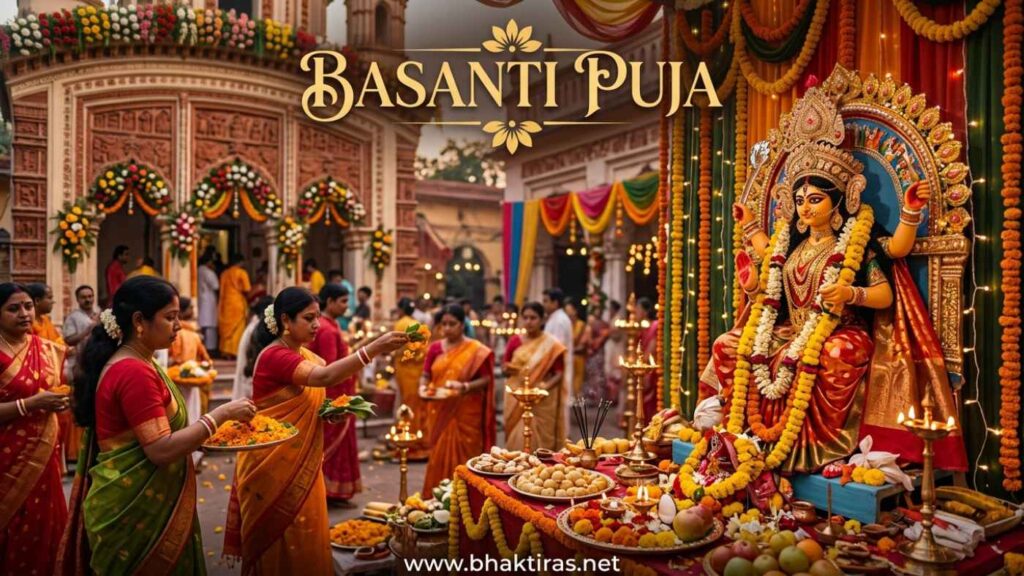
Basanti Puja is the worship of Goddess Durga in spring, held over the bright fortnight of the Bengali month of Chaitra (March-April) and peaking across Saptami, Ashtami, Navami and Dashami. Bengalis treat it as the older, scripturally prescribed Durga Puja, while the far more famous autumn festival is the akal bodhan or untimely awakening that Lord Rama began. Its final day coincides with Ram Navami, so the festival closes with both the immersion of the Goddess and the birthday of Rama. Compared with the autumn spectacle it is quieter, more domestic and rooted in a handful of old family and village pujas.
Basanti Puja 2026-2028: Dates & Calendar
Basanti Puja next falls on 13-16 April 2027. It moves each year because it follows the Hindu lunar calendar, tracking the bright half of the month of Chaitra rather than a fixed solar date.
| Year | Saptami to Dashami | Main day (Ashtami) | Notes |
|---|---|---|---|
| 2026 | 25-28 March | Thu 26 March | Ram Navami on 27 March; now past |
| 2027 | 13-16 April | Wed 14 April | Next occurrence; Ram Navami on 15 April |
| 2028 | 2-4 April | Mon 3 April | Ram Navami on 3 April |
The four principal days are Maha Saptami, Maha Ashtami (with Sandhi Puja at the join of Ashtami and Navami), Maha Navami and Dashami. In 2027 Maha Navami on 15 April also falls on Ram Navami, and the Goddess is given her farewell with the Dashami immersion on 16 April.
Why Basanti Puja Is Celebrated
Basanti Puja is celebrated because Chaitra, in spring, is the season the scriptures name as the proper time to worship Durga. It is often called the original Durga Puja, older than the popular autumn festival.
The original, scriptural Durga Puja
Classical texts assign Durga’s great worship to the spring month of Chaitra. Basanti Puja keeps to that older calendar, which is why many Bengalis call it the real or first Durga Puja, even though far fewer households observe it today than the autumn one.
The 'akal bodhan' contrast
The famous autumn Sharadiya Durga Puja is described as akal bodhan, an untimely awakening of the Goddess. According to the Ramayana tradition, Rama roused Durga out of season, in autumn, to seek her blessing before facing Ravana. Basanti Puja is the timely worship; the autumn one is the borrowed slot that later grew larger.
Woven into Chaitra Navratri
Basanti Puja sits inside Chaitra Navratri (also called Vasant Navratri), the nine spring nights when the Goddess is honoured across much of India. Bengal marks the last stretch, Saptami to Dashami, as a compact Durga Puja rather than the North Indian nine-day fast.
Ends on Ram Navami
Maha Navami of Basanti Puja falls on the same tithi as Ram Navami, the birthday of Lord Rama. The festival therefore closes with a double meaning: the Goddess is bid farewell, and Rama’s birth is celebrated on the very day Rama is said to have first awakened her in autumn.
Deities & Figures Worshipped
The central figure is Goddess Durga, here worshipped in her spring form and often addressed as Basanti Devi. She is accompanied by the same family of deities seen in the autumn puja.
Durga (Basanti Devi)
Durga is worshipped as the ten-armed slayer of the buffalo demon Mahishasura, mounted on her lion. In spring she is invoked as Basanti Devi, the same Goddess honoured in autumn but in her scripturally timely season.
Lakshmi and Saraswati
As in the autumn puja, Lakshmi (fortune and abundance) and Saraswati (learning and the arts) stand beside Durga in the traditional tableau, one on each side.
Ganesha and Kartikeya
Ganesha, remover of obstacles, and Kartikeya, the warrior son, complete the family group. The whole set is worshipped together on the same platform through Saptami to Navami.
Lord Rama
Because Maha Navami coincides with Ram Navami, Rama is remembered on the ninth day. Many households read from the Ramayana or hold a small worship of Rama alongside the Goddess.
Key Rituals, Step by Step
Basanti Puja follows the rhythm of a Durga Puja compressed into its final days, framed by the wider Chaitra Navratri.
- Chaitra Navratri build-up. The nine spring nights open with Ghatasthapana on Pratipada; many keep a fast or light diet and daily worship of the Goddess in the run-up to the main days.
- Bodhan and adhivas. Just before Saptami the Goddess is invoked and awakened, and the Bel (wood-apple) tree is honoured, preparing the idol and space for worship.
- Maha Saptami. The Nabapatrika, a bundle of nine plants that stands for the Goddess, is bathed and installed, and the first full day of formal Durga worship begins.
- Maha Ashtami. The most elaborate day, with offerings, Pushpanjali (flower offerings) and, in some places, symbolic Kumari Puja honouring a young girl as the living Goddess.
- Sandhi Puja. At the join of Ashtami and Navami, a special worship is offered during a short, fixed window; this is regarded as the most powerful moment of the puja.
- Maha Navami and Ram Navami. The ninth day completes the Durga worship with homa and final offerings; because it is also Ram Navami, Rama’s birth is marked the same day.
- Dashami and immersion. On Dashami the Goddess is given a farewell, married women often offer sindoor, and the idol is carried to a river or pond for immersion (Visarjan).
Special Foods of Basanti Puja
The kitchen echoes the autumn puja: simple bhog cooked for the Goddess and shared as prasad, mostly vegetarian and often without onion or garlic.
Khichuri bhog
A soft rice-and-lentil khichuri, cooked with ghee and mild spices, is the heart of the bhog. It is offered to the Goddess on the main days and then served to everyone who visits the puja.
Luchi and torkari
Deep-fried white-flour luchi with a light potato or mixed-vegetable curry (torkari) is a festive plate, especially for the morning after worship.
Seasonal fruits
Plates of fresh spring fruit, cut and whole, are placed before the Goddess as naivedya and shared as prasad after the offering.
Bengali sweets
Sandesh, rasgulla, payesh (rice pudding) and other milk sweets round off the offerings, keeping the meal celebratory without being heavy.
Where It Is Celebrated
Basanti Puja is chiefly a West Bengal and eastern-India observance, kept alive by older family and village pujas rather than the huge public pandals of autumn.
West Bengal
The heartland of Basanti Puja. It is held in a smaller number of long-standing bonedi (aristocratic family) homes, old rural pujas and some temples, with far fewer community pandals than the autumn Durga Puja.
Eastern India and Tripura
Bengali communities in Tripura, Assam and neighbouring areas keep the spring puja, often as a quieter household or temple event tied to the Chaitra calendar.
Chaitra Navratri elsewhere
Across North and West India the same nine spring nights are observed as Chaitra or Vasant Navratri, focused on the nine forms of the Goddess and ending on Ram Navami, though usually without Bengal’s Durga-Puja format.
Annapurna Puja link
Basanti Puja season overlaps with Annapurna Puja, the worship of the Goddess as giver of food, observed on Ashtami of Chaitra Shukla; the two are often kept close together in Bengali homes.
Basanti Puja Do's and Don'ts
A few simple practices help you observe the spring puja with the right spirit.
Do
- Follow the Sandhi Puja window from your local panchang, as it is short and fixed.
- Keep offerings and bhog simple, fresh and vegetarian, usually without onion and garlic.
- Join or support a traditional family or village puja if you can, since these keep the spring observance alive.
- Remember Ram Navami on Maha Navami with a reading or short worship of Rama.
- Offer Pushpanjali with a calm, clean mind on the main mornings.
Avoid
- Do not treat Basanti Puja as a lesser event; the scriptures place it before the autumn one.
- Do not fix your own Sandhi Puja or immersion timings; follow the panchang.
- Do not serve tamasic food such as meat or alcohol as part of the bhog.
- Do not rush the immersion; give the Goddess a proper Dashami farewell.
- Do not confuse it with the autumn Sharadiya Durga Puja, which is a separate, later festival.
Frequently Asked Questions
When is Basanti Puja in 2027?
Basanti Puja 2027 runs from Tuesday 13 April to Friday 16 April. Maha Saptami is on 13 April, Maha Ashtami with Sandhi Puja on 14 April, Maha Navami (also Ram Navami) on 15 April, and the Dashami immersion on 16 April.
When is Basanti Puja in 2026 and 2028?
In 2026 Basanti Puja fell on 25-28 March, with Ram Navami on 27 March, so it has already passed. In 2028 it falls on 2-4 April, with Ram Navami on 3 April. The dates shift each year because the festival follows the lunar month of Chaitra.
How is Basanti Puja different from the autumn Durga Puja?
Basanti Puja is the spring Durga Puja, held in Chaitra (March-April) and considered by the scriptures the original, correct time to worship Durga. The far more famous autumn Sharadiya Durga Puja is called akal bodhan, an untimely awakening that Lord Rama began before facing Ravana. Basanti Puja is quieter and more home-and-village based, with far fewer public pandals.
Why is Basanti Puja considered the original Durga Puja?
Basanti Puja is considered the original Durga Puja because classical texts prescribe spring, the month of Chaitra, as the proper season for the Goddess’s great worship. The autumn festival grew out of Rama’s out-of-season worship of Durga, so Basanti Puja is the older, scripturally timely observance even though fewer people keep it today.
Which goddess is worshipped in Basanti Puja?
Basanti Puja worships Goddess Durga in her spring form, often called Basanti Devi, as the ten-armed slayer of Mahishasura. She is accompanied by Lakshmi, Saraswati, Ganesha and Kartikeya, the same family group seen in the autumn Durga Puja.
Is Basanti Puja the same as Chaitra Navratri?
Basanti Puja takes place within Chaitra Navratri (also called Vasant Navratri), the nine spring nights of the Goddess. In Bengal the last days of that period, Saptami to Dashami, are observed as a compact Durga Puja called Basanti Puja, while much of North India keeps the full nine-day Navratri instead.
How does Basanti Puja connect to Ram Navami?
Basanti Puja’s Maha Navami falls on the same tithi as Ram Navami, the birthday of Lord Rama. So the festival closes by celebrating Rama’s birth on the very day he is said to have first awakened Durga in autumn, before the Dashami immersion of the Goddess.
What food is offered during Basanti Puja?
The main offering is khichuri bhog, a soft rice-and-lentil dish cooked in ghee, served as prasad on the puja days. Households also prepare luchi with vegetable curry, plates of seasonal fruit, and Bengali sweets such as sandesh and payesh, kept vegetarian and usually free of onion and garlic.
May the spring Goddess bless your home with strength and light. Basanti Pujor Shubhechha.