
Anant Chaturdashi 2026 – Vishnu's Vrat & Ganpati Visarjan
अनंत चतुर्दशी
When is Anant Chaturdashi in 2026?
Anant Chaturdashi falls on Friday, 25 September 2026. It is the fourteenth day of the bright half of Bhadrapada, when devotees worship Vishnu in his infinite (Anant) form and tie the fourteen-knotted Anant sutra. In Maharashtra and much of India the same day is Ganpati Visarjan, the grand finale of the ten-day Ganesh festival.
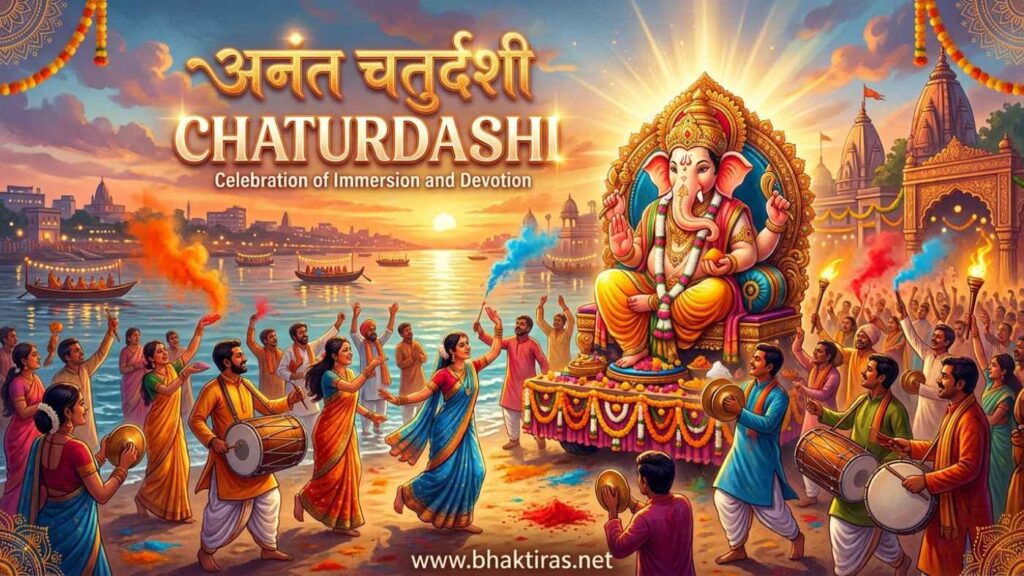
Anant Chaturdashi is one of those rare days that carries two celebrations at once. It falls on the fourteenth day of the bright fortnight of Bhadrapada, usually in September. For followers of Vishnu it is a quiet vrat honouring him as Anant, the one without end, marked by tying a knotted sacred thread on the wrist. Across Maharashtra and much of India the same day turns loud and joyful, because it is Ganpati Visarjan – the tenth and final day of Ganesh Chaturthi, when Ganesha idols are carried through the streets and given to the water.
Anant Chaturdashi 2026-2028: Dates & Calendar
The next Anant Chaturdashi is on Friday, 25 September 2026. The date shifts each year because it follows the Hindu lunar calendar rather than the fixed Gregorian one.
| Year | Date | Day | Notes |
|---|---|---|---|
| 2026 | 25 September | Friday | Next occurrence – Ganpati Visarjan day |
| 2027 | 14 September | Tuesday | Bhadrapada Shukla Chaturdashi |
| 2028 | 2 September | Saturday | Bhadrapada Shukla Chaturdashi |
The thread-tying and puja are done during the Chaturdashi tithi in the morning after the household has bathed; families following the visarjan side often start processions from late morning onward and immerse the idol by evening. Exact tithi start and end times vary a little by city, so check a local panchang for your town.
Why Anant Chaturdashi Is Celebrated
Anant Chaturdashi honours Vishnu as Anant, the infinite and unbroken, and in most of India it also closes the ten-day Ganesh festival with the visarjan.
Vishnu as the Infinite
Anant means endless or without limit, one of Vishnu’s names for his boundless, eternal nature. On this day he is worshipped in that form, often shown reclining on the coils of the serpent Shesha on the cosmic ocean. The vrat is a way of asking that protection to be as unbroken as the god it honours.
The Anant Vrat Katha
The story tied to the day comes from the Mahabharata. When the Pandavas lost everything and were living in the forest, Krishna is said to have advised Yudhishthira to keep the Anant vrat to recover their fortune and dignity. The katha of a devotee named Sushila and her husband Kaundinya, who lost and then regained prosperity through the vrat, is read aloud during the puja.
Ganpati Visarjan
In Maharashtra, Goa and beyond, Anant Chaturdashi is the tenth day of Ganeshotsav, when the idol worshipped at home or in the public pandal is taken for immersion. The chant “Ganpati Bappa Morya, pudhchya varshi lavkar ya” – come again soon next year – carries the crowds to the water and marks the god’s send-off.
The Jain observance
For Jains the day has a separate meaning as the final day of Paryushana, their most important period of fasting, reflection and forgiveness. It is followed by Kshamavani, the day of seeking and granting pardon, when Jains say Micchami Dukkadam to release any hurt caused during the year.
Deities & Figures Worshipped
The central figure is Vishnu as Anant, worshipped alongside the serpent Shesha; on the visarjan side, Ganesha is the deity being bid farewell.
Vishnu (Anant)
Worshipped in his infinite form, the preserver whose protection has no end. The Anant sutra, a thread of fourteen knots often dyed in turmeric, is placed before him, worshipped, and then tied on the wrist – the right arm for men, the left for women in most traditions.
Shesha Naga
The thousand-headed serpent on whose coils Vishnu rests. The fourteen knots of the Anant thread are linked in some tellings to the fourteen worlds or the fourteen years of the vrat, and Shesha’s endless coils echo the idea of Anant, the unending.
Ganesha
On the same date, the Ganesha idol installed on Ganesh Chaturthi is given its farewell. The remover of obstacles is thanked, offered a last aarti with modaks, and carried in procession for immersion, to return the following year.
Key Rituals, Step by Step
The Vishnu vrat centres on the Anant thread; households keeping the visarjan follow the immersion procession. Many families do both.
- Bathe and prepare. The observer wakes early, bathes, and cleans the puja space, often taking a vow (sankalp) to keep the vrat.
- Set up the puja. An image or picture of Vishnu is placed on a low altar, sometimes with a small pot (kalash) of water, flowers and a coconut representing the deity.
- Prepare the Anant sutra. A cotton or silk thread is tied with fourteen knots and coloured with turmeric, then placed before Vishnu to be worshipped.
- Offer the puja. The thread and deity are honoured with water, sandal paste, flowers, incense, a lamp and sweets, and the fourteen knots are worshipped one by one in some traditions.
- Read the vrat katha. The Anant Vrat Katha of the Pandavas – and of Sushila and Kaundinya – is read or heard, explaining why the vow restores lost fortune.
- Tie the thread. The blessed Anant sutra is tied on the wrist and worn as a mark of protection; an old thread from the previous year is removed first.
- Ganpati farewell (visarjan households). A final aarti is offered to the Ganesha idol with modaks and coconut, the family asks forgiveness for any lapse in worship, and the idol is lifted for the procession.
- Immersion. Amid drums, colour and the cry of “Ganpati Bappa Morya, pudhchya varshi lavkar ya”, the idol is carried to a river, tank, sea or an eco-friendly artificial pond and immersed.
Special Foods of Anant Chaturdashi
Vrat-keepers eat simple satvik food, while the visarjan side leans on the sweets that have defined the whole Ganesh festival.
Modak
Ganesha’s best-loved offering – steamed rice-flour dumplings (ukadiche modak) filled with jaggery and coconut, or the fried variety. A last plate is offered before the idol leaves for immersion.
Puran poli
A soft flatbread stuffed with sweet chana-dal and jaggery filling, cooked in ghee. It is a festival staple across the ten days and often part of the final naivedya.
Satvik vrat food
Those keeping the fast eat fruit, milk and light meals without onion, garlic or grains, breaking the vrat only after the puja and the tying of the thread.
Kheer and prasad
Rice or vermicelli kheer, coconut, and seasonal fruit are commonly offered and shared as prasad among family and neighbours.
Regional Names & Variations
The balance between the Vishnu vrat and the Ganpati visarjan shifts sharply from one part of the country to another.
Maharashtra & Goa
The day is overwhelmingly Ganpati Visarjan. City-wide processions, especially in Mumbai and Pune, carry thousands of idols to the sea and rivers over many hours, with lezim, dhol-tasha and colour on every street.
North & Central India
In much of the north the Vishnu-centred Anant Chaturdashi vrat is more prominent, with the tying of the Anant thread and the reading of the vrat katha at home.
Telangana & Andhra
The Ganesh immersion is a major public event here too – Hyderabad’s Khairatabad Ganesh and the Hussain Sagar immersions draw huge crowds on the same day.
Jain communities
For Jains across regions the day closes Paryushana. The mood is one of fasting, reflection and forgiveness rather than procession, leading into Kshamavani the next day.
Anant Chaturdashi Do's and Don'ts
A few simple points help you keep the day meaningful and, where there is a visarjan, kind to the water.
Do
- Bathe and keep the puja space clean before beginning.
- Tie the Anant thread with respect and read or listen to the vrat katha.
- Offer Ganesha a heartfelt final aarti before visarjan.
- Choose eco-friendly clay idols and natural colours where you can.
- Immerse at designated or artificial ponds to protect rivers and the sea.
Avoid
- Do not immerse plaster-of-Paris idols or plastic decorations in open water.
- Do not remove the old year’s Anant thread carelessly – dispose of it in water or clean soil.
- Do not rush the puja; the thread and katha are the heart of the vrat.
- Do not leave immersion waste on beaches and riverbanks.
- Avoid non-satvik food if you are keeping the Vishnu vrat.
Frequently Asked Questions
When is Anant Chaturdashi in 2026?
Anant Chaturdashi is on Friday, 25 September 2026. It falls on the Chaturdashi tithi of the bright fortnight of Bhadrapada and is also the day of Ganpati Visarjan that ends the Ganesh festival.
When is Anant Chaturdashi in 2027 and 2028?
Anant Chaturdashi will be on Tuesday, 14 September 2027 and on Saturday, 2 September 2028. The date changes each year because it follows the Hindu lunar calendar rather than the fixed Gregorian date.
Why is Anant Chaturdashi celebrated?
Anant Chaturdashi celebrates Vishnu in his infinite (Anant) form, when devotees tie a fourteen-knotted sacred thread for lasting protection and prosperity and read the Anant Vrat Katha of the Pandavas. In Maharashtra and much of India the same day is Ganpati Visarjan, the final day of the ten-day Ganesh Chaturthi festival.
Which god is worshipped on Anant Chaturdashi?
Vishnu is the main deity, worshipped as Anant, the eternal one, alongside the serpent Shesha. On the same day, households observing the Ganesh festival worship and then bid farewell to Ganesha through visarjan.
What is the Anant sutra thread?
The Anant sutra is a cotton or silk thread tied with fourteen knots and coloured with turmeric. It is worshipped before Vishnu and then tied on the wrist as a symbol of his unbroken protection, worn for the year until it is renewed on the next Anant Chaturdashi.
What is Ganpati Visarjan?
Ganpati Visarjan is the immersion of the Ganesha idol in water on Anant Chaturdashi, marking the tenth and final day of Ganesh Chaturthi. Idols are carried in processions to the accompaniment of “Ganpati Bappa Morya, pudhchya varshi lavkar ya” and immersed in the sea, rivers, tanks or eco-friendly ponds.
How is Anant Chaturdashi connected to the Pandavas?
According to the Mahabharata, Krishna advised Yudhishthira to keep the Anant vrat during the Pandavas’ exile to regain their lost kingdom and prosperity. The Anant Vrat Katha read on this day recalls that story and the tale of the devotee Kaundinya.
Is Anant Chaturdashi important for Jains?
Yes. For Jains, Anant Chaturdashi is the last day of Paryushana, their most sacred period of fasting and reflection, followed the next day by Kshamavani, when they seek and grant forgiveness with the words Micchami Dukkadam.
May the thread you tie hold through the year and may Bappa return soon – Ganpati Bappa Morya, pudhchya varshi lavkar ya.