
ॐ
Ram Chalisa
श्री राम चालीसा
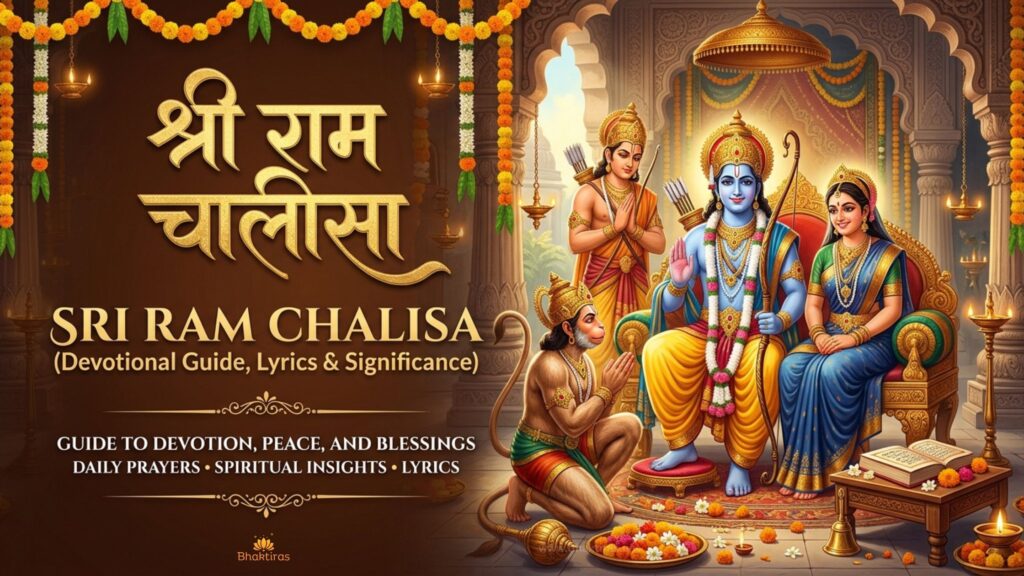
The Ram Chalisa is a forty-verse Hindi devotional hymn that praises Lord Rama, the seventh avatar of Vishnu and the central hero of the Ramayana. Its couplets recall Rama’s compassion for the helpless, the protective power of his name, and the devotion of Hanuman, Lakshmana, Bharata, and Sita that surrounds him. Devotees recite it to invite courage, clarity, and Rama’s grace into daily life, often pairing it with the Hanuman Chalisa.
Ram Chalisa Lyrics in English (Transliteration)
Roman transliteration for easy chanting. Tap “Meaning” under any verse for the English translation.
Shri Raghuveer bhakt hitkaari
Sun leejai prabhu araj hamaari
Meaning
O Raghuveer, friend and benefactor of your devotees, please listen kindly to the prayer we place before you.
Nishidin dhyaan dharai jo koi
Taa sam bhakt aur nahin hoi
Meaning
Anyone who keeps you in mind through every day and night becomes a devotee whom none can surpass.
Dhyaan dharey Shivji man maaheen
Brahm Indra paar nahin paaheen
Meaning
Even Shiva meditates on you in his heart, and neither Brahma nor Indra can reach the limit of your greatness.
Doot tumhaar Veer Hanumaana
Jaasu prabhaav tihoon pur jaana
Meaning
Your messenger is the mighty Hanuman, whose power is known across all three worlds.
Tab bhuj dand prachand kripaala
Raavan maari suran pratipaala
Meaning
With your fierce, powerful arms, O merciful one, you slew Ravana and protected the gods.
Tum anaath ke naath gunsaai
Deenan ke ho sada sahaai
Meaning
You are the master of the masterless, O Lord, and the constant helper of the poor and humble.
Brahmaadik tav paar na paavain
Sada eesh tumharo yash gaavain
Meaning
Even Brahma and the great gods cannot fathom your depth, yet they forever sing your glory.
Chaariu Ved bharat hain saakhi
Tum bhaktan ki lajja raakheen
Meaning
All four Vedas bear witness to you, and you guard the honour of those who trust in you.
Gun gaavat Sharad man maaheen
Surpati taako paar na paaheen
Meaning
Saraswati sings your virtues in her heart, and even the king of the gods cannot find their end.
Naam tumhaar let jo koi
Taa sam dhanya aur nahin hoi
Meaning
Whoever utters your name becomes more blessed than any other person.
Raam naam hai aparampaara
Chaarihu Vedan jaahi pukaara
Meaning
The name of Rama is boundless, and the four Vedas call out to it.
Ganpati naam tumhaaro leenho
Tinko pratham poojya tum keenho
Meaning
Even Ganesha took up your name, and you made him the first deity to be worshipped.
Shesh ratat nit naam tumhaara
Mahi ko bhaar sheesh par dhaara
Meaning
Shesha endlessly chants your name while bearing the weight of the earth upon his head.
Phool samaan rahat so bhaara
Paav na koou tumharo paara
Meaning
To him that burden feels as light as a flower, yet no one can reach the limit of who you are.
Bharat naam tumharo ur dhaaro
Taason kabahun na ran mein haaro
Meaning
Bharata holds your name in his heart, and so he is never defeated in any battle.
Naam Shatrughna hriday prakaasha
Sumirat hot shatru kar naasha
Meaning
Your name shines in Shatrughna's heart, and remembering it brings destruction to enemies.
Lakhan tumhaare aagyaakaari
Sada karat santan rakhwaari
Meaning
Lakshmana is ever obedient to you and always keeps watch over the saints.
Taate ran jeetey nahin koi
Yuddh jurey Yamahoon kin hoi
Meaning
Because of this, none can defeat them in war, even if Yama himself were to join the fight.
Mahaalakshmi dhar avataara
Sab vidhi karat paap ko chhaara
Meaning
As an incarnation of Mahalakshmi, Sita destroys every kind of sin by all means.
Seeta Raam puneeta gaayo
Bhuvaneshwari prabhaav dikhaayo
Meaning
Sita and Rama are sung as the embodiment of purity, and Sita reveals the power of the world's divine mother.
Ghat son prakat bhai so aai
Jaako dekhat chandra lajaai
Meaning
She appeared from a pot of earth, and seeing her beauty even the moon feels shy.
So tumrey nit paanv palotat
Navo nidhi charanan mein lotat
Meaning
She lovingly serves at your feet, and the nine treasures roll about before your steps.
Siddhi athaarah mangalkaari
So tum par jaavai balihaari
Meaning
The eighteen auspicious powers of attainment willingly surrender themselves to you.
Aurahu jo anek prabhutaai
So Seeta pati tumahin banaai
Meaning
Whatever other forms of greatness exist, O husband of Sita, they are all made yours.
Ichchha te kotin sansaara
Rachat na laagat pal ki baara
Meaning
By your will you create millions of worlds, and it does not take even a moment to do so.
Jo tumhe charanan chit laavai
Taaki mukti avasi ho jaavai
Meaning
Whoever fixes the mind upon your feet is certain to attain liberation.
Jai jai jai prabhu jyoti swaroopa
Nirgun Brahm akhand anoopa
Meaning
Victory, victory, victory to you, the Lord whose form is pure light, the formless, unbroken, and matchless Brahman.
Satya satya jai satyavrat swaami
Satya sanaatan antaryaami
Meaning
True, true is your praise, O master vowed to truth, the eternal reality who dwells within all.
Satya bhajan tumharo jo gaavai
So nishchay chaaron phal paavai
Meaning
Whoever sincerely sings your hymn will surely gain the four great aims of life.
Satya shapath Gauripati keenheen
Tumne bhaktihin sab vidhi deenheen
Meaning
Shiva, lord of Gauri, swore it to be true: you grant devotion to your devotees in every way.
Sunahu Raam tum taat hamaare
Tumahin Bharat kul poojya prachaare
Meaning
Hear us, Rama, you are our protector, and you are honoured as worthy of worship in the line of Bharata.
Tumahin dev kul dev hamaare
Tum guru dev praan ke pyaare
Meaning
You are the family deity of the gods and our own, our guru and the dearest of our life.
Jo kuchh ho so tum hi raaja
Jai jai jai prabhu raakho laaja
Meaning
Whatever exists, you alone are its king; victory to you, Lord—please protect our honour.
Raam aatma poshan haare
Jai jai Dashrath raaj dulaare
Meaning
Rama, you nourish the soul; victory to you, the beloved prince of King Dasharatha.
Gyaan hriday do gyaan swaroopa
Namo namo jai jagpati bhoopa
Meaning
Grant wisdom to our hearts, O embodiment of knowledge; salutations again and again to you, sovereign of the universe.
Dhanya dhanya tum dhanya prataapa
Naam tumhaar harat santaapa
Meaning
Blessed, blessed is your majesty, and your name takes away all sorrow and suffering.
Satya shuddh devan mukh gaaya
Baji dundubhi shankh bajaaya
Meaning
The gods sang your praise with pure and truthful voices, drums sounded and conches were blown.
Satya satya tum satya sanaatan
Tum hi ho hamre tan man dhan
Meaning
True, true are you, the eternal truth; you alone are our body, mind, and wealth.
Yaako paath karey jo koi
Gyaan prakat taake ur hoi
Meaning
Whoever recites this hymn finds wisdom awakening within the heart.
Aavaagaman mitai tihi keraa
Satya vachan maane shir meraa
Meaning
Their cycle of birth and rebirth comes to an end—accept these words as true, I bow my head upon it.
Aur aas man mein jo hoi
Manvaanchhit phal paave soi
Meaning
Whatever hope is held in the mind, the devotee receives the fruit their heart desires.
Teenhun kaal dhyaan jo lyaavai
Tulsi dal aru phool chadhaavai
Meaning
Whoever meditates on you at the three times of day and offers tulsi leaves and flowers,
Saag patra so bhog lagaavai
So nar sakal siddhata paavai
Meaning
and offers simple food of greens and leaves, that person attains every spiritual accomplishment.
Ant samay Raghubarpur jaai
Jahan janma Hari bhakt kahaai
Meaning
At life's end such a one reaches Rama's abode, where they are reborn and known as a devotee of Hari.
Shri Haridaas kahai aru gaavai
So Baikunth dhaam ko paavai
Meaning
Whoever, like Haridas, recites and sings this hymn attains the realm of Vaikuntha.
Saat divas jo nem kar, paath kare chit laay
Haridas Hari kripa se, avasi bhakti ko paay
Meaning
Whoever keeps a vow for seven days and recites this with a focused mind will surely, by Rama's grace, receive the gift of devotion.
Raam Chalisa jo padhe, Raam charan chit laay
Jo ichchha man mein karai, sakal siddh ho jaay
Meaning
Whoever reads the Ram Chalisa with the heart set on Rama's feet will find every sincere wish fulfilled.
Benefits of Reciting the Ram Chalisa
Regular recitation of the Ram Chalisa is believed to steady the mind, strengthen resolve, and draw the protective grace of Rama, Sita, and Hanuman into the devotee’s life. Practitioners turn to it for both inner calm and practical courage.
- Protection and courage: the verses invoke Rama’s strength to face fear, negativity, and difficult circumstances with a settled heart.
- Mental clarity: the hymn asks Rama to awaken wisdom within, helping the reader think and act with discernment.
- Fulfilment of sincere wishes: the closing doha promises that heartfelt desires are met when one reads with devotion and a focused mind.
- Spiritual progress: consistent practice is said to deepen bhakti and turn the mind toward liberation and Rama’s abode.
When and How to Chant the Ram Chalisa
The Ram Chalisa can be recited on any day, though Tuesdays and the festival of Ram Navami are considered especially auspicious. Many devotees chant it in the early morning after bathing, or in the evening, while seated before an image or picture of Lord Rama. Light a lamp, settle the mind, and read each verse slowly with attention to its meaning; some keep a seven-day vow of daily recitation. It is common to close by chanting “Jai Shri Ram,” “Jai Hanuman,” and “Jai Sita Ram,” and to pair the hymn with the Hanuman Chalisa.
About the Ram Chalisa
The Ram Chalisa belongs to the popular Hindi “chalisa” tradition of forty-verse praise hymns and is recited across North India as a heartfelt prayer to Lord Rama. Rama, son of King Dasharatha and the seventh avatar of Vishnu, is remembered as the ideal king and the hero of Valmiki’s Ramayana—the one who upholds dharma through truth, duty, and compassion even at great personal cost. The hymn weaves his story together with the devotion of those around him, from Hanuman and Lakshmana to Bharata and Sita, presenting Rama as the embodiment of righteousness whose name itself carries protective power.
Frequently Asked Questions
Who is the Ram Chalisa dedicated to?
It is dedicated to Lord Rama, the seventh avatar of Vishnu and the central hero of the Ramayana, praised as the ideal king and the embodiment of dharma.
How many verses are in the Ram Chalisa?
It follows the chalisa form of around forty chaupai verses, framed by opening and closing dohas (couplets) that introduce the prayer and describe the rewards of reciting it.
What are the benefits of reciting the Ram Chalisa?
Devotees recite it for courage, protection from negativity, mental clarity, and inner peace, and believe that sincere recitation with a focused mind helps fulfil heartfelt wishes and deepens devotion.
When should the Ram Chalisa be chanted?
It can be chanted on any day, but Tuesdays and Ram Navami are especially favoured. Mornings after bathing or evenings before an image of Rama are common times.
Is the Ram Chalisa recited on Ram Navami?
Yes. Ram Navami, which celebrates Rama's birth, is one of the most popular occasions for reciting the Ram Chalisa, often alongside the Hanuman Chalisa and Rama's aarti.
॥ Ram Chalisa ॥