
ॐ
Hanuman Chalisa
श्री हनुमान चालीसा
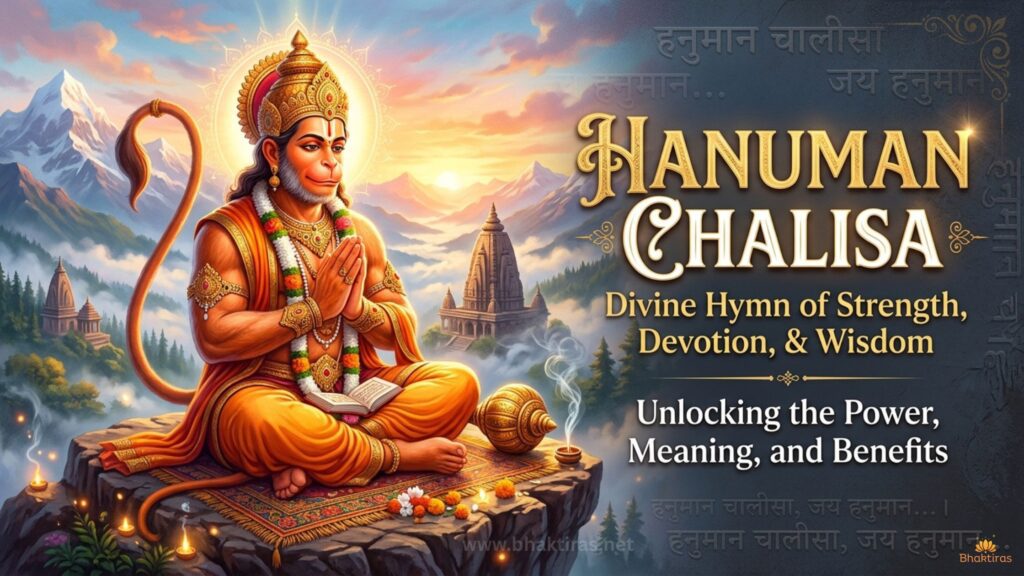
The Hanuman Chalisa is a forty-verse devotional hymn to Lord Hanuman, composed by the saint-poet Goswami Tulsidas in the 16th century. Recited across India for strength, courage and protection, it is among the most chanted prayers in Hinduism. Below is the complete Hanuman Chalisa in easy-to-read English transliteration — with the meaning of every verse just a tap away — so you can chant along and understand each line.
Hanuman Chalisa Lyrics in English (Transliteration)
Roman transliteration for easy chanting. Tap “Meaning” under any verse for the English translation.
Shri guru charan saroj raj nij manu mukuru sudhari,
Baranau Raghubar bimal jasu jo dayaku phal chari.
Meaning
Cleansing the mirror of my mind with the dust of my Guru’s lotus feet, I sing the pure glory of Lord Rama, which grants the four fruits of life.
Buddhihin tanu janike sumirau Pavan Kumar,
Bal buddhi bidya dehu mohi harahu kales bikar.
Meaning
Knowing myself to be without wisdom, I remember you, son of the wind. Grant me strength, intellect and knowledge, and remove my sorrows and faults.
Jai Hanuman gyan gun sagar,
Jai Kapis tihu lok ujagar.
Meaning
Victory to Hanuman, ocean of wisdom and virtue; victory to the lord of monkeys who illumines the three worlds.
Ram doot atulit bal dhama,
Anjani putra Pavansut nama.
Meaning
Messenger of Rama, abode of matchless strength, known as the son of Anjani and the son of the wind.
Mahabir bikram Bajrangi,
Kumati nivar sumati ke sangi.
Meaning
Great hero of mighty valour, body strong as a thunderbolt; you dispel evil thoughts and befriend the wise.
Kanchan baran biraj subesa,
Kanan kundal kunchit kesa.
Meaning
Golden-hued and beautifully adorned, with rings in your ears and curly hair.
Hath bajra au dhwaja biraje,
Kandhe moonj janeu saje.
Meaning
In your hands shine the mace and the banner, and a sacred thread of munja grass adorns your shoulder.
Shankar suvan Kesari nandan,
Tej pratap maha jag bandan.
Meaning
Born of Shiva’s grace and son of Kesari, your radiance and glory are honoured by all the world.
Vidyavan guni ati chatur,
Ram kaj karibe ko atur.
Meaning
Learned, virtuous and exceedingly clever, ever eager to do the work of Rama.
Prabhu charitra sunibe ko rasiya,
Ram Lakhan Sita man basiya.
Meaning
You delight in listening to the Lord’s deeds; Rama, Lakshmana and Sita dwell in your heart.
Sukshma roop dhari Siyahi dikhava,
Bikat roop dhari Lank jarava.
Meaning
You showed yourself to Sita in a tiny form, and in a fearsome form you burned Lanka.
Bhim roop dhari asur sanhare,
Ramchandra ke kaj sanvare.
Meaning
Taking a mighty form you destroyed the demons and accomplished all of Rama’s tasks.
Lay Sajivan Lakhan jiyaye,
Shri Raghubir harashi ur laye.
Meaning
You brought the Sanjivani herb and revived Lakshmana; Rama joyfully embraced you.
Raghupati kinhi bahut badai,
Tum mam priya Bharatahi sam bhai.
Meaning
Rama praised you greatly, saying: you are as dear to me as my brother Bharata.
Sahas badan tumharo jas gavai,
As kahi Shripati kanth lagavai.
Meaning
“The thousand-mouthed serpent sings your glory” — so saying, Rama clasped you to his heart.
Sankadik Brahmadi munisa,
Narad Sarad sahit Ahisa.
Meaning
The sages such as Sanaka, Brahma and the great seers, Narada, Saraswati and the serpent-king —
Jam Kuber digpal jaha te,
Kabi kobid kahi sake kaha te.
Meaning
— Yama, Kubera and the guardians of the directions: how can mere poets and scholars describe your glory?
Tum upkar Sugrivahi kinha,
Ram milay raj pad dinha.
Meaning
You did a great service to Sugriva, uniting him with Rama and restoring his kingdom.
Tumharo mantra Bibhishan mana,
Lankeshwar bhaye sab jag jana.
Meaning
Vibhishana heeded your counsel and became lord of Lanka, as all the world knows.
Jug sahasra jojan par Bhanu,
Lilyo tahi madhur phal janu.
Meaning
The sun, thousands of leagues away, you swallowed thinking it a sweet fruit.
Prabhu mudrika meli mukh mahi,
Jaladhi langhi gaye achraj nahi.
Meaning
Holding the Lord’s ring in your mouth, you leapt across the ocean — no wonder at all.
Durgam kaj jagat ke jete,
Sugam anugrah tumhre tete.
Meaning
However difficult the tasks of this world, by your grace they all become easy.
Ram duare tum rakhvare,
Hot na agya binu paisare.
Meaning
You guard the door of Rama; none may enter without your leave.
Sab sukh lahai tumhari sarna,
Tum rachchak kahu ko dar na.
Meaning
In your refuge all happiness is found; with you as protector there is no fear.
Apan tej samharo apai,
Tinon lok hank te kanpai.
Meaning
You alone can hold your own might; at your roar the three worlds tremble.
Bhoot pisach nikat nahi aavai,
Mahabir jab nam sunavai.
Meaning
Ghosts and evil spirits cannot come near when one utters your name, O mighty hero.
Nasai rog harai sab pira,
Japat nirantar Hanumat bira.
Meaning
Disease is destroyed and all pain removed by constant remembrance of brave Hanuman.
Sankat te Hanuman chhudavai,
Man kram bachan dhyan jo lavai.
Meaning
Hanuman frees from every trouble those who remember him in thought, deed and word.
Sab par Ram tapasvi raja,
Tin ke kaj sakal tum saja.
Meaning
Rama is the supreme ascetic king, and you accomplish all his work.
Aur manorath jo koi lavai,
Soi amit jivan phal pavai.
Meaning
Whoever brings any heartfelt wish to you obtains its boundless fruit in life.
Charon jug partap tumhara,
Hai parsiddh jagat ujiyara.
Meaning
Your glory shines through all four ages, famous and bright across the world.
Sadhu sant ke tum rakhvare,
Asur nikandan Ram dulare.
Meaning
You protect the saints and the holy, destroy the demons, and are dear to Rama.
Ashta siddhi nau nidhi ke data,
As bar din Janaki mata.
Meaning
You can grant the eight powers and nine treasures — a boon given to you by Mother Sita.
Ram rasayan tumhre pasa,
Sada raho Raghupati ke dasa.
Meaning
The elixir of Rama’s name is yours; may you ever remain Rama’s devoted servant.
Tumhre bhajan Ram ko pavai,
Janam janam ke dukh bisravai.
Meaning
Through devotion to you one attains Rama and forgets the sorrows of countless births.
Ant kal Raghubar pur jai,
Jaha janm Haribhakt kahai.
Meaning
At life’s end one goes to Rama’s abode and is reborn as a devotee of Hari.
Aur devta chitt na dharai,
Hanumat sei sarv sukh karai.
Meaning
One need not hold other gods in mind; serving Hanuman brings every happiness.
Sankat katai mitai sab pira,
Jo sumirai Hanumat balbira.
Meaning
All troubles are cut away and pain removed for those who remember mighty Hanuman.
Jai Jai Jai Hanuman Gosai,
Kripa karahu Gurudev ki nai.
Meaning
Victory, victory, victory to Lord Hanuman; bless me with grace as my Guru does.
Jo sat bar path kar koi,
Chhootahi bandi maha sukh hoi.
Meaning
Whoever recites this a hundred times is freed from bondage and gains great joy.
Jo yah padhai Hanuman Chalisa,
Hoy siddhi sakhi Gaurisa.
Meaning
Whoever reads this Hanuman Chalisa attains perfection — Shiva himself is witness.
Tulsidas sada Hari chera,
Kijai nath hriday mah dera.
Meaning
Tulsidas is ever Hari’s servant; O Lord, make your home within my heart.
Pavantanay sankat haran mangal murati roop,
Ram Lakhan Sita sahit hriday basahu sur bhoop.
Meaning
O son of the wind, remover of troubles, embodiment of all that is auspicious — dwell in my heart with Rama, Lakshmana and Sita, O king of gods.
Benefits of Reciting the Hanuman Chalisa
Devotees turn to the Hanuman Chalisa for very practical reasons. Its verses are believed to grant courage in the face of fear, strength in weakness, and steadiness of mind under pressure. Verse 24, “Bhoot pisach nikat nahi aavai”, promises that negative forces keep their distance from those who chant Hanuman’s name, which is why the prayer is so often recited for protection.
- Courage & confidence: calms fear and anxiety before challenges.
- Protection: traditionally recited to ward off negativity and bad dreams.
- Health & relief: verse 25 speaks of the easing of illness and pain.
- Focus & discipline: daily recitation builds a steady devotional routine.
When and How to Chant the Hanuman Chalisa
The Hanuman Chalisa can be recited on any day, but Tuesday and Saturday are considered especially dear to Hanuman. Many devotees chant it after a bath in the early morning or at dusk, seated facing an image of Hanuman with a lamp lit. For a vow (sankalp), it is commonly recited 7, 11 or 108 times. What matters most is sincerity and steady attention — the prayer itself asks for devotion of “thought, deed and word.”
Who Wrote the Hanuman Chalisa?
The Hanuman Chalisa was composed by Goswami Tulsidas (1532–1623), the great devotional poet who also wrote the Ramcharitmanas, his Awadhi retelling of the Ramayana. Tulsidas places his own name in the fortieth verse, a traditional poet’s signature, dedicating himself as the eternal servant of Hari and asking Hanuman to dwell in his heart.
Frequently Asked Questions
Who wrote the Hanuman Chalisa?
The Hanuman Chalisa was composed by the saint-poet Goswami Tulsidas in the 16th century, in the Awadhi language. Tulsidas, who also wrote the Ramcharitmanas, signs his name in the final verse.
How many verses are in the Hanuman Chalisa?
The Hanuman Chalisa has forty (chalis) chaupais — from which it takes its name — framed by three dohas: two at the beginning and one at the end, making forty-three verses in all.
What are the benefits of reciting the Hanuman Chalisa?
Devotees recite it for courage, strength and protection, for relief from fear, illness and obstacles, and for peace of mind. Verse 24 promises that evil spirits stay away from those who chant Hanuman’s name.
When should the Hanuman Chalisa be chanted?
It can be recited any day, but Tuesday and Saturday are considered most auspicious for Hanuman. Many devotees chant it in the early morning or evening, often 7, 11 or 108 times for a vow.
What does “Bhoot pisach nikat nahi aavai” mean?
This line from verse 24 means “ghosts and evil spirits do not come near” those who utter Hanuman’s name, which is why the Chalisa is recited for protection from fear and negative forces.
॥ जय श्री राम ॥ • ॥ बजरंगबली की जय ॥