
ॐ
Sita Chalisa
श्री सीता चालीसा
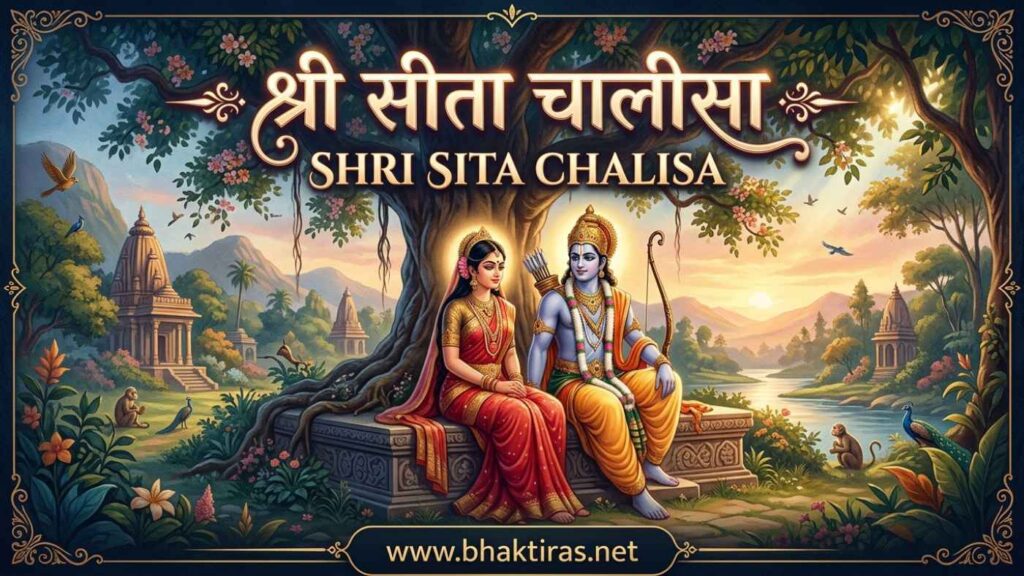
The Sita Chalisa is a 40-verse devotional hymn to Mata Sita — Janaki, the daughter of King Janaka, consort of Lord Rama, and an incarnation of Goddess Lakshmi. Drawn from the Ramayana, its verses retell her divine birth, her marriage at the swayamvara, the exile, her abduction by Ravana, and her return to Ayodhya, honouring her as the ideal of patience and devotion. This page gives the full Roman English transliteration together with a clear meaning for every verse, so you can both recite the words and understand them.
Sita Chalisa Lyrics in English (Transliteration)
Roman transliteration for easy chanting. Tap “Meaning” under any verse for the English translation.
Bandau charan saroj nij janak lali sukh dhaam
Ram priya kirpa karen sumiraun aathon dhaam
Kirati gatha jo padhen sudhrain sagare kaam
Man mandir basa karen dukh bhanjan Siya Ram
Meaning
I bow at the lotus feet of Sita, beloved daughter of King Janaka and the home of all joy. O dear one of Rama, grant your grace as I call to mind every sacred place; whoever reads this glorious account finds their tasks set right. May Siya-Ram dwell in the shrine of my heart and end every sorrow.
Ram priya Raghupati Raghurai
Vaidehi ki kirat gai
Meaning
O beloved of Rama, lord of the Raghu line, I sing aloud the glory and fame of Vaidehi, that is, Sita.
Charan kamal bandon sir nai
Siya Surasari sab pap nasai
Meaning
I bow my head at your lotus feet; like the heavenly Ganga, O Sita, your presence washes away every sin.
Janak dulari Raghav pyari
Bharat Lakhan Shatruhan vari
Meaning
Cherished daughter of Janaka and dear to Raghava, you are a guardian and well-wisher to Bharata, Lakshmana and Shatrughna alike.
Divya dhara son upji Sita
Mithleshwar bhayo neh atita
Meaning
Sita rose from the sacred earth itself, and the king of Mithila was filled with boundless love for the child he found.
Siya roop bhaayo manva ati
rachyo swayamvar Janak mahipati
Meaning
Sita's beauty won every heart, and so King Janaka arranged the swayamvara at which she would choose her groom.
Bhaari Shiv dhanu kheenchain joi
Siya jaymaal sajihain soi
Meaning
The condition was set: whoever could lift and string Lord Shiva's mighty bow would receive Sita's victory garland.
Bhupati nrapati Ravan sanga
nahin kari sake Shiv dhanu bhanga
Meaning
Kings and princes came, Ravana among them, yet not one of them could so much as bend, let alone break, Shiva's bow.
Janak niraash bhaye lakhi kaaran
janmyo nahin avan mohi taaran
Meaning
Seeing all of them fail, King Janaka grew downcast, fearing that no one worthy had been born to lift the bow and relieve his concern.
Yah sun Vishwamitra muskaaye
Ram Lakhan muni sees navaaye
Meaning
Hearing the king's despair, Sage Vishwamitra only smiled, and Rama and Lakshmana bowed their heads before the sage.
Aagya pai uthe Raghurai
isht dev guru hiyan manai
Meaning
At his teacher's word Lord Rama rose, holding his chosen deity and his guru firmly in his heart.
Janak suta Gauri sir nava
Ram roop unke hiy bhava
Meaning
Janaka's daughter bowed before Goddess Gauri in prayer, while the image of Rama had already taken root in her heart.
Maarat palak Ram kar dhanu le
khand khand kari patkin bhoo pai
Meaning
In the time of a single blink Rama lifted the bow, snapped it into pieces, and cast the fragments to the ground.
Jay jaykar hui ati bhaari
aanandit bhaye sain nar naari
Meaning
A great roar of victory went up on every side, and all the men and women present were overcome with delight.
Siya chali jaymaal samhaale
mudit hoy greeva mein daale
Meaning
Sita stepped forward, carefully holding the garland, and with great joy placed it around Rama's neck.
Mangal baaj baje chahun ora
pare Ram sang Siya ke phera
Meaning
Auspicious music sounded from all four directions as Sita and Rama took the sacred wedding rounds together.
Lauti baraat Avadhpur aai
teenon matu karain norai
Meaning
The marriage party returned to Ayodhya, where the three royal mothers welcomed the couple with the rites of greeting.
Kaikei kanak bhavan Siya dinha
Matu Sumitra godahi linha
Meaning
Kaikeyi gave Sita a palace of gold, and Mother Sumitra lovingly took her into her lap.
Kaushalya sut bhent diyo Siya
harkh apar hue Sita hiya
Meaning
Kaushalya presented Sita with gifts, and Sita's heart filled with measureless happiness.
Sab vidhi baanti badhai
rajatilak kai yukti sunai
Meaning
Congratulations were shared in every form, and plans were made for the ceremony of Rama's coronation.
Mand mati Manthara adhain
Ram na Bharat rajpad pain
Meaning
But mean-minded Manthara interfered, scheming so that Bharata, not Rama, would gain the throne.
Kaikei kop bhavan ma gaili
vachan pati son apnei gahili
Meaning
Kaikeyi withdrew to the chamber of anger and held King Dasharatha to a promise he had once made her.
Chaudah baras kop banvasa
Bharat rajpad dehi dilasa
Meaning
She demanded fourteen years of forest exile for Rama and the kingdom for her son Bharata.
Aagya mani chale Raghurai
sang Janaki Lakshman bhai
Meaning
Accepting his father's word without protest, Rama set out for the forest, with Janaki and his brother Lakshmana at his side.
Siya Shri Ram path path bhatkain
mrig Marichi dekhi man chitakain
Meaning
As Sita and Rama travelled the forest trails, the sight of the golden deer, Maricha in disguise, caught Sita's longing.
Mrig ko maari Ram nrip dhaaye
Siya pukari Lakhan samjhaye
Meaning
Rama hurried off to take the deer, and when a cry was heard, Sita pleaded with Lakshmana to go after him.
Lakhan gaye tab Ravan aayo
Siya ko har liye bal paayo
Meaning
Once Lakshmana had left, Ravana arrived and, finding his chance, carried Sita away by force.
Siya ko lai Ravan Lanka aayo
Ashok Vatika mein rakhaayo
Meaning
Ravana brought Sita to Lanka and held her captive in the Ashoka grove.
Siya ke aage Ravan aayo
pativrat dharm nahi bhulaayo
Meaning
Though Ravana came before her again and again, Sita never wavered from her vow of fidelity to her husband.
Ram Lakhan Hanuman sang aaye
Lanka jari sab sukh paaye
Meaning
Rama, Lakshmana and Hanuman came to her aid; Lanka was set ablaze and relief came at last.
Ravan ko maari sab sukh paayo
Siya Ram ayodhya laaye
Meaning
With Ravana slain, peace returned, and Sita and Rama were brought home to Ayodhya.
Raj tilak bhayo ati bhaari
sab sukh paaye nar nari
Meaning
The coronation was held with great grandeur, and every man and woman shared in the happiness.
Siya Ram ke gunn gaiye
sab bidhi sukh samuha paiye
Meaning
Sing the virtues of Siya-Ram, and you will gather to yourself every kind of joy.
Jo Siya Chalisa path kare
sab kathin kaaj tav tar hare
Meaning
Whoever recites the Sita Chalisa will find even the hardest of tasks made easy and resolved.
Sukh sampati ghar mein aave
klesh rog sab mit jaave
Meaning
Comfort and prosperity enter the home, while suffering and sickness are cleared away.
Pati patni mein prem badhave
kul mein sukh shanti aave
Meaning
Affection between husband and wife deepens, and peace and contentment settle over the whole family.
Jo nari path kare suhagin
kabahu na hove vidhva bhagin
Meaning
A married woman who recites it with faith is blessed with the lasting good fortune of her marriage.
Putra labh paave santan
bhaye na garbh mein koi kathan
Meaning
The devotee is blessed with children, and pregnancy passes without trouble or hardship.
Jo shradha bhav se gaave
moksh pad nischay hi paave
Meaning
Whoever sings these verses with sincere devotion will surely reach the state of liberation.
Siya Ram ka sumiran kare
janam janam ke paap hare
Meaning
Remembering Siya-Ram dissolves the accumulated sins of countless lifetimes.
Jo chalisa path kare
Siya Ram charnon mein dhyaan dhare
Meaning
Whoever recites this Chalisa and fixes the mind on the feet of Siya-Ram is held in their grace.
Benefits of Reciting the Sita Chalisa
Devotees recite the Sita Chalisa for the calm and harmony that Mata Sita represents, and the verses themselves promise these fruits.
- Marital harmony: The hymn is associated with deeper love and understanding between husband and wife and a settled, peaceful home.
- Relief from hardship: Its words speak of difficult tasks being eased and worries, fear and grief being lifted.
- Health and prosperity: Recitation is linked with comfort, well-being and the grace of Lakshmi, Sita’s divine form.
- Blessings for the family: Married women recite it for the welfare of their household, and the verses bless devotees with children and family peace.
- Inner strength: Meditating on Sita’s patience and steadfastness cultivates resilience and devotion to truth.
- Spiritual merit: Sincere chanting is said to erase old sins and draw the reciter toward liberation.
When and How to Chant the Sita Chalisa
The most auspicious day to recite the Sita Chalisa is Sita Navami (the ninth day of the bright fortnight of Vaishakha, in April–May), and Ram Navami is also fitting; Tuesdays and Fridays are traditionally kept for the divine feminine, though any day done sincerely is welcome. Bathe and wear clean clothes, sit on a clean mat facing east or north, light a lamp or incense, and begin with a short prayer to Ganesha and your guru. Recite each verse slowly and clearly, keeping the mind on its meaning and on Sita’s qualities, and close with a few words of gratitude.
About the Sita Chalisa
The Sita Chalisa is a traditional devotional hymn of forty chaupai verses framed by an opening doha, composed in the chaupai-and-doha form of Hindi-Awadhi bhakti poetry. Rooted in the Ramayana, it follows the arc of Mata Sita’s life — her birth from the earth, the breaking of Shiva’s bow and her marriage to Rama, the years of exile, her abduction and captivity in Lanka, and the return to Ayodhya. Throughout, the verses hold her up as the ideal of pativrata dharma, the steadfast devotion of a wife, and as an embodiment of patience, purity and faith. Like other chalisas, it is passed down through oral and printed tradition rather than ascribed to a single named author.
Frequently Asked Questions
What is the Sita Chalisa?
The Sita Chalisa is a forty-verse devotional hymn to Mata Sita, the consort of Lord Rama and an incarnation of Goddess Lakshmi. Built on episodes from the Ramayana, it praises her birth, marriage, exile and steadfast virtue, and is recited for marital harmony, peace and protection.
What are the benefits of reciting the Sita Chalisa?
Devotees recite it for harmony between husband and wife, peace and prosperity in the home, relief from worry and grief, and the grace of Sita as the form of Lakshmi. Reflecting on her patience and devotion is also said to build inner strength and spiritual merit.
Which day is best to recite the Sita Chalisa?
Sita Navami, the ninth day of the bright fortnight of Vaishakha (April–May), is the most auspicious occasion, and Ram Navami is also suitable. Tuesdays and Fridays are traditionally favoured for the divine feminine, but the Chalisa may be recited sincerely on any day.
How many verses are in the Sita Chalisa?
It has forty main verses, known as chaupais, preceded by an introductory doha (couplet). This file contains the opening doha followed by all forty numbered verses with their Roman transliteration and meaning.
Can the Sita Chalisa be recited in English?
Yes. Reciting from the Roman English transliteration on this page is perfectly acceptable, as what matters most is faith and understanding. The per-verse meanings help you follow the words even if you do not read Devanagari.
Who is Mata Sita?
Mata Sita — also called Janaki and Vaidehi — is the daughter of King Janaka of Mithila, found by him as an infant in a furrow of the earth. She is the consort of Lord Rama, revered as an incarnation of Goddess Lakshmi and as the ideal of wifely devotion, patience and sacrifice.
॥ Sita Chalisa ॥