
ॐ
Jagannath Chalisa
श्री जगन्नाथ चालीसा
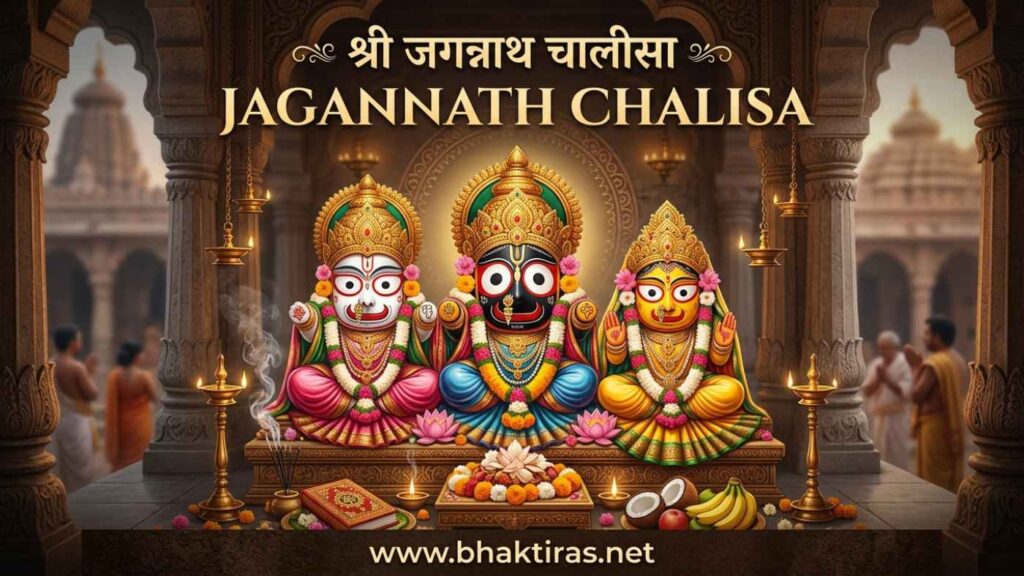
The Jagannath Chalisa is a forty-verse devotional hymn addressed to Lord Jagannath, the “Lord of the Universe” worshipped at the great temple in Puri, Odisha. A form of Vishnu and Krishna, Jagannath is enshrined alongside his elder brother Balabhadra and his sister Subhadra, and is carried through the streets each year during the famous Rath Yatra. On this page you will find the complete Roman transliteration so you can read and chant it aloud, with a clear English meaning provided for every verse.
Jagannath Chalisa Lyrics in English (Transliteration)
Roman transliteration for easy chanting. Tap “Meaning” under any verse for the English translation.
Jai Jagannath Swami, Jai Balabhadra Sambhav
Jai Subhadra Taai, Agya Karain Sab Kaaj
Meaning
Glory to Lord Jagannath, glory to his brother Balabhadra, and glory to sister Subhadra. May the three of them command and see every task through to completion.
Jai Jagannath Dayalu, Daya Nidhaan
Karuna Ras Sindhu, Nayan Andhakaar
Meaning
Hail the merciful Jagannath, the very storehouse of compassion. He is an ocean of loving-kindness who clears the darkness that clouds our sight and understanding.
Katakat Dhanush Viraajat, Shankhaadhaar
Mukh Mein Kamal, Nainan Mein Chakaar
Meaning
The bow and conch shine in his hands. His face is lovely as a lotus, and his wide eyes hold everyone spellbound.
Kanakamay Sheesh Nav, Chaaru Chandra Bhaala
Nakh Sikhar Chhavi Ganjit, Sohe Baala
Meaning
His head is crowned with gold and his brow glows like a fair moon. From crown to toe his beauty surpasses all, and he appears ever youthful and radiant.
Arunaanchal Mukut Shriya, Sohat Noop
Mukh Mein Murli, Banmaal Ajare
Meaning
His crown glows like the dawn horizon and his anklets ring sweetly. A flute rests at his lips and a garland of forest blossoms rests on his chest.
Shankh Baaje, Mridang Baajat Taal
Vajraankush Gadaa, Shubh Badan Kaal
Meaning
Conches sound and drums and cymbals keep the beat in his honour. He bears the thunderbolt, the goad and the mace, and his blessed form is dark like a rain cloud.
Rakta Ang Vastra, Vibhushan Baajat
Prateet Shobhit Neel Vishaal Jaajat
Meaning
His limbs are dressed in red cloth and jewelled ornaments. He stands revealed in his vast, dark and beautiful form, shining with supreme majesty.
Aavat Dhaavat Tab Joo, Taar Grihavat
Kaaraaj Sarv Karain, Sudheer Budhavat
Meaning
When his devotees call, he comes running to lift and rescue them. He completes every task and grants steady wisdom to those who seek it.
Shachi Jab Bhay Bhaye, Saagar Paar
Raamdaas Kahain, Ved Bikhyaat
Meaning
Even when fear grips us, he carries us safely across the sea of worldly life. The devotee Ramdas declares that his fame is sung throughout the Vedas.
Jai Jagannath Jagat Ke Swami
Bhavsagar Ke Tum Hi Thami
Meaning
Hail Jagannath, master of the whole world. You alone are the anchor that holds us steady in the ocean of existence.
Neelanchal Mein Divya Vihari
Subhadra Balabhadra Tumhari
Meaning
You dwell in divine splendour on the Blue Mountain of Puri. Subhadra and Balabhadra are your own sister and brother beside you.
Mahima Teri Aparampaara
Sarv Srishti Ke Palanhara
Meaning
Your greatness is beyond all measure. You are the one who nourishes and sustains the entire creation.
Ratna Sinhasan Shobha Bhaari
Bhaktan Par Tum Kripa Uchaari
Meaning
Seated on a jewelled throne of great splendour, you pour out your grace upon your devotees.
Deen-Dukhi Ke Sankat Haari
Kripa Drishti Sab Par Nyari
Meaning
You take away the troubles of the poor and the suffering. Your merciful gaze rests on all in a way that is entirely your own.
Hari Hari Naam Sada Uchaara
Paapi Bhi Tar Jaaye Taara
Meaning
Keep chanting the name “Hari, Hari” always. By it even wrongdoers are carried across and set free.
Andh Bhakt Jab Pukaare
Sahaj Kripa Tum Hi Ubaare
Meaning
When a helpless devotee cries out to you, you naturally shower your grace and lift them to safety.
Jag Mein Sabko Raah Dikhaao
Bhav Bhay Se Sabko Bachaao
Meaning
Show the right way to everyone in the world. Save all people from the fear of worldly bondage.
Hari-Hari Kehte Jo Jan Pyaare
Tinke Kaaj Tumahi Sanwaare
Meaning
For those dear devotees who chant “Hari, Hari,” you yourself set right all their affairs.
Charan Sharan Mein Jo Bhi Aaye
Sankat Kabhi Nahin Sataaye
Meaning
Whoever takes shelter at your feet is never again tormented by hardship.
Amit Kripa Drishti Hai Nyari
Sab Sant Karein Jai Jai Kaari
Meaning
Your boundless and singular gaze of mercy falls on all, and every saint sings your praise and hails your victory.
Jai Jagannath Karuna Nidhaan
Bhakton Ke Tum Ho Sada Bhagwan
Meaning
Hail Jagannath, the treasury of compassion. To your devotees you are forever their God.
Sampurna Jagat Ke Tum Ho Swami
Sabke Jeevan Ke Tum Ho Dhaani
Meaning
You are the lord of the entire universe. You are the wealth and support of every living being.
Krishna Roop Dhar Jag Mein Aaye
Geeta Ka Updesh Sunaye
Meaning
You came into this world in the form of Krishna and delivered the teaching of the Bhagavad Gita.
Radha Sang Raas Rachaye
Gwal-Baal Sang Kreeda Dikhaye
Meaning
You danced the Raas with Radha and played your divine games with the cowherd children.
Rathyatra Mein Bhakt Sang Sawaari
Jan Jan Mein Tumne Li Pukaar
Meaning
During the Rath Yatra you ride out among your devotees, answering the call that rises from every heart.
Sampurna Jagat Ki Tum Ho Rakshak
Dukh Harne Wale Ho Parameshwar
Meaning
You are the guardian of the whole world. You are the Supreme Lord who carries away all sorrow.
Baal Gopal Ka Roop Dhara
Mathura Mein Tumne Khela
Meaning
You took the form of the child Gopal and spent your early play in the land of Mathura.
Kans Ka Tumne Ant Kiya
Bhakton Ka Tumne Kasht Mitaya
Meaning
You brought the tyrant Kansa to his end and wiped away the suffering of your devotees.
Tumhare Naam Ka Jo Sumiran Kare
Jeevan Mein Uska Kalyan Hove
Meaning
Whoever remembers your name with devotion finds well-being and blessing throughout their life.
Sharan Mein Jo Teri Aa Jaata Hai
Uska Bhavsagar Tar Jaata Hai
Meaning
Anyone who comes into your shelter is carried safely across the ocean of worldly existence.
Dhanya Hai Vo Bhakt Jan Sada
Jo Tumhara Sumiran Karte Hain
Meaning
Ever blessed are those devotees who keep you always in their remembrance.
Dukh-Daridr Mite Uska Sada
Jeevan Mein Sukh-Sampatti Bharte Hain
Meaning
Their grief and poverty are removed for good, and their lives are filled with comfort and abundance.
Sharnagat Ke Ho Rakshak
Kabhi Na Karo Unhein Nirash
Meaning
You are the protector of all who surrender to you. Never let them be turned away in disappointment.
Apne Naam Ki Mahima Aparampaar
Sansar Kare Tumhari Jai Jai Kaar
Meaning
The glory of your name is beyond all measure, and the whole world resounds with hails of your victory.
Srishti Ke Palanhaar Tum
Sampurna Jagat Ke Adhipati Ho
Meaning
You are the one who sustains creation. You are the sovereign of the entire universe.
Deen-Dukhiyon Ke Ho Uddhaarak
Karuna Ke Saagar Tum Hi Ho
Meaning
You are the deliverer of the poor and the sorrowful. You yourself are the ocean of compassion.
Jagannath Tumhari Mahima Aparampaar
Tumhare Dar Par Sabka Uddhaar
Meaning
Lord Jagannath, your greatness knows no limit. At your doorstep every soul finds release.
Daas Tumhare Sharan Mein Aaye
Uski Raksha Sada Tum Karaye
Meaning
Your servant has come to take refuge in you. May you protect them always.
Tumhari Mahima Ka Varnan Nahin Ho Paaye
Jo Tera Dhyan Lagaye Sada Sukh Paaye
Meaning
Your glory can never be fully put into words. Whoever fixes their mind on you finds lasting peace and joy.
Hum Bhi Tere Charanon Mein Sir Jhukayen
Prabhu Hamein Bhi Apne Bhakton Mein Shaamil Kar Len
Meaning
We too bow our heads at your feet. Lord, please count us also among your devotees.
Karte Hain Hum Tumhari Vandana
Rakho Hum Par Bhi Apna Kripa
Meaning
We offer our worship and prayers to you. Keep your grace upon us as well.
Shri Jagannath Chalisa Jo Koi, Gaavein Paath Karain, Kalesh Nakhataai
Jo Yah Paath Kare Mann Laai, Tes Hi Kripa Karahu Jagdish
Meaning
Whoever sings or recites this Shri Jagannath Chalisa has their troubles and afflictions destroyed. O Lord of the Universe, pour your grace upon all who read it with a heart full of devotion.
Benefits of Reciting the Jagannath Chalisa
Devotees turn to the Jagannath Chalisa for both inner steadiness and daily comfort. Its regular recitation is valued for several reasons:
- Peace of mind: The steady rhythm of the verses helps calm anxious thoughts and settles the mind before or after the day’s work.
- Refuge in hardship: Many verses describe Jagannath rescuing devotees from fear and difficulty, offering reassurance during troubled times.
- Devotional focus: Reading the hymn draws the mind toward Krishna, the Gita and the story of Puri, deepening one’s connection to the tradition.
- Gratitude and surrender: The closing verses model humble surrender at the Lord’s feet, encouraging a grateful and trusting attitude.
- Festival participation: Reciting it around the Rath Yatra season lets devotees who cannot travel to Puri still share in the celebration.
- Family practice: Because it is short and easy to read in English, it suits group or family recitation across generations.
When and How to Chant the Jagannath Chalisa
The Jagannath Chalisa is often recited on Thursdays, on Ekadashi, and especially during the Rath Yatra festival in Ashadha (June or July), when Jagannath, Balabhadra and Subhadra are taken out in their chariots. Bathe and sit in a clean place facing an image or picture of the Lord, light a lamp or incense if you wish, and then read the verses slowly and attentively. What matters most is a settled, sincere heart rather than perfect pronunciation, so read at a pace that lets each verse register.
About the Jagannath Chalisa
This Chalisa follows the familiar chaupai-and-doha pattern of Hindi devotional verse: an opening couplet, forty short verses of praise, and a closing couplet. It is composed in simple Hindi and is presented here in Roman transliteration for easy reading. The verses describe Jagannath’s beauty and weapons, his home on the Blue Mountain at Puri, his siblings Balabhadra and Subhadra, his life as Krishna in Mathura and Vrindavan, and his ride during the Rath Yatra. This is a widely circulated version, and minor differences in wording exist between traditions.
Frequently Asked Questions
What is the Jagannath Chalisa?
The Jagannath Chalisa is a forty-verse Hindi devotional hymn praising Lord Jagannath, the form of Vishnu and Krishna worshipped at Puri in Odisha alongside his brother Balabhadra and sister Subhadra. It follows the traditional chaupai-and-doha structure and is recited to seek his blessings and protection.
What are the benefits of reciting the Jagannath Chalisa?
Devotees recite it for peace of mind, relief in times of difficulty, and a deeper devotional connection to Jagannath and to the Krishna tradition. Its verses describe the Lord rescuing his devotees, which offers reassurance, and it is especially recited around the Rath Yatra festival.
Which day is best to recite the Jagannath Chalisa?
Thursday is a favoured day for worship of Vishnu and his forms, and the Chalisa is also read on Ekadashi and during the Rath Yatra festival in the month of Ashadha. That said, it may be recited on any day with devotion.
How many verses are in the Jagannath Chalisa?
It has forty numbered verses (chaupais), framed by an opening doha and a closing doha, matching the standard Chalisa format found in hymns such as the Hanuman Chalisa.
Can the Jagannath Chalisa be recited in English?
Yes. This page provides the complete hymn in Roman transliteration so it can be read and chanted by anyone who does not read Devanagari, along with an English meaning for every verse.
॥ Jagannath Chalisa ॥