
ॐ
Bhairav Chalisa
श्री भैरव चालीसा
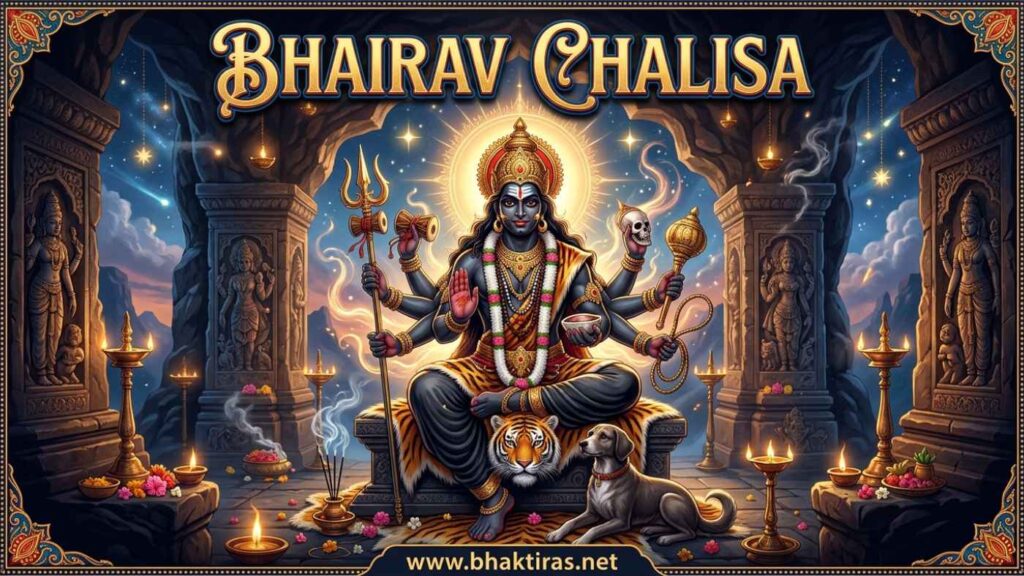
The Bhairav Chalisa is a forty-verse devotional hymn to Lord Bhairav, the fierce protective form of Shiva worshipped as Kaal Bhairav and Batuk Bhairav, and honoured as the guardian (Kotwal) of Kashi. It opens with invocatory dohas to Ganesha, the Guru and Gauri, then praises Bhairav’s dark form, his trident, damaru and bells, and his power to remove fear and grant courage and tantric blessings. This page gives the full Roman (English) transliteration along with a clear meaning for every verse, so you can recite it accurately and understand each line.
Bhairav Chalisa Lyrics in English (Transliteration)
Roman transliteration for easy chanting. Tap “Meaning” under any verse for the English translation.
Shri Ganapati, Guru Gauri pad, prem sahit dhari maath
Chalisa vandan karon, Shri Shiv Bhairavnath
Meaning
With love I place upon my head the feet of Ganesha, the Guru, and Mother Gauri. With reverence I offer this Chalisa in praise of Shiva's form, Lord Bhairavnath.
Shri Bhairav sankat haran, mangal karan kripal
Shyam varan vikaral vapu, lochan laal vishaal
Meaning
Shri Bhairav removes distress and, in his compassion, brings auspiciousness. His body is dark and awesome to behold, with wide, red eyes.
Jai jai Shri Kali ke laala
Jayati jayati Kashi-kutwala
Meaning
Victory, victory to the dear son of Kali. Glory and glory to the Kotwal (guardian) of Kashi.
Jayati Batuk Bhairav bhay haari
Jayati Kaal Bhairav balkari
Meaning
Glory to Batuk Bhairav, the remover of fear. Glory to Kaal Bhairav, the giver of strength.
Jayati Nath Bhairav vikhyata
Jayati sarv Bhairav sukhdata
Meaning
Glory to the renowned Lord Bhairav. Glory to Bhairav in all his forms, the bestower of happiness.
Bhairav roop kiyo Shiv dharan
Bhav ke bhaar utaran karan
Meaning
Shiva himself took on the form of Bhairav for the purpose of lifting the burden of worldly existence from his devotees.
Bhairav rav suni hwai bhay doori
Sab vidhi hoy kaamna poori
Meaning
On hearing the roar of Bhairav, fear is driven away, and every kind of wish is fulfilled.
Shesh Mahesh aadi gun gayo
Kashi-kotwal kahlayo
Meaning
Shesha, Mahesh and the great gods have sung his praises. He is called the Kotwal, the protector of Kashi.
Jata joot shir chandra virajat
Bala mukut bijayath sajat
Meaning
On his matted locks the moon shines, and a crown adorns his head, lending him radiant splendour.
Kati kardhani ghungharu bajat
Darshan karat sakal bhay bhajat
Meaning
A girdle of small bells sounds at his waist, and merely beholding him causes all fear to flee.
Jeevan daan daas ko deenhyo
Keenhyo kripa Nath tab cheenhyo
Meaning
He has granted the gift of life to his servants; only when the Lord shows his grace is his true nature recognised.
Vasi rasna bani Sarad-Kali
Deenhyo var rakhyo mam laali
Meaning
Dwelling upon the tongue as Sharada and Kali, he has granted his boon and preserved his devotee's honour.
Dhanya dhanya Bhairav bhay bhanjan
Jai manranjan khal dal bhanjan
Meaning
Blessed, blessed is Bhairav, the destroyer of fear. Victory to him who delights the heart and shatters the ranks of the wicked.
Kar trishool damaru shuchi kora
Kripa kataksh suyash nahin thora
Meaning
In his hands he holds the trident, the damaru and a pure whip; his glory and the grace of his sidelong glance are not small.
Jo Bhairav nirbhay gun gaavat
Ashtasiddhi nav nidhi phal paavat
Meaning
Whoever sings the praises of Bhairav fearlessly obtains the fruit of the eight siddhis and the nine treasures.
Roop vishaal kathin dukh mochan
Krodh karaal laal duhun lochan
Meaning
Vast in form, he releases his devotees from severe suffering; terrible in his wrath, both his eyes are red.
Aganit bhoot pret sang dolat
Bam bam bam Shiv bam bam bolat
Meaning
Countless spirits and ghosts move in his company, calling out 'Bam Bam Bam Shiva, Bam Bam.'
Rudrakaya Kali ke laala
Maha Kaalhoo ke ho kaala
Meaning
You have the body of Rudra, O dear son of Kali; you are the death even of Maha Kaal (great Time itself).
Batuk Nath ho kaal gambhira
Shvet rakt aru shyam shareera
Meaning
O Batuk Nath, you are grave and deep as Time; your form appears in white, red and dark hues.
Karat neenahoon roop prakasha
Bharat subhaktan kahn shubh aasha
Meaning
You reveal yourself in these three forms, filling your true devotees with auspicious hope.
Ratn jadit kanchan singhasan
Vyaghra charm shuchi narm suaanan
Meaning
You are seated on a golden, jewel-studded throne, with a soft, pure tiger-skin and a gentle face.
Tumhi jaai Kashihin jan dhyavahin
Vishwanath kahn darshan paavahin
Meaning
Those devotees who go to Kashi and meditate upon you also receive the sight of Lord Vishwanath.
Jai Prabhu sanharak Sunand jai
Jai unnat Har Uma-nand jai
Meaning
Victory to you, Lord, the destroyer and bringer of bliss; victory to the exalted one, the joy of Hara and Uma.
Bheem Trilochan svaan saath jai
Vaijnath Shri Jagatnath jai
Meaning
Victory to the fearsome three-eyed one who keeps the dog at his side; victory to Vaijnath, the Lord of the world.
Maha bheem bheeshan shareer jai
Rudra Rudraksh dhaari veer jai
Meaning
Victory to the one of vast and dreadful form; victory to the brave Rudra who wears the rudraksha beads.
Trishool damaru dhari damkavat
Sada Shiv ki seva paavat
Meaning
Holding trident and damaru, he sounds the drum, and forever receives the service of Shiva.
Brahma ka maan mardan kariho
Bhav ke bhaar utaran kariho
Meaning
You humble the pride of Brahma, and you lift away the burden of worldly existence.
Kari kripa Prabhu daas pe keejai
Ab mohi bhav saagar ten deejai
Meaning
Show your grace upon this servant, O Lord, and now carry me across the ocean of worldly existence.
Main anaath Nath tum mere
Jai jai jai Bhairav bade ghanere
Meaning
I am helpless, and you are my Lord and master. Victory, victory, victory to the immense and mighty Bhairav.
Bhairav bhakti hamen deejai
Hriday baas Shiv ka keejai
Meaning
Grant us devotion to Bhairav, and let Shiva take up his dwelling within our heart.
Riddhi siddhi sab sukh deejai
Ant samay Shiv pur keejai
Meaning
Bestow prosperity, spiritual powers and every happiness, and at the final hour give me a place in Shiva's abode.
Karat nyaay deen ki rakhwari
Bhairav rav sun bhaaje bhaari
Meaning
He delivers justice and protects the humble; hearing the roar of Bhairav, great calamities take flight.
Shri Ganapati Guru Gauri pad, prem sahit dhari maath
Chalisa vandan karo, Shri Shiv Bhairavnath
Meaning
Again, with love placed upon the head, I bow at the feet of Ganesha, the Guru and Gauri, offering this Chalisa in praise of Shiva's form, Lord Bhairavnath.
Benefits of Reciting the Bhairav Chalisa
Devotees recite the Bhairav Chalisa to seek the protection and fearless strength of Kaal Bhairav. Its commonly described benefits include:
- Protection: As the guardian Kotwal of Kashi, Bhairav is invoked to shield home, travel and life from harm and negative forces.
- Removal of fear: The repeated cry that fear flees on hearing Bhairav’s roar makes this a favourite prayer for anxiety, nightmares and dread.
- Courage: Worship of Kaal Bhairav is associated with inner strength and the resolve to face difficult situations.
- Obstacle removal: The verses praise Bhairav as the one who lifts the burden of worldly troubles and shatters the ranks of the wicked.
- Spiritual and tantric blessings: The Chalisa speaks of the eight siddhis and nine treasures, reflecting Bhairav’s place in tantric and Shaiva devotion.
- Peace at the end: The closing verses ask for a place in Shiva’s abode, framing the prayer as a wish for liberation as well as worldly help.
When and How to Chant the Bhairav Chalisa
Bhairav is traditionally worshipped on Sunday and Tuesday, and especially on Kaal Bhairav Ashtami (Bhairav Ashtami), which falls in the month of Margashirsha. Bathe and sit before an image or picture of Bhairav, light a lamp (mustard-oil lamps are common), and offer flowers; some devotees also offer to a dog, which is Bhairav’s vehicle. Recite the two opening dohas, then the chaupais in order, and close with the final doha, reading at a steady, attentive pace. The spirit of the recitation is fearless surrender: you are asking the fierce guardian of Kashi for protection, courage and freedom from fear, so recite with sincerity rather than haste.
About the Bhairav Chalisa
The Bhairav Chalisa follows the classic Chalisa form: opening and closing dohas (couplets) framing a series of chaupais (four-line verses), in the Hindi devotional style. This recension carries two introductory dohas, thirty chaupai couplets and a closing doha that echoes the opening invocation; the name ‘Chalisa’ refers to the genre’s traditional forty-verse scale rather than an exact count in every version. The text praises Bhairav as the dark, fierce form of Shiva, guardian of Kashi, lord of spirits, holder of the trident, damaru and bells, and the deity who removes fear and grants protection. It draws on Shaiva and tantric tradition and is recited across Kashi, Ujjain and much of North India.
Frequently Asked Questions
What is the Bhairav Chalisa?
The Bhairav Chalisa is a devotional hymn of praise to Lord Bhairav, the fierce protective form of Shiva worshipped as Kaal Bhairav and Batuk Bhairav. Written in the traditional Chalisa form of dohas and chaupais, it praises his form and power and asks for protection, courage and freedom from fear.
What are the benefits of reciting the Bhairav Chalisa?
Reciting the Bhairav Chalisa is believed to bring protection from harm and negative forces, removal of fear and anxiety, courage in difficult situations, the clearing of obstacles, and tantric and spiritual blessings. The closing verses also seek peace and a place in Shiva's abode.
Which day is best to recite the Bhairav Chalisa?
Sunday and Tuesday are considered especially suitable for worshipping Bhairav. Kaal Bhairav Ashtami, in the month of Margashirsha, is regarded as the most auspicious day for his worship and for reciting this Chalisa.
How many verses are in the Bhairav Chalisa?
This recension contains two opening dohas, thirty chaupai couplets and a closing doha. The title 'Chalisa' refers to the genre's traditional forty-verse scale, and the exact number of lines can vary slightly between published versions.
Who is Bhairav, and how is he linked to Kashi?
Bhairav is a fierce manifestation of Lord Shiva, honoured as Kaal Bhairav and Batuk Bhairav. He is revered as the Kotwal, or guardian, of Kashi (Varanasi), and the Chalisa repeatedly calls him the protector of Kashi who watches over devotees and removes their fear.
Can the Bhairav Chalisa be recited in English?
Yes. This page provides the full Roman (English) transliteration so that anyone who cannot read Devanagari can recite it accurately, along with a clear meaning for each verse to help understand what is being said.
॥ Bhairav Chalisa ॥