
ॐ
Ashta Lakshmi Chalisa
श्री अष्ट लक्ष्मी चालीसा
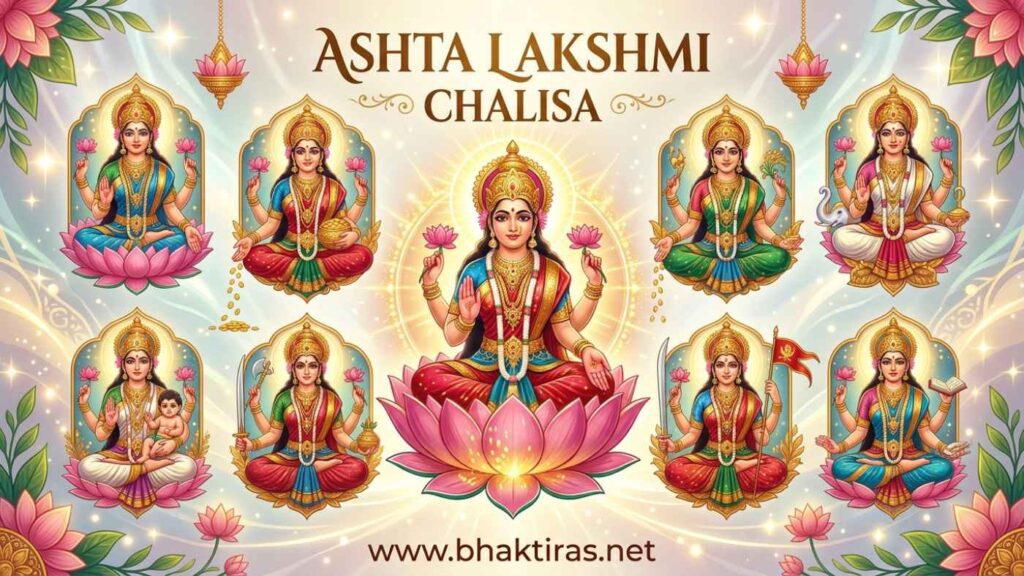
The Ashta Lakshmi Chalisa is a devotional hymn to Goddess Lakshmi in her eight forms — Adi, Dhana, Dhanya, Gaja, Santana, Veera, Vijaya and Vidya Lakshmi — who together grant wealth, food, courage, progeny, victory and knowledge. Composed as opening dohas followed by chaupai verses, it praises the ocean-born mother, consort of Vishnu, and asks for her steady grace in daily life.
This page gives the full Ashta Lakshmi Chalisa in easy English (Roman) transliteration, with a clear, original meaning for every verse so you can both recite the words and understand what you are saying.
Ashta Lakshmi Chalisa Lyrics in English (Transliteration)
Roman transliteration for easy chanting. Tap “Meaning” under any verse for the English translation.
Maatu Lakshmi kari kripa, karo hridaya mem vasa
Manokamana siddha kari, paruvahu meri asa
Meaning
O Mother Lakshmi, be gracious and make your home within my heart. Fulfil the wishes of my mind and carry my hopes to completion.
Yahi mora aradasa, hatha jod vinati karom
Saba vidhi karahu suvasa, jaya janani jagadambika
Meaning
This is my single request, made with folded hands. Bring auspiciousness to me in every way, victory to you, Mother of the universe, Jagadambika.
Sindhu suta vishnupriye nata shira barambara
Riddhi siddhi mamgalaprade nata shira barambara
Meaning
Daughter of the ocean, beloved of Vishnu, I bow my head to you again and again. Giver of prosperity, spiritual attainment and every good fortune, again and again I bow.
Sindhu suta maim sumiraum tohi
Jnana buddhi vidya do mohi
Meaning
Ocean-born goddess, I hold you in memory. Grant me knowledge, sound intellect and learning.
Tuma samana nahim koi upakari
Saba vidhi purabahu asa hamari
Meaning
No one does good like you do. In every way, complete the hopes I carry.
Jai jai jagata janani jagadamba
Sabake tumahi ho svalamba
Meaning
Victory, victory to you, mother of the world, Jagadamba. You are the support on whom everyone rests.
Tuma hi ho ghata ghata ke vasi
Vinati yahi hamari khasi
Meaning
You live within every heart. This is the special prayer we place before you.
Jaga janani jaya sindhu kumari
Dinana ki tuma ho hitakari
Meaning
Mother of the world, victory to you, daughter of the sea. You are the well-wisher of the humble and the helpless.
Vinavaum nitya tumahim maharani
Kripa karau jaga janani bhavani
Meaning
Great queen, I pray to you every day. Show your grace, mother of the world, Bhavani.
Kehi vidhi stuti karaum tihari
Sudhi lijai aparadha bisari
Meaning
In what manner can I possibly praise you? Take notice of me and let my faults be forgotten.
Kripa drishti chitavo mama ori
Jagata janani vinati suna mori
Meaning
Turn your merciful gaze in my direction. Mother of the world, listen to this prayer of mine.
Gyan budhi sab sukh kee data
Sankat haro hamari mata
Meaning
You are the giver of knowledge, wisdom and all happiness. Remove our difficulties, O our Mother.
Ksheer sindhu jab Vishnu mathayo
Chaudah ratna sindhu may payo
Meaning
When Vishnu churned the ocean of milk, fourteen precious treasures rose from the sea.
Chaudah rattan me tum sukh rasi
Seva kiyo prabhu ban dasi
Meaning
Among those fourteen treasures you were the very store of joy. You served the Lord as his devoted attendant.
Jo jo janam prabhu jahan leenha
Roop badal tahan seva keena
Meaning
In whatever birth the Lord took, wherever he went, you changed your form and served him there.
Svayam Vishnu jab nar tanu dhara
Leenyo avadhpuri avatara
Meaning
When Vishnu himself took a human body and was born in the city of Ayodhya.
Tab tum prakat janakpur manhee
Seva kiyo hriday pulkahi
Meaning
You then appeared in Janakpur as Sita and served him with a heart full of joy.
Apnayo tohi antaryami
Vishwa vidhit tribhuvan ke swami
Meaning
The inner-knower, Lord of the three worlds known throughout the universe, accepted you as his own.
Tum sam prabal shakti nahin aani
Kahnlau mahima kaho bakhani
Meaning
There is no power as mighty as you. How far can I describe and recount your glory?
Man kram vachan karay sevakayee
Man ichhit vanchit phal payee
Meaning
Those who serve you in thought, action and speech obtain the very fruits their heart longs for.
Taji chal kapat aur chaturayee
Pujahee Vividh bhaanti man lai
Meaning
Setting aside trickery, deceit and clever scheming, one should worship you wholeheartedly in many ways.
Aur hal mai kahoum bjhuyayee
Jo yeh path karay mun layee
Meaning
And now I say this plainly and with certainty: whoever recites this text with a focused mind.
Ta ko koee kasht na hoyee
Mun icchit vanchit phal payee
Meaning
No trouble will come to that person, and they will receive the fruit their heart desires.
Trahi trahi jai dhukh nivarini
Taapbhav bandhan haranee
Meaning
Save me, save me, victory to you, remover of sorrow. You break the bonds of worldly suffering and torment.
Jo yah padhey aur padhavay
Dhyan laga kar suney sunavay
Meaning
Whoever reads this or has it read, who listens or has it recited with full attention.
Tako koi rog na satavey
Puttarad dhan sampatti pavey
Meaning
No illness will torment them; they gain children, wealth and prosperity.
Puttarheen aru sampatiheena
Andha vadhr koree ati deena
Meaning
The childless and the poor, the blind, the deaf, those afflicted with disease and the utterly wretched.
Vippra bolayay key path kara
Shanka dil mein kabhi na lavai
Meaning
Should invite a learned Brahmin to recite it for them, and never let doubt enter the heart.
Path karavay din chalisa
Tapar kripa karein gaurisha
Meaning
If the recitation is carried out for forty days, the Goddess pours her grace upon that devotee.
Sukh sampati bahut see pavay
Kami nahi kaho kea aaway
Meaning
They gain abundant comfort and wealth; no shortage or want ever reaches them.
Barah maas karai jo puja
Taihi sam dhanya aur nahi duja
Meaning
Whoever performs this worship for twelve months is blessed; there is no one else as fortunate.
Pratidin path karaai man mahi
Un sum koi jag main nahi
Meaning
One who recites it daily with a settled mind has no equal anywhere in the world.
Bahu vidhi kya maim karaum badaai
Tumri mahima ko naahi
Meaning
In how many ways can I sing your praise? Your greatness has no end that I could reach.
Kari vishvasa karaim vrata nema
Tum kripa karo jani
Meaning
To those who keep vows and observances with faith, know that you extend your grace.
Jaya jaya jaya lakshmi maharani
Saba sukh data jagadamba bhavani
Meaning
Victory, victory, victory to you, Queen Lakshmi, giver of every happiness, mother of the world, Bhavani.
Tumharo teja prabala jaga mahim
Saba vidhi raakho sada
Meaning
Your radiance is powerful throughout the world. Protect us always and in every way.
Mohi anatha ki sudhi aba lijai
Kripa drishti chitavo
Meaning
Take notice now of me, one with no other refuge. Cast your merciful glance upon me.
Bhula chuka kari kshama hamari
Aparaadha sab taro
Meaning
Forgive my slips and mistakes; pardon every one of my offences.
Bina darashana vyakula adhikari
Daras dehu ab mori
Meaning
Without a sight of you your devotee grows restless. Grant me your vision now.
Nahim mohim jnana buddhi hai tana mem
Tum hi data sab
Meaning
I have neither knowledge nor wisdom within me; you alone are the giver of everything.
Rupa chaturbhuja karake dharana
Daras dikhao ab
Meaning
Taking on your four-armed form, show me your vision now.
Kahi prakara maim karaum badaai
Stuti karai Ramadasa
Meaning
In what way can I offer your praise? Ramdas, the poet, sings this hymn of adoration to you.
Ramadasa aba kahai pukari
Trahi trahi duhkha harini haro begi saba trasa
Meaning
Now Ramdas calls out aloud: save me, save me, remover of sorrow; swiftly take away all my fears.
Benefits of Reciting the Ashta Lakshmi Chalisa
Regular, sincere recitation of the Ashta Lakshmi Chalisa is offered by devotees for material and spiritual well-being across all eight aspects of Lakshmi:
- Wealth and stability: It is recited to invite steady prosperity (Dhana and Dhanya Lakshmi) and freedom from want.
- Progeny and family: Verses ask the mother for children and a protected, harmonious home (Santana Lakshmi).
- Courage and victory: The hymn calls on Veera and Vijaya Lakshmi for strength in struggles and success in worthy efforts.
- Knowledge and clarity: Several verses request intellect, wisdom and learning (Vidya Lakshmi).
- Relief from difficulty: The closing dohas repeatedly ask her to remove sorrow, disease and worldly bondage.
- Inner devotion: Beyond outcomes, daily recitation steadies the mind and deepens gratitude toward the Divine Mother.
When and How to Chant the Ashta Lakshmi Chalisa
Friday is traditionally kept for Lakshmi worship, and the Ashta Lakshmi Chalisa is especially recited during Diwali, Varalakshmi Vratam and Sharad Purnima. After bathing, sit before an image or picture of the Goddess, light a lamp or incense, and recite calmly with a clean, focused mind. Many keep a forty-day discipline as the verses themselves suggest; what matters most is honesty and steadiness rather than speed.
About the Ashta Lakshmi Chalisa
The Ashta Lakshmi Chalisa is a traditional Hindi hymn, cast in the classic chalisa form of opening dohas followed by chaupai verses and a closing doha, and signed in the final lines by the poet Ramdas. Its verses recall Lakshmi rising from the churning of the ocean of milk, her service to Vishnu across his incarnations including her appearance as Sita in Janakpur, and her role as the eight-fold giver of wealth, food, courage, progeny, victory and knowledge. The transliteration here follows the widely recited text; where regional versions vary slightly in wording, the meaning of each verse is unchanged.
Frequently Asked Questions
What is the Ashta Lakshmi Chalisa?
The Ashta Lakshmi Chalisa is a devotional Hindi hymn praising Goddess Lakshmi in her eight forms — Adi, Dhana, Dhanya, Gaja, Santana, Veera, Vijaya and Vidya Lakshmi. Written as opening dohas and chaupai verses, it asks the ocean-born mother for wealth, progeny, victory and knowledge.
What are the benefits of reciting the Ashta Lakshmi Chalisa?
Devotees recite it for prosperity, protection of the family and children, courage in difficulty, success in worthy efforts, and clarity of mind. The verses also ask the Goddess to remove sorrow, illness and worldly bondage.
Which day is best to recite the Ashta Lakshmi Chalisa?
Friday is the day most associated with Lakshmi. It is also recited with special devotion during Diwali, Varalakshmi Vratam and Sharad Purnima, though daily recitation is welcome.
How many verses are in the Ashta Lakshmi Chalisa?
This text has forty chaupai verses framed by opening dohas and a closing doha, following the standard chalisa form. It is signed by the poet Ramdas in the final lines.
Can the Ashta Lakshmi Chalisa be recited in English?
Yes. This page provides the full text in easy English (Roman) transliteration so anyone can recite it correctly, along with a clear meaning for every verse to help you understand the words as you say them.
॥ Ashta Lakshmi Chalisa ॥