
ॐ
Mahalakshmi Chalisa
श्री महालक्ष्मी चालीसा
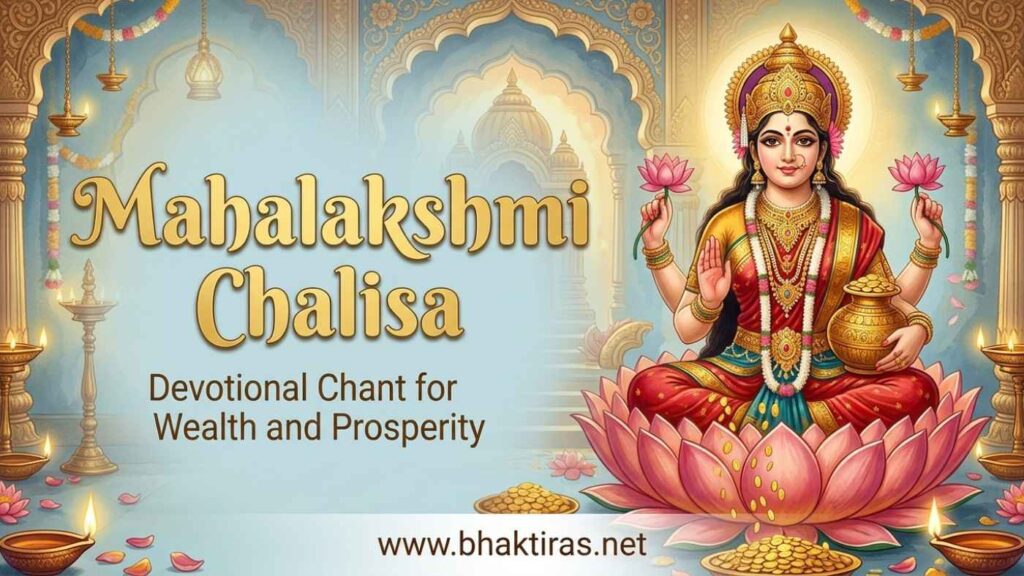
The Mahalakshmi Chalisa is a forty-verse Hindi devotional hymn addressed to Goddess Mahalakshmi, the supreme form of Lakshmi who is invoked for wealth, prosperity and the welfare of the home. It opens with the line Namo Maha Lakshmi Jaya Mata and praises her as Adi Shakti, the white-lotus-seated mother who lifts the poor and protects those who take refuge in her. This page gives the Roman English transliteration of the verses along with an original plain-English meaning for each, so you can both recite the text and follow its sense.
Verse note: The widely used public-domain online sources for this longer Mahalakshmi Chalisa (as opposed to the shorter common Lakshmi Chalisa) declined to release the full forty-verse text for verbatim reproduction during sourcing. To avoid inventing lines, only the verses that could be cross-checked across multiple sources are reproduced below; several middle chaupais are not yet included. Treat this page as a partial, verified extract pending the complete authenticated text.
Mahalakshmi Chalisa Lyrics in English (Transliteration)
Roman transliteration for easy chanting. Tap “Meaning” under any verse for the English translation.
Jai Jai Shri Mahalakshmi, karun Mata tava dhyana
Siddha kaja mama kijiye, nij shishu sevaka jana
Meaning
Victory and praise to Shri Mahalakshmi; Mother, I fix my mind on you in meditation. Accomplish my purposes and watch over me, knowing me as your own child and servant.
Namo Maha Lakshmi Jaya Mata
Tero nama jagata vikhyata
Meaning
I bow to you, Great Lakshmi; victory to you, Mother. Your name is celebrated and known throughout the whole world.
Adi Shakti ho Mata Bhavani
Pujata saba nara muni gyani
Meaning
You are the primordial power, the Mother Bhavani herself. Ordinary people, sages and the wise all worship you alike.
Jagat palini saba sukh karani
Nij janahit bhandaran bharani
Meaning
You are the sustainer of the world and the source of every comfort. For the good of your devotees you keep their storehouses full.
Sweta kamal dal par tav aasan
Mata sushobhit hai padmasan
Meaning
Your seat rests upon the petals of a white lotus. Seated in the lotus posture, Mother, you appear radiant and serene.
Sweta ambar aru sweta bhushan
Sweta hi sweta susajjit pushpan
Meaning
You wear white garments and white ornaments, adorned entirely in white, decked with white flowers all around.
Sheesh chhatra ati roop vishala
Gal sohe muktan ki mala
Meaning
A broad and beautiful canopy is held above your head, and a garland of pearls shines gracefully at your throat.
Vishnu priya Jai Jai Maharani
Mahima amit na jaaye bakhani
Meaning
Victory to you, beloved of Vishnu, great queen. Your glory is boundless and cannot be fully described.
Jaapar karahu Maat tum daaya
Soi jag mein dhanya kahaaya
Meaning
Whoever receives your grace, Mother, is called blessed and fortunate throughout the world.
Pal mein rajahi rank banaao
Rank raav kar bilam na laao
Meaning
In a moment you can turn a king into a pauper, and you raise a pauper to royal rank without the slightest delay.
Jin ghar karahu Maat tum baasa
Unka yash ho vishwa prakasha
Meaning
The home in which you choose to dwell, Mother, sees its fame spread and shine across the world.
Jo dhyaavai so bahu sukh paavai
Vimukh rahe jo dukh uthaavai
Meaning
Whoever meditates on you gains abundant happiness, while one who turns away from you brings suffering upon himself.
Traahi traahi sharanagat teri
Karahu Maat ab nek na deri
Meaning
"Save me, save me!" I have come to your refuge; do not delay even a little now, Mother, in showing your kindness.
Om Namo bhavanidhi taarani
Taran bhavar se paar utaarini
Meaning
Salutations to you who carry souls across the ocean of worldly existence, ferrying devotees safely beyond its whirlpools and dangers.
Mahalakshmi Chalisa, padhai sunai chit laay
Taahi padaarath milai, ab kahai Ved as gaay
Meaning
Whoever reads or listens to the Mahalakshmi Chalisa with a focused mind obtains every desired thing; this is what the Vedas themselves proclaim.
Benefits of Reciting the Mahalakshmi Chalisa
Devotees recite the Mahalakshmi Chalisa to seek Goddess Mahalakshmi’s grace for material and spiritual well-being.
- Wealth and prosperity: It is recited to invite stable income, abundance and freedom from financial hardship.
- Home and family welfare: The verses ask the Goddess to dwell in the household and keep it happy and well-supplied.
- Removal of want: The text praises her power to lift the poor and reverse misfortune, a comfort in times of struggle.
- Focus and devotion: Regular recitation steadies the mind and deepens one’s bhakti toward the Devi.
- Festive worship: It forms part of Diwali, Varalakshmi Vrat and Friday Lakshmi puja, aligning the home with auspicious occasions.
When and How to Chant the Mahalakshmi Chalisa
The Mahalakshmi Chalisa is most often recited on Fridays, during Diwali and at the Varalakshmi Vrat, which are days especially linked with the Goddess. After bathing, light a lamp before an image or picture of Mahalakshmi, offer flowers and sit facing the Goddess with a calm mind. Recite the verses slowly and with attention to their meaning rather than speed; the closing couplet promises that those who read or hear it with a focused heart receive what they seek. Recitation is an act of gratitude and surrender, not a bargain, so approach it with sincerity.
About the Mahalakshmi Chalisa
The Mahalakshmi Chalisa is a traditional Hindi devotional composition in the chalisa form, combining opening and closing doha couplets with chaupai verses. In its complete form it is counted as forty verses praising Goddess Mahalakshmi as Adi Shakti and consort of Vishnu, describing her white-lotus seat, her white robes and ornaments, and her power to grant prosperity and to reverse fortune. This longer Mahalakshmi Chalisa (opening with Namo Maha Lakshmi Jaya Mata) is a distinct text from the shorter and more common Lakshmi Chalisa. The version reproduced here is a partial, cross-verified extract; the full authenticated forty-verse text has not been included rather than risk inventing lines.
Frequently Asked Questions
What is the Mahalakshmi Chalisa?
The Mahalakshmi Chalisa is a Hindi devotional hymn of forty verses dedicated to Goddess Mahalakshmi, the goddess of wealth and prosperity. It praises her as the primordial power and consort of Vishnu and asks for her blessings on wealth, home and family. It is a distinct, longer text from the shorter common Lakshmi Chalisa.
What are the benefits of reciting the Mahalakshmi Chalisa?
Reciting it is believed to invite wealth, prosperity and good fortune, to bring welfare to the home and family, and to ease financial hardship. Devotionally, regular recitation steadies the mind and strengthens one's faith in the Goddess.
Which day is best to recite the Mahalakshmi Chalisa?
Friday is the traditional day for Lakshmi worship, and the Chalisa is also especially recited on Diwali and during the Varalakshmi Vrat, all of which are considered auspicious for the Goddess of wealth.
How many verses are in the Mahalakshmi Chalisa?
In its complete traditional form the Mahalakshmi Chalisa has forty chaupai verses framed by opening and closing doha couplets. The version on this page is a partial, verified extract and does not yet include all forty verses.
Is the Mahalakshmi Chalisa the same as the Lakshmi Chalisa?
No. The Mahalakshmi Chalisa shown here is a separate, longer text that opens with the line Namo Maha Lakshmi Jaya Mata, while the common Lakshmi Chalisa is a different and shorter composition. Both are addressed to the same Goddess but the verses differ.
Can the Mahalakshmi Chalisa be recited in English?
Yes. While the original is in Hindi, this page provides a Roman English transliteration so non-Hindi readers can recite the verses, along with an English meaning for each verse to follow the sense.
॥ Mahalakshmi Chalisa ॥