
Shravan Somvar Vrat 2026 – The Sacred Mondays of Sawan for Lord Shiva
श्रावण सोमवार व्रत
When is the first Shravan Somvar Vrat in 2026?
The first Shravan Somvar Vrat in 2026 falls on Monday, 3 August, in North India. Sawan (Shravana) runs from 30 July to 28 August in the North Indian Purnimanta calendar, giving four Mondays: 3, 10, 17 and 24 August 2026. On each of these Mondays devotees fast and worship Lord Shiva with water, milk and bilva leaves poured over the Shivling.
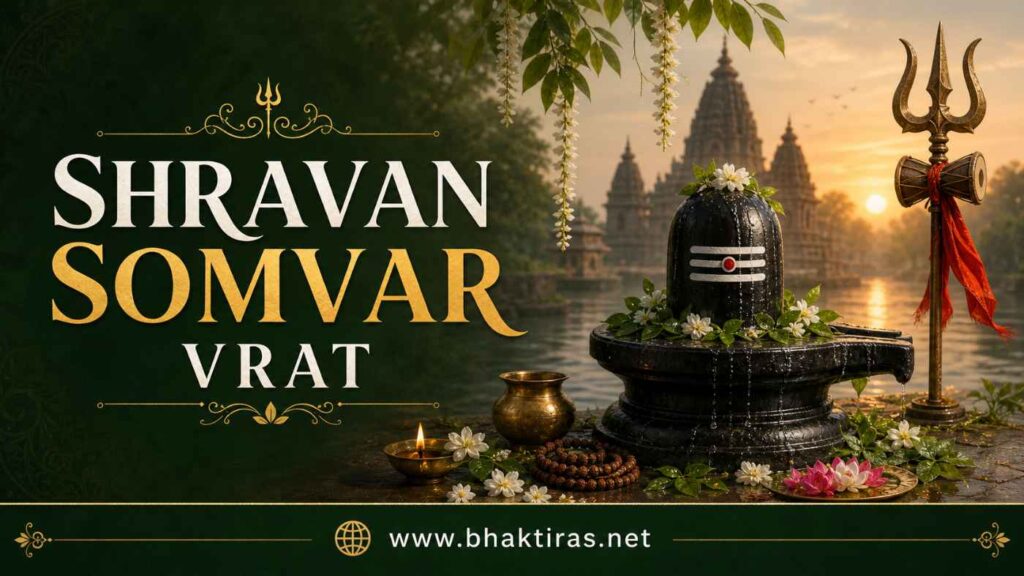
Shravan Somvar Vrat is the fast kept on every Monday of Shravana, the holiest month in the Hindu calendar for Lord Shiva. Falling across July and August, these Mondays draw crowds to Shiva temples across India for Rudrabhishek and the offering of water, milk and bilva leaves on the Shivling. In 2026 the first Sawan Monday in North India is 3 August. Many devotees also join the Kanwar Yatra, carrying holy Ganga water on foot to bathe the deity.
Shravan Somvar Vrat 2026-2028: Monday Dates
The next Shravan Somvar falls on Monday, 3 August 2026 in North India. Because Shravana is a lunar month, its Mondays shift each year and the exact set differs between the North Indian Purnimanta calendar and the Amanta calendar of Maharashtra and the South.
| Year | Shravan Somvar (North India) | Day | Notes |
|---|---|---|---|
| 2026 | 3 August | Monday | First Sawan Somvar – next occurrence |
| 2026 | 10 August | Monday | Second Somvar |
| 2026 | 17 August | Monday | Third Somvar |
| 2026 | 24 August | Monday | Fourth (final) Somvar |
| 2027 | 19 & 26 July; 2, 9, 16 Aug | Mondays | Five Sawan Mondays |
| 2028 | 10, 17, 24 & 31 July | Mondays | Four Sawan Mondays |
In North India (Purnimanta), Shravana in 2026 runs from 30 July to 28 August, which gives four Mondays. In 2027 the month begins earlier, on 19 July, producing five Sawan Somvars; in 2028 it opens on 7 July with four Mondays. In the Amanta calendar followed in Maharashtra and the South, the 2026 Shravana Mondays instead fall on 17 August, 24 August, 31 August and 7 September.
Why Shravan Somvar Vrat Is Observed
Shravan Somvar Vrat is observed because Shravana is regarded as Lord Shiva’s most beloved month and Monday (Somvar) is his weekday, so the two together are considered the finest time to seek his blessings.
The month’s link to Shiva is traced to the Samudra Manthan, the churning of the ocean of milk. When the deadly halahala poison surfaced and threatened all creation, Shiva drank it to save the worlds, holding it in his throat, which turned blue and earned him the name Neelkantha. The gods poured water and Ganga over him to cool the burning, and that act of relief is remembered every Shravana when devotees bathe the Shivling with water and milk.
Shiva's favourite month
Shravana is held to be the period when Shiva is most easily pleased. Devotees believe prayers, fasting and abhishek offered now carry special weight, so temple footfall rises sharply and many take on a vow for the whole month rather than a single day.
Monday, the day of Shiva
Somvar is dedicated to Shiva across the year, but in Shravana each Monday becomes a mini festival. Keeping the fast is thought to bring peace of mind, good health, marital harmony and the removal of obstacles, with the moon (Soma) that rules the day also linked to Shiva through the crescent on his head.
Solah Somvar for a good spouse
Unmarried girls often keep the Solah Somvar Vrat, a set of sixteen consecutive Monday fasts frequently begun in Shravana, praying to Shiva and Parvati for a devoted, well-matched husband. The vow recalls how Parvati herself won Shiva through long, unwavering penance.
The Kanwar Yatra
Through Shravana, saffron-clad pilgrims called Kanwariyas walk hundreds of kilometres to collect Ganga water from places like Haridwar, Gaumukh and Sultanganj, carrying it on decorated slings to pour over a Shivling back home. It is one of the largest annual pilgrimages in India.
Deities & Figures Worshipped
Shravan Somvar Vrat is centred on Lord Shiva, worshipped chiefly in his aniconic form, the Shivling, and honoured alongside his consort Parvati and his vahana Nandi.
Lord Shiva
Shiva is the focus of every Sawan Monday. As Neelkantha, Mahadeva and the great ascetic of Kailash, he is worshipped for destruction of negativity, inner calm and blessings on family life. The abhishek of water, milk and bilva leaves is offered directly to him.
The Shivling
Most rituals are performed on the Shivling, the sacred form representing Shiva’s infinite, formless nature. Cool substances like water, milk, curd, honey and Ganga jal are poured over it because Shiva is believed to remain heated from swallowing the halahala poison.
Goddess Parvati
Parvati is invoked with Shiva, especially by those keeping the vow for marriage or family well-being. The pair together represent the ideal of a balanced, devoted union, which is why couples and unmarried girls both hold the fast.
Nandi
Nandi, the bull who serves as Shiva’s mount and gatekeeper, is honoured at the temple entrance. Devotees often whisper their wishes into Nandi’s ear, trusting him to carry them to the Lord.
Shravan Somvar Puja, Step by Step
The Sawan Monday fast follows a simple rhythm: an early bath, abhishek of the Shivling, mantra chanting through the day, an evening puja and then breaking the fast.
- Wake early and bathe. Rise before sunrise, bathe and wear clean clothes, preferably in white or saffron. Take a sankalp (resolve) to keep the fast for Lord Shiva.
- Visit the temple or set up the puja. Go to a Shiva temple, or clean the home shrine and place a Shivling or Shiva image for worship.
- Perform the abhishek. Bathe the Shivling with water, then milk, and again with water. Many also use curd, honey, ghee and Ganga jal, finishing with a final water rinse.
- Offer bilva and flowers. Place bilva (bel) leaves in threes, white flowers, dhatura, bhang, sandalwood paste and akshat (rice). Bilva leaves are considered especially dear to Shiva.
- Light the lamp and chant. Light a diya and incense and recite the Panchakshari mantra Om Namah Shivaya, the Mahamrityunjaya mantra or the Shiva Chalisa through the day.
- Keep the fast. Stay on water, fruit and non-grain (phalahar) food during the day. Some keep a strict waterless fast, others eat one sattvic meal.
- Evening aarti and katha. At dusk perform the Shiva aarti and read or listen to the Somvar Vrat Katha before the deity.
- Break the fast. After the evening worship, break the fast with prasad and simple sattvic food, avoiding grains, onion and garlic on the vrat day.
What Devotees Eat on Shravan Somvar
The Sawan Monday fast is a phalahar (fruit-based) vrat: grains, common salt, onion and garlic are set aside, and light sattvic dishes made from vrat-friendly ingredients are eaten instead.
Sabudana khichdi
Soaked tapioca pearls tossed with peanuts, potato, cumin and green chilli, seasoned with rock salt (sendha namak). It is the classic filling vrat dish, light on the stomach yet sustaining through a long fasting day.
Phalahar
Fresh and dry fruits, milk, curd and nuts form the core of the fast. Many devotees stay on fruit and milk alone until the evening puja, treating the day as a cleansing rather than a full meal.
Vrat-friendly staples
Dishes are made from kuttu (buckwheat) or singhara (water chestnut) flour, samak rice, potato and rock salt. Kuttu puris, aloo sabzi and samak kheer are common once the fast is broken.
Prasad and sweets
Panchamrit, made of milk, curd, honey, ghee and sugar, is offered to Shiva and shared as prasad. Sweets like kheer, halwa and fruit are distributed after the evening aarti.
What is left out
Grains such as wheat and rice, pulses, ordinary salt, onion, garlic, alcohol and non-vegetarian food are all avoided on the vrat day, in keeping with the sattvic spirit of Shravana.
Regional Names & Variations
The fast is kept across India, but the calendar, the customs and even the intensity of the pilgrimage change from region to region.
North India (Purnimanta)
In Rajasthan, Uttar Pradesh, Madhya Pradesh, Punjab, Bihar and the Hindi belt, Shravana is counted full-moon to full-moon and begins in mid to late July. This is the heartland of the Kanwar Yatra, and the Sawan Somvars here often start a fortnight before the South.
Maharashtra & the South (Amanta)
Maharashtra, Gujarat, Karnataka, Andhra, Telangana and Tamil Nadu follow the Amanta calendar, so their Shravana starts about two weeks later. Marathi households mark Shravani Somvar with great devotion, alongside other Shravana vrats like Mangala Gauri on Tuesdays.
The Kanwar Yatra corridors
In the North, Kanwariyas throng the routes from Haridwar, Gaumukh and Sultanganj, while in the East the Sultanganj to Deoghar (Baba Baidyanath) walk draws huge numbers. Roads turn saffron with pilgrims through the month.
Solah Somvar circles
Across regions, groups of unmarried girls and newly married women keep the sixteen-Monday Solah Somvar Vrat, often starting in Shravana, gathering to read the vrat katha and share prasad after the fast is broken.
Shravan Somvar Vrat Do's and Don'ts
A few simple practices keep the fast sincere and its spirit intact.
Do
- Bathe early and take a clear sankalp before starting the fast
- Offer water, milk and bilva leaves on the Shivling
- Chant Om Namah Shivaya or the Mahamrityunjaya mantra through the day
- Eat only sattvic phalahar food with rock salt
- Perform the evening aarti and read the Somvar Vrat Katha before breaking the fast
Avoid
- Do not eat grains, pulses, onion, garlic or common salt on the vrat day
- Avoid tulsi leaves and turmeric on the Shivling (they are not offered to Shiva)
- Do not consume alcohol or non-vegetarian food during Shravana
- Avoid anger, harsh speech and quarrels while keeping the fast
- Do not break the fast before completing the evening puja
Frequently Asked Questions
When is the first Shravan Somvar Vrat in 2026?
The first Shravan Somvar Vrat in 2026 is on Monday, 3 August, in North India. Sawan (Shravana) runs from 30 July to 28 August in the Purnimanta calendar, so the four Mondays fall on 3, 10, 17 and 24 August 2026.
How many Shravan Somvars are there in 2026?
There are four Shravan Somvars in 2026 in North India: 3, 10, 17 and 24 August. In Maharashtra and South India, which follow the Amanta calendar, the four Shravana Mondays instead fall on 17 August, 24 August, 31 August and 7 September 2026.
What are the Shravan Somvar dates in 2027 and 2028?
In 2027, North India has five Sawan Mondays: 19 and 26 July, then 2, 9 and 16 August. In 2028 there are four: 10, 17, 24 and 31 July. The count changes because the lunar Shravana month begins on a different date each year.
Why is Shravan Somvar dedicated to Lord Shiva?
Shravan Somvar is dedicated to Lord Shiva because Shravana is considered his most beloved month and Monday is his weekday. The link is tied to the Samudra Manthan, when Shiva drank the halahala poison to save creation, and devotees pour water and milk on the Shivling to cool him and earn his blessings.
What do you eat during the Shravan Somvar fast?
During the Shravan Somvar fast devotees eat phalahar, or fruit-based food, avoiding grains, pulses, onion, garlic and common salt. Popular dishes include sabudana khichdi, fruit, milk, curd and items made from kuttu or singhara flour with rock salt, with prasad taken after the evening puja.
What is the Solah Somvar Vrat and how is it linked to Shravan?
The Solah Somvar Vrat is a set of sixteen consecutive Monday fasts kept for Lord Shiva, often begun during Shravana. It is especially popular with unmarried girls praying for a good and devoted husband, recalling how Goddess Parvati won Shiva through her penance.
What is the Kanwar Yatra during Shravan?
The Kanwar Yatra is a pilgrimage in which devotees, called Kanwariyas, walk to sacred rivers such as the Ganga to collect holy water and carry it back to bathe a Shivling. Undertaken through Shravana, it is one of India’s largest annual pilgrimages, with routes turning saffron with walking pilgrims.
How do you perform the Shravan Somvar puja at home?
To perform the Shravan Somvar puja at home, bathe early, take a sankalp, and bathe a Shivling with water, milk and again water. Offer bilva leaves, white flowers, dhatura and sandalwood, chant Om Namah Shivaya, keep a phalahar fast, and end with the evening Shiva aarti and vrat katha before breaking the fast.
May the cool waters of Shravana carry your prayers to Mahadeva this Sawan. Har Har Mahadev.