
Varamahalakshmi Vratam 2026 – Boon-Granting Vrat to Goddess Lakshmi
वरमहालक्ष्मी व्रतम्
When is Varamahalakshmi Vratam in 2026?
Varamahalakshmi Vratam falls on Friday, 28 August 2026. It is observed by married women on the last Friday of the bright fortnight of Shravana, just before the full moon, to invoke Goddess Mahalakshmi for family prosperity, health and marital wellbeing. In 2026 the vrat coincides with Shravana Purnima, which many consider especially auspicious.
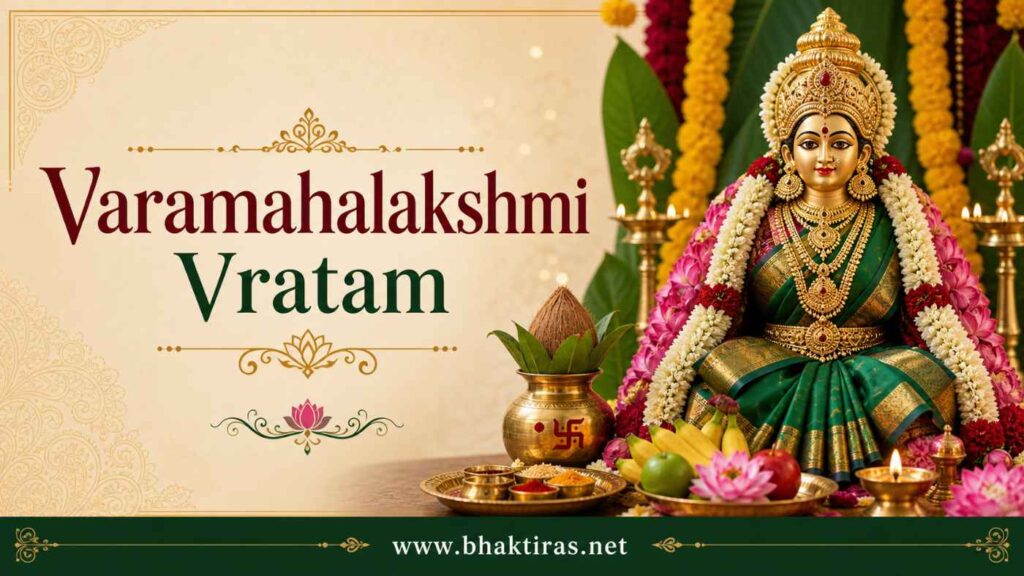
Varamahalakshmi Vratam, also called Varalakshmi Vratam, is a one-day vow kept mainly by married women across South India to please Goddess Mahalakshmi and win her “vara” or boons for the family. It is held on the Friday before the full moon of Shravana, which in 2026 falls on 28 August. Women set up a brass or silver pot as the living form of the goddess, dress it with a face, jewellery and a saree, and worship it for wealth, health, children and lasting marital happiness.
Varamahalakshmi Vratam 2026-2028: Dates & Calendar
The next Varamahalakshmi Vratam is on Friday, 28 August 2026. The date shifts each year because it is fixed to the last Friday of the waxing fortnight of the lunar month of Shravana, so it can land anywhere from late July to late August.
| Year | Date | Day | Notes |
|---|---|---|---|
| 2026 | 28 August | Friday | Next occurrence; coincides with Shravana Purnima |
| 2027 | 6 August | Friday | Shravana Shukla Paksha Friday |
| 2028 | 4 August | Friday | Shravana Shukla Paksha Friday |
The vrat is always kept on a Friday, the weekday sacred to Lakshmi, so a vrat date on any other day is a calendar error. Many families begin the puja in the morning after an oil bath, though evening worship is also common in some households.
Why Varamahalakshmi Vratam Is Celebrated
Varamahalakshmi Vratam is kept to invoke Goddess Lakshmi as the giver of boons, so that the whole family enjoys wealth, health, harmony and long life. Worshipping her on this single Friday is said to equal worshipping all eight of her forms together.
The eight Lakshmis in one puja
The word Varamahalakshmi honours Lakshmi as the great goddess who grants wishes. Devotees believe that praying to her on this day pleases the Ashtalakshmi, her eight aspects governing wealth (Dhana), grain (Dhanya), courage (Dhairya), progeny (Santana), victory (Vijaya), knowledge (Vidya), the earth’s bounty (Gaja) and primordial abundance (Adi). One vrat is thus counted as complete Lakshmi worship.
A vrat for the family's welfare
Unlike temple festivals, this is a home vow that a wife keeps on behalf of everyone she loves. The prayers ask for her husband’s long life, the wellbeing of children, and steady prosperity in the household. It is one of the most cherished women’s observances of the Shravana season.
Told by Shiva to Parvati
The Skanda Purana frames the vrat as advice Lord Shiva gave to Parvati when she asked for a rite that would benefit women. To show its power he narrated the story of a devoted Brahmin woman named Charumati, whom the goddess visited in a dream and instructed to keep this fast.
The story of Charumati
Charumati of the Magadha kingdom served her family with great devotion. Pleased with her, Varalakshmi appeared in her dream and asked her to worship on the Friday before the Shravana full moon. Charumati did so with her neighbours, and they were blessed with gold, wealth and happiness, which is why the vrat is kept to this day.
Deities & Figures Worshipped
The single focus of the day is Goddess Mahalakshmi, worshipped in the form of a decorated pot called the kalasha, treated as her living presence.
Mahalakshmi (Varalakshmi)
Lakshmi, consort of Vishnu, is honoured here as Varalakshmi, the boon-granting goddess of fortune, prosperity and auspiciousness. Women invite her into the home through the kalasha and offer her flowers, turmeric, kumkum, bangles and a saree, seeking her lasting grace over the family.
Ashtalakshmi
Lakshmi’s eight forms are invoked collectively on this day, each ruling a different kind of abundance from money and grain to knowledge, courage and children. Worshipping Varalakshmi is understood to cover all eight at once.
Charumati
Charumati is not a deity but the ideal devotee of the origin story. She stands for the sincere householder whose devotion draws the goddess near, and her example is recalled during the katha (story reading) that forms part of the puja.
Key Rituals, Step by Step
The heart of the day is transforming an ordinary pot into the goddess herself and worshipping her with the shodashopachara, the sixteen traditional offerings.
- Clean and prepare the space. After an early oil bath, women clean the puja area, draw a rangoli or kolam on the floor and place a small wooden plank or a mound of raw rice for the kalasha to rest on.
- Set up the kalasha. A brass, silver or copper pot is filled with water, rice, a coin, turmeric, betel and a few coins, then topped with mango leaves and a coconut smeared with turmeric.
- Dress the pot as the goddess. A paper or metal face of Lakshmi is fixed to the coconut, and the kalasha is adorned with a small saree, gold or artificial jewellery, a nose ring, bangles and a garland so that it looks like the goddess seated in the home.
- Invoke Lakshmi (avahana). With chanting and a lamp lit before her, the goddess is formally invited to reside in the kalasha for the day.
- Tie the sacred thread. A yellow thread with turmeric and a few flowers, sometimes with nine knots, is worshipped and then tied around the right wrist of each woman as a token of the goddess’s protection.
- Perform the shodashopachara puja. The goddess is offered the sixteen honours in order: seat, water for the feet and hands, bath, clothes, sandal paste, turmeric and kumkum, flowers, incense, lamp, food (naivedya) and more, with the Lakshmi ashtottara (108 names) recited.
- Read the katha and do aarti. The story of Charumati is read aloud so all present hear how the vrat began, followed by aarti with a camphor flame and devotional songs to Lakshmi.
- Share haldi-kumkum. In the evening the hostess invites married women, offers them turmeric, kumkum, betel, fruit and a small gift (tamboolam), and distributes the prasad, closing the day on a note of shared blessing.
Special Foods of Varamahalakshmi Vratam
Offerings lean towards sweet and savoury preparations that Lakshmi is believed to favour, later shared as prasad among family and visiting women.
Sweet Pongal (Sakkarai Pongal)
Rice and moong dal cooked with jaggery, ghee, cashews and cardamom, this warm golden sweet is a favourite naivedyam offered to the goddess and served to everyone afterwards.
Payasam / Kheer
A milk pudding made with vermicelli, rice or moong dal and flavoured with cardamom and dry fruits. It is one of the most common offerings placed before the kalasha.
Vada
Crisp urad dal fritters, often garlanded and offered in a plate. Their round shape is considered auspicious, and they balance the sweetness of the other dishes.
Sundal
A light stir of boiled chana or other legumes tempered with mustard, curry leaves and grated coconut. It is an easy, wholesome offering typical of Lakshmi and Navaratri worship in the south.
Kosambari & fruit
Soaked moong dal salad with cucumber and coconut, along with bananas, coconut and betel, rounds out the offering plate in many Kannada homes.
Regional Names & Variations
The vrat is strongest across the four southern states, where the details of decoration and timing vary from home to home.
Karnataka
Called Varamahalakshmi Vrata, it is one of the biggest women’s festivals of the year. Homes are cleaned and decorated with mango-leaf torans, and the kalasha is dressed elaborately with a silk saree and gold. Families exchange visits to see each other’s Lakshmi setups.
Andhra Pradesh & Telangana
Known as Varalakshmi Vratam, it is observed with the kalasha, the sacred thread and readings of the vrata katha in Telugu. Neighbouring women gather in the evening for haldi-kumkum and tamboolam.
Tamil Nadu
Here too it is Varalakshmi Vratham. The pot is decorated as Lakshmi, sweet Pongal and payasam are offered, and married women tie the yellow thread and invite others home to share turmeric, kumkum and prasad.
Varamahalakshmi Vratam Do's and Don'ts
A few simple customs keep the vow respectful and the household in the right spirit.
Do
- Bathe early and keep the puja space and yourself clean.
- Decorate the kalasha with care as the goddess’s living form.
- Read or listen to the Charumati katha during the puja.
- Invite married women for haldi-kumkum and share the prasad.
- Keep prayers focused on family wellbeing and gratitude.
Avoid
- Do not observe the vrat on any day other than the Shravana Friday.
- Avoid non-vegetarian food, onion and garlic during the fast.
- Do not leave the sacred pot or lamp unattended while lit.
- Avoid quarrels, harsh words or waste on the day of the vow.
- Do not dismantle the kalasha in a hurry; conclude with a proper farewell (udvasana) the next day.
Frequently Asked Questions
When is Varamahalakshmi Vratam in 2026?
Varamahalakshmi Vratam is on Friday, 28 August 2026. It is kept on the last Friday of the bright fortnight of Shravana, just before the full moon, and in 2026 it happens to coincide with Shravana Purnima, which many families regard as especially auspicious.
When is Varamahalakshmi Vratam in 2027 and 2028?
Varamahalakshmi Vratam falls on Friday, 6 August 2027 and Friday, 4 August 2028. The vrat is always kept on the Friday of the waxing fortnight of Shravana that comes just before the full moon, so the calendar date shifts each year while the weekday stays Friday.
Why is Varamahalakshmi Vratam celebrated?
Varamahalakshmi Vratam is celebrated to invoke Goddess Lakshmi as the granter of boons (vara) for the family’s prosperity, health and marital happiness. According to the Skanda Purana, Lord Shiva recommended the vrat to Parvati as a rite that would benefit women, and its power is illustrated by the story of the devout Charumati.
Which goddess is worshipped on Varamahalakshmi Vratam?
Goddess Mahalakshmi, the consort of Vishnu and giver of fortune, is worshipped as Varalakshmi. She is honoured in the form of a decorated pot (kalasha), and praying to her on this day is believed to please all eight of her forms, the Ashtalakshmi, at once.
How is the Varamahalakshmi kalasha decorated?
The kalasha is a brass, silver or copper pot filled with water, rice, turmeric, a coin and betel, topped with mango leaves and a turmeric-smeared coconut. A face of Lakshmi is fixed to it and the pot is dressed with a small saree, jewellery, bangles and a garland so that it appears as the goddess seated in the home.
Who observes the Varamahalakshmi vrat?
The vrat is mainly observed by married women, who keep it for the wellbeing of their husbands, children and the whole household. It is most widely followed in Karnataka, Andhra Pradesh, Telangana and Tamil Nadu, where women also gather in the evening to exchange haldi-kumkum.
What is the significance of the sacred thread tied on this day?
A yellow turmeric thread, often knotted and worshipped alongside the goddess, is tied around the wrist of each woman as a token of Lakshmi’s protection and blessing. It symbolises the boons of the vrat carried on the body until it is removed after the observance.
What foods are offered during Varamahalakshmi Vratam?
Common offerings include sweet Pongal, payasam or kheer, vada, sundal and seasonal fruit, all placed before the kalasha as naivedyam. After the puja these are shared as prasad with family members and the married women invited for haldi-kumkum.
May Goddess Varalakshmi bless your home with abundance and lasting joy. Varamahalakshmi Vratam Shubhakankshalu.