
Bathukamma 2026 – Telangana's Floral Festival of the Goddess
బతుకమ్మ
When is Bathukamma in 2027?
Bathukamma 2027 runs for nine days, from around 30 September to 8 October 2027. It is the floral festival of Telangana, when women build conical stacks of seasonal flowers to honour the goddess Gauri and float them on ponds on the final day, Saddula Bathukamma, which falls on Durgashtami.
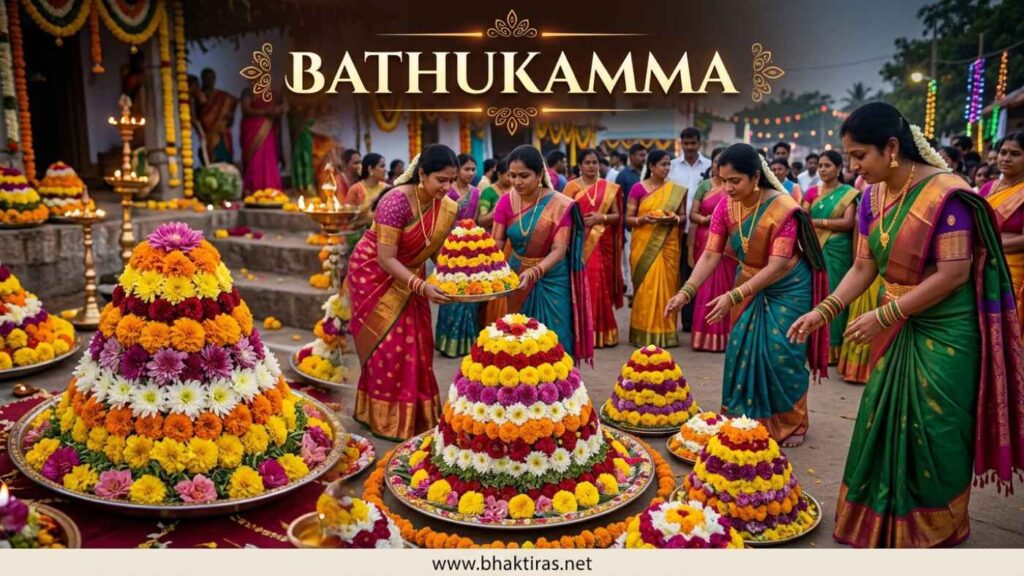
Bathukamma is the flower festival of Telangana, nine evenings when women turn the last of the monsoon’s blooms into a living offering to the goddess. Working with tangedu, gunugu, marigold and lotus, they build a conical stack of flowers on a brass plate, crown it with a small turmeric Gauri, and gather in courtyards to circle it with songs and rhythmic claps. The name means “come alive, Mother Goddess”. It begins on Mahalaya Amavasya and ends on Durgashtami, just before Dussehra.
Bathukamma 2026-2028: Dates & Calendar
Bathukamma runs for nine days and always ends on Durgashtami, so the whole span shifts with the lunar calendar each year. The next full celebration falls in early October 2027.
| Year | Nine-day span | Final day (Saddula Bathukamma) | Notes |
|---|---|---|---|
| 2026 | 10-18 October (approx) | Sunday, 18 October | Ends on Durgashtami; Day 1 around Mahalaya Amavasya |
| 2027 | 30 September – 8 October (approx) | Friday, 8 October | Next occurrence |
| 2028 | 18-26 September (approx) | Tuesday, 26 September | Falls earlier in September this year |
The most important evening is the last one, Saddula Bathukamma, when the tallest and most elaborate stacks are made and the whole community turns out. The first day is known as Engili Pula Bathukamma and the arrangements grow larger as the nine days go on.
Why Bathukamma Is Celebrated
Bathukamma celebrates the goddess Gauri as the giver of life, marks the end of the monsoon, and honours the bond between women. The flowers, gathered when the countryside is at its most colourful, become a shared prayer for health, marriage and family wellbeing.
The goddess who comes alive
“Bathukamma” translates as “come alive, Mother Goddess”. Gauri, a gentle form of Parvati, is invoked as the deity of life and fertility. Women pray for the long life of their families and, unmarried girls especially, for a good husband and a happy home.
A festival by and for women
Unlike temple-centred festivals, Bathukamma belongs to women in the courtyard. Mothers, daughters, sisters and neighbours build the stacks together and dance in a circle as equals. For married women visiting their parents’ village, it is also a yearly reunion.
Thanks to the land and water
The festival lands just as the monsoon eases and ponds and fields brim over. The flowers used are wild and seasonal, and floating the Bathukamma on water at the end returns the blooms to the ponds that fed them. It reads as a quiet act of gratitude to nature.
A story of loss and homecoming
One folk tradition links Bathukamma to a daughter of the region who was lost and whose return was prayed for with flowers and song. Whatever the retelling, the emotional core is constant: care for one’s own, and the wish that the goddess keep the household safe.
Deities & Figures Worshipped
The central deity of Bathukamma is Gauri, worshipped in the form of the flower stack itself with a turmeric figure of the goddess placed on top.
Gauri (Maha Gauri)
Gauri, the fair and benevolent aspect of Parvati, is the presiding goddess. She is honoured as Bathukamma, the life-giving mother. A small mound of turmeric shaped into the goddess sits at the summit of the flower stack and is the focus of the evening prayers.
Durga / the Devi
Because the ninth and grandest day, Saddula Bathukamma, coincides with Durgashtami, the festival flows into the wider worship of Durga during Navratri. Many families see Bathukamma and the goddess of Navratri as the same divine mother in different moods.
Key Rituals, Step by Step
Each of the nine evenings follows the same warm rhythm, building towards the grand final night. Here is how a typical Bathukamma evening unfolds.
- Gather the flowers. During the day, families collect seasonal blooms – yellow tangedu, gunugu, marigold, chrysanthemum, lotus and more. The tangedu, a bright yellow wild flower, is the signature of the festival.
- Build the stack. On a wide brass or bronze plate, flowers are arranged in tight concentric rings by colour, rising into a neat cone. Each ring is pressed flat so the stack stands tall and steady.
- Crown it with Gauri. A small turmeric mound shaped into the goddess is placed at the very top, sometimes with a pinch of vermilion. This makes the flower stack an image of Bathukamma herself.
- Dress and assemble. Women put on their best sarees and jewellery and carry their Bathukammas to a shared courtyard or open space, where all the stacks are set down together in a circle.
- Sing and dance. Standing around the flowers, the women clap in rhythm and move in a circle, singing traditional Bathukamma songs that pass from verse to verse, each woman leading a line.
- Offer and share. Prayers are made to the goddess for the family’s wellbeing, and prasadam such as maleeda and sweet-and-savoury snacks is shared among everyone present.
- Carry in procession. After the singing, the women lift their Bathukammas onto their heads and walk together, often singing, towards the nearest pond, lake or river.
- Float on water. The flower stacks are gently set afloat on the water, releasing the blooms back to nature and marking the close of that evening’s worship. On Saddula Bathukamma this final immersion is the emotional high point of the whole festival.
Special Foods of Bathukamma
Food is central to the sharing spirit of Bathukamma, with sweet offerings made for the goddess and distributed among the women who gather.
Maleeda
The signature Bathukamma prasadam. Roti or flatbread is crumbled and mixed with jaggery and ghee into soft, fragrant balls. It is offered to the goddess and then shared among everyone at the gathering.
Sakinalu
Crisp, spiralled rice-flour snacks flavoured with sesame seeds, a much-loved Telangana speciality made in large batches during the festival season and offered to guests.
Sweet pindi vantalu
An assortment of home-made sweets and savouries prepared from rice flour and jaggery, laid out on the final days and exchanged between neighbours and relatives.
Seasonal fruits and jaggery
Simple offerings of fruit, puffed rice and jaggery are placed before the Bathukamma, keeping the festival’s food humble, seasonal and rooted in the harvest.
Where Bathukamma Is Celebrated
Bathukamma is the cultural signature of Telangana, though Telugu communities elsewhere keep it alive too.
Telangana
The festival’s home, celebrated across every district with special fervour in Warangal, Karimnagar, Hyderabad and the rural heartland. The Telangana government has made Bathukamma a state festival, with public grounds, decorations and cultural programmes.
Parts of Andhra Pradesh
Telugu families in the border areas of Andhra Pradesh also make Bathukammas, sharing the songs and the flower stacks though the scale is smaller than in Telangana.
Telugu diaspora
Wherever Telangana families have settled – other Indian cities and abroad – women recreate Bathukamma in community halls and gardens, adapting to whatever seasonal flowers they can find and keeping the songs and circle dance intact.
Bathukamma Do's and Don'ts
A few gentle customs help keep the spirit of the festival.
Do
- Use fresh, seasonal flowers, keeping tangedu and gunugu at the heart of the stack
- Build the arrangement in clean, even rings so it stands steady
- Wear traditional dress and join the circle with your neighbours
- Learn a Bathukamma song or two so you can lead a line
- Choose a clean pond or lake for the immersion and be gentle with the water
Avoid
- Do not use plastic or artificial flowers, which defeat the festival’s link to nature
- Avoid pollutants like thermocol, glitter or paint on the stack that harm the water
- Do not rush the singing and dancing; the gathering is the point, not the finish
- Avoid turning it into a display contest at the cost of the shared, joyful mood
- Do not leave litter or leftover materials at the waterside after the immersion
Frequently Asked Questions
When is Bathukamma in 2027?
Bathukamma 2027 runs for nine days, from around 30 September to 8 October 2027, with the grand final day, Saddula Bathukamma, on Friday 8 October. The exact start can vary slightly by local panchang, as the festival follows the lunar month of Ashwin.
When is Bathukamma in 2026 and 2028?
Bathukamma 2026 is celebrated from around 10 to 18 October 2026, ending on Durgashtami. In 2028 it falls earlier, from around 18 to 26 September. Because the festival is tied to the lunar calendar, these nine-day spans shift each year and should be confirmed against a regional calendar.
What does Bathukamma mean?
Bathukamma means “come alive, Mother Goddess” in Telugu. It is both the name of the festival and the name given to the conical stack of flowers, which is worshipped as a living form of the goddess Gauri.
Which goddess is worshipped during Bathukamma?
Bathukamma honours Gauri, a gentle form of the goddess Parvati, worshipped as the giver of life. She is represented by a small turmeric figure placed at the top of the flower stack. As the festival ends on Durgashtami, it also connects with the wider worship of Durga.
How is the Bathukamma flower stack made?
The Bathukamma is built on a wide brass plate by arranging seasonal flowers in tight concentric rings, sorted by colour, into a tall cone. Signature blooms include yellow tangedu and gunugu, along with marigold and lotus. A turmeric image of Gauri is placed on top.
Why is Bathukamma a festival of women?
Bathukamma is led entirely by women, who build the flower stacks, sing the traditional songs and dance in a circle around them. It celebrates womanhood and the bond between mothers, daughters, sisters and neighbours, and is also a yearly homecoming for married women visiting their parents’ village.
Why are the flowers floated on water?
On each evening, and grandly on the final Saddula Bathukamma, the flower stacks are carried in procession and gently set afloat on ponds and lakes. This returns the seasonal blooms to the water that nourished them, marking gratitude to nature and the monsoon’s end.
How is Bathukamma related to Dussehra?
Bathukamma runs through the nine days of Ashwin and ends on Durgashtami, which falls within Sharad Navratri just before Dussehra. So the festival flows straight into the goddess worship of Navratri and closes the day before Vijayadashami.
May the goddess bloom bright in your courtyard this year. Bathukamma Bathukamma Uyyalo!