
Ratha Saptami 2027 – The Sun God's Birthday and His Turning Chariot
रथ सप्तमी
When is Ratha Saptami (Bhanu Saptami) in 2027?
Ratha Saptami falls on Saturday, 13 February 2027. Also called Surya Jayanti or Magha Saptami, it marks the day the Sun god Surya turns his seven-horse chariot towards the northern sky. When this Saptami lands on a Sunday, as it did on 25 January 2026, it is called Bhanu Saptami, since Bhanu is another name for the Sun.
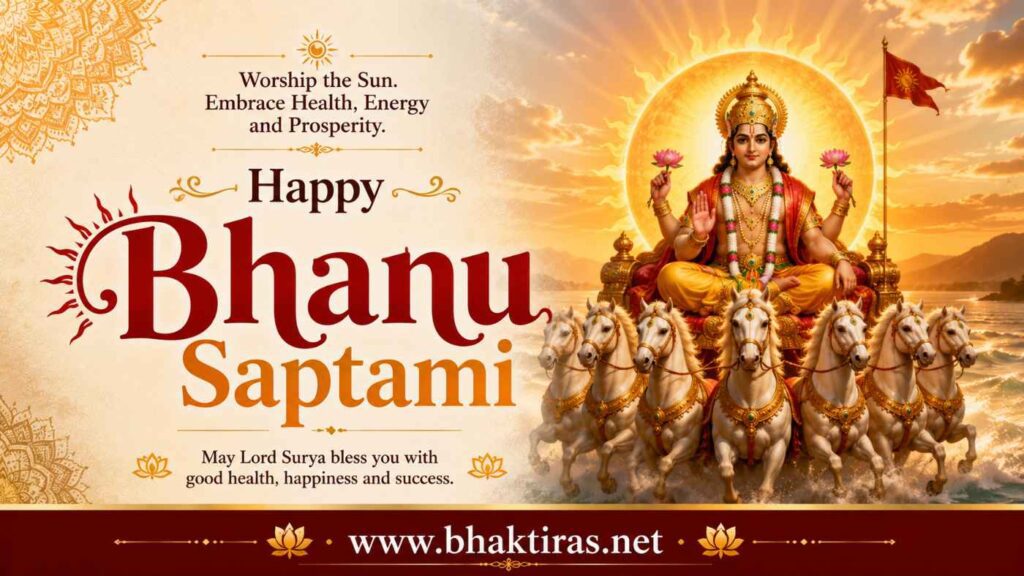
Ratha Saptami honours Surya, the Sun god, on the seventh day of the bright fortnight of Magha. Hindu tradition treats it as Surya’s birthday, the moment his golden chariot (ratha), pulled by seven horses and steered by the dawn-charioteer Aruna, swings northward and lengthens the days. Devotees wake before first light for a ritual bath, carry arka leaves on the head and shoulders, and offer water to the rising sun. When the tithi coincides with a Sunday, the Sun’s own weekday, it carries the added name Bhanu Saptami.
Ratha Saptami 2026-2028: Dates & Calendar
The next Ratha Saptami is on Saturday, 13 February 2027. The date shifts each year because it follows the Hindu lunar calendar – it is always the seventh tithi of the waxing moon in the month of Magha.
| Year | Date | Day | Notes |
|---|---|---|---|
| 2026 | 25 January | Sunday | Fell on a Sunday – observed as Bhanu Saptami |
| 2027 | 13 February | Saturday | Next occurrence |
| 2028 | 3 February | Thursday | Magha Shukla Saptami |
The heart of the observance is the pre-dawn bath, so families check the local Arunodaya (first light) and sunrise times for their city, since the arghya is offered as the sun’s disc clears the horizon.
Why Ratha Saptami Is Celebrated
Ratha Saptami celebrates Surya’s symbolic birthday and the turning of his chariot towards the northern hemisphere, which begins the season of longer, warmer days and the approach of spring.
The Sun's birthday
Many traditions count this Saptami as the day Surya was born, or the day his radiance first spread over the world. That is why it also carries the name Surya Jayanti. The worship is thanksgiving for light, warmth and the ripening of crops.
The chariot turns north
The word ratha means chariot. On this day Surya’s chariot, drawn by seven horses that stand for the seven colours of light and the seven days of the week, is said to wheel towards the north. Longer days follow, which farmers have long read as the promise of harvest.
Health and healing
Surya is honoured in the Vedas as a giver of health and eyesight. The dawn bath and the arghya are believed to clear illness and past faults, which is why the day is treated as one of the more auspicious for charity, fasting and starting good habits.
Bhanu Saptami's extra grace
When the tithi falls on a Sunday, the weekday already ruled by the Sun, it becomes Bhanu Saptami and is considered especially fruitful for Surya worship. The overlap is not fabricated by the calendar-makers; it simply happens some years, as it did in January 2026.
Deities & Figures Worshipped
The day belongs to Surya, but the imagery around his chariot brings in two more figures who ride with him at dawn.
Surya
The Sun god, source of light, time and the seasons. He is pictured on a chariot of gold, red-robed, holding lotuses, with the whole visible sky as his domain. Prayers ask him for health, clear sight, energy and steady good fortune.
Aruna
The charioteer of the Sun, the personification of the reddish glow just before sunrise. He sits ahead of Surya, so devotees who rise in that first pink light feel they are greeting the god as his chariot approaches.
The seven horses
Surya’s chariot is pulled by seven horses, often read as the seven colours that make up sunlight or the seven notes and seven days. They give the festival its name – ratha, the chariot they draw across the sky.
Key Rituals, Step by Step
The core of Ratha Saptami happens in the short window between first light and full sunrise, so most of the ritual is done before the day properly begins.
- Rise before dawn. Devotees wake in the Brahma Muhurta and prepare for the holy bath while it is still dark, aiming to finish as the sun rises.
- Bathe with arka (ekka) leaves. Seven leaves of the arka (calotropis) plant are placed on the head, shoulders and knees, and the person bathes in a river, tank or at home. The seven leaves echo the seven horses of the chariot.
- Offer Arghya to the rising sun. Standing facing east, the devotee pours water from cupped hands or a small vessel towards the rising sun, often through the fingers so it catches the light, while reciting the Surya mantra or Gayatri.
- Draw the Sun’s chariot. A rangoli or kolam of Surya’s chariot with its seven horses is drawn at the doorway or in the courtyard, sometimes coloured red and gold.
- Cook milk-pongal facing the sun. In South India, milk is boiled in a new pot in the open, and it is considered auspicious when it boils over towards the sun – a sign of abundance. The pongal is then offered to Surya.
- Worship at home and at Surya temples. A lamp, red flowers, jaggery and fruit are offered before an image of Surya. Many visit sun temples such as Konark or the Suryanarayana temples, where the day draws large crowds.
- Fast, give and pray. Some keep a partial fast until the midday worship, and the day is thought a good one for charity, feeding the needy and offering prayers for the health of the family.
Special Foods of Ratha Saptami
Because the festival centres on the sun and the coming harvest, the food is simple, warm and often cooked in the open air.
Chakkara Pongal
Sweet pongal made of newly harvested rice, milk and jaggery, cooked outdoors so it can boil over towards the sun. It is the signature offering, later shared as prasad.
Milk-pongal / Ksheerannam
Rice cooked in milk that is deliberately allowed to spill over the pot. The overflow, spreading towards the rising sun, is read as a blessing of plenty for the household.
Jaggery and sesame sweets
Til and gur preparations are common in the Magha cold season, offered to Surya and eaten for their warming quality.
Seasonal fruit and red flowers
Red hibiscus, red flowers and fresh winter fruit are placed before Surya, red being the colour linked with the Sun and with Aruna’s dawn light.
Regional Names & Variations
Though Ratha Saptami is observed across India, the sun temples of the south and east and the temple towns of Andhra and Tamil Nadu keep it with the greatest colour.
Tamil Nadu
Known as Ratha Saptami or Surya Jayanti, it is marked with dawn baths, arka-leaf rituals and milk-pongal boiled facing the sun. Suryanarayana temples hold special abhishekams.
Andhra Pradesh & Telangana
A major Surya day, with early baths, chariot rangolis and pongal offerings. Sun temples and the great Tirumala temple observe it with early-morning worship.
Odisha & East India
The Konark Sun Temple region and Odia households honour Surya on this day, tying the festival to the coast’s long tradition of sun worship.
Karnataka & Maharashtra
Homes draw the seven-horse chariot at the threshold and offer arghya at sunrise, with the day noted in the panchang as Magha Saptami.
North India
Observed more quietly as Achala Saptami or Magha Saptami, with a holy bath, sun-worship and charity, and remembered as Surya’s birthday.
Ratha Saptami Do's and Don'ts
The day rewards an early start and a simple, sincere worship of the sun.
Do
- Rise before sunrise and finish the holy bath as the sun comes up
- Offer Arghya (water) facing the rising sun in the east
- Place arka leaves on head and shoulders during the bath if you keep the old custom
- Draw the Sun’s seven-horse chariot at your doorway
- Share pongal or a meal as charity and prasad
Avoid
- Do not skip the pre-dawn timing – the bath and arghya are meant for sunrise
- Do not treat it as only a South-Indian custom; Surya worship is pan-Indian
- Do not invent muhurat times – check your city’s sunrise in a reliable panchang
- Do not waste the boiled-over pongal; it is offered and shared, not discarded
- Do not confuse it with the chariot festival of Puri (Ratha Yatra), which is a different festival for Jagannath
Frequently Asked Questions
When is Ratha Saptami in 2027?
Ratha Saptami is on Saturday, 13 February 2027. It falls on Magha Shukla Saptami, the seventh day of the bright fortnight of the Hindu month of Magha, and is dedicated to the Sun god Surya.
When is Ratha Saptami in 2026 and 2028?
In 2026 Ratha Saptami was on Sunday, 25 January, and because it fell on a Sunday it was observed as Bhanu Saptami. In 2028 it falls on Thursday, 3 February. The date moves each year as it follows the lunar Magha Shukla Saptami tithi.
What is the difference between Ratha Saptami and Bhanu Saptami?
They are the same Surya festival. It is simply called Bhanu Saptami in years when Magha Shukla Saptami falls on a Sunday, because Bhanu is a name for the Sun and Sunday is the Sun’s weekday, which makes the day especially auspicious for sun worship.
Why is Ratha Saptami celebrated?
Ratha Saptami is celebrated as the birthday of Surya, the Sun god, and marks the day his seven-horse chariot turns towards the north, bringing longer and warmer days. Devotees give thanks for light and harvest and pray to Surya for health and good fortune.
Which god is worshipped on Ratha Saptami?
The Sun god Surya is worshipped on Ratha Saptami, which is why it is also called Surya Jayanti. His charioteer Aruna and the seven horses that draw his chariot feature in the imagery and rituals of the day.
What are the main rituals of Ratha Saptami?
The main rituals are a pre-dawn holy bath, often with seven arka (ekka) leaves on the head and shoulders, and offering Arghya (water) to the rising sun facing east. Families also draw the Sun’s chariot in rangoli, cook milk-pongal that boils over towards the sun, and worship at Surya temples such as Konark.
Why is milk boiled over on Ratha Saptami?
In South India milk is boiled in a new pot in the open on Ratha Saptami, and when it boils over towards the rising sun it is seen as a sign of abundance and blessing for the home. The milk-pongal is then offered to Surya and shared as prasad.
Is Ratha Saptami the same as the Puri Ratha Yatra?
No. Ratha Saptami is a one-day Sun-worship festival in the month of Magha, dedicated to Surya. The Ratha Yatra is a separate summer chariot festival for Lord Jagannath at Puri; the two share only the word ratha, meaning chariot.
May Surya’s turning chariot bring you longer, brighter days ahead – Surya Namaskar.