
Sharad Purnima 2026 – The Night the Moon Rains Nectar
शरद पूर्णिमा
When is Sharad Purnima in 2026?
Sharad Purnima falls on Monday, 26 October 2026. It is the full-moon night of the month of Ashwin, when the moon is at its brightest and, by tradition, showers down cooling amrit (nectar). Families set out bowls of kheer under the open sky overnight and eat it the next morning as blessed prasad.
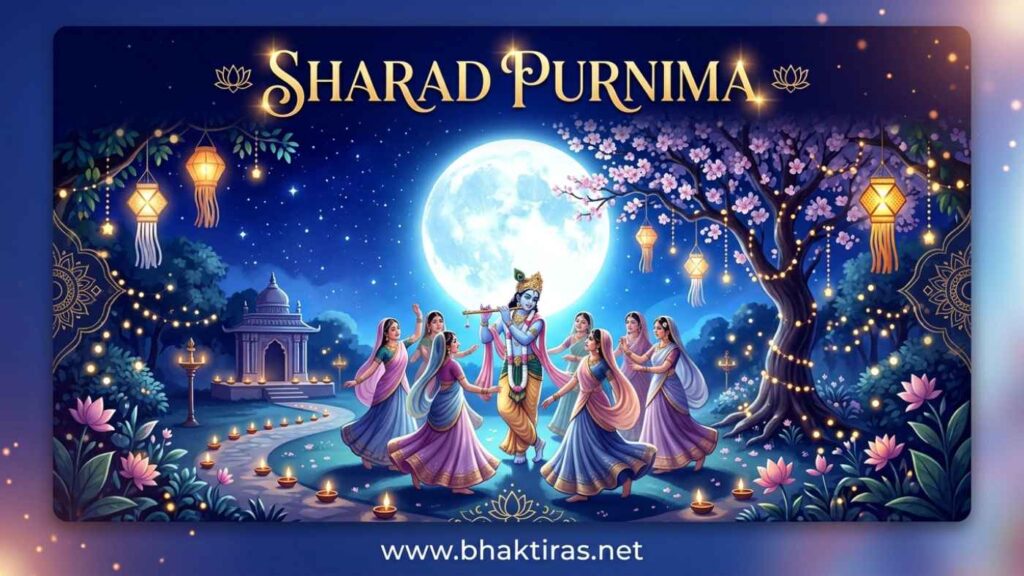
Sharad Purnima is the full-moon night of Ashwin (October), the first clear full moon after the rains have gone. Old belief holds that on this one night the moon is complete in all its sixteen kalas and lets fall amrit, a healing nectar, so families leave bowls of kheer out in the moonlight to soak up its cool light before eating it at dawn. In Bengal and Odisha the same night becomes Kojagari Lakshmi Puja, a vigil kept for the goddess of fortune; in Braj it is Raas Purnima, the night of Krishna’s great dance with the gopis.
Sharad Purnima 2026-2028: Dates & Calendar
The next Sharad Purnima is on 26 October 2026. The date shifts each year because it follows the Hindu lunar calendar – the full moon (Purnima) of the month of Ashwin, which lands in September or October.
| Year | Date | Day | Notes |
|---|---|---|---|
| 2026 | 26 October | Monday | Next occurrence – Ashwin Purnima |
| 2027 | 15 October | Friday | Purnima tithi from 14 Oct evening |
| 2028 | 14 October | Thursday | Ashwin full moon |
The kheer is kept out only once the moon has fully risen, so the ritual belongs to the night rather than to a fixed clock time. Because the Purnima tithi can straddle two calendar days, some panchangs list the moonrise date and others the tithi-start date; the moonlit night is what people observe.
Why Sharad Purnima Is Celebrated
Sharad Purnima marks the moon at its brightest, believed to pour down nectar, and it opens the autumn festival season that leads towards Diwali. It carries three overlapping meanings across India: healing moonlight, the worship of Lakshmi, and Krishna’s Raas Leela.
The night of nectar
This is held to be the one full moon of the year when Chandra, the moon, shines in all sixteen kalas or divisions, and his rays are thought to carry amrit. Milk-based kheer left uncovered in that light is believed to absorb a cooling, restorative quality – a folk idea tied to the season, when the heavy monsoon has just ended and the air first turns crisp.
Kojagari Lakshmi
In Bengal and Odisha the night belongs to Goddess Lakshmi. The name comes from her question, “Ko jagarti?” – “Who is awake?” She is said to walk the earth this night and grant fortune to whoever keeps watch for her, so households stay up through the vigil with lamps lit and the door left open.
Raas Purnima in Braj
In Vrindavan, Mathura and the wider Braj region this is Raas Purnima, remembered as the night Krishna danced the Maha-Raas with the gopis under an autumn full moon, multiplying himself so each dancer felt he was beside her alone. Temples hold night-long kirtan and Raas performances.
The turn of the season
Sharad Purnima closes the monsoon and opens sharad ritu, the clear autumn weeks before Diwali. For farmers it also falls near the ripening of the year’s crop, which is why some regions call it Navanna or Kaumudi Purnima and offer the new harvest.
Deities & Figures Worshipped
Sharad Purnima honours Goddess Lakshmi and Chandra the moon across most of India, with Krishna and Radha at its centre in the Braj region.
Lakshmi
The goddess of wealth and wellbeing is the chief deity of the Bengali and Odia observance. Devotees keep an all-night vigil, light lamps and offer her the season’s first fruits and sweets, hoping to be found awake when she asks who is watching.
Chandra (the Moon)
The moon deity is worshipped directly on this night, since it is his light that is believed to carry nectar. Offerings of kheer and flowers are made to Chandra, and the whole ritual of moonlit prasad rests on his brightness.
Krishna & Radha
In Vrindavan and Mathura the night is Krishna’s Raas Purnima. Radha-Krishna temples stay open late for kirtan and Raas Leela, marking the divine dance that this full moon is said to have witnessed.
Key Rituals, Step by Step
The heart of Sharad Purnima is simple: cook kheer, leave it under the full moon, and share it as prasad. The Kojagari vigil and moon worship build around that.
- Cook the kheer. Through the evening, prepare rice or vermicelli kheer with milk, sugar and cardamom – the classic Sharad Purnima offering.
- Clean and light the space. Sweep the courtyard or terrace and light lamps or diyas, especially where Lakshmi is worshipped as Kojagari.
- Wait for the full moon. Once the moon has fully risen, carry the kheer to an open terrace, courtyard or window where the moonlight falls directly on it.
- Leave it in the moonlight. Place the bowl uncovered (or under a thin muslin cloth) so the rays reach it, and let it sit through the night to absorb the moon’s cooling light.
- Keep the vigil (jagran). In Bengal and Odisha, stay awake for Kojagari Lakshmi Puja – offer her kheer, fruit and betel, play games or sing through the night, and keep the door open for the goddess.
- Offer to the deity. Present the moonlit kheer first to Lakshmi, Chandra or Krishna as bhog, along with flowers and incense.
- Share as prasad. The next morning, distribute and eat the kheer as blessed prasad, believed to carry the moon’s healing quality.
Special Foods of Sharad Purnima
One dish defines the night – milk kheer left in the moonlight – joined by regional sweets and the season’s fresh produce.
Kheer / Rice Payasam
Rice simmered slowly in milk with sugar, cardamom and often almonds and raisins. Cooked in the evening and set out under the full moon overnight, it is the one food no Sharad Purnima is without, eaten as prasad the next morning.
Coconut & poha offerings
For Kojagari Lakshmi Puja, the goddess is offered flattened rice (chira/poha), coconut, jaggery, sweets and the season’s fruit, laid out through the night vigil.
Makhana kheer
Fox-nut (makhana) kheer is a popular variant for the night, light and often prepared for those keeping a partial fast before the moonlit prasad.
New-harvest rice
Where the festival marks the ripening crop, dishes made from the season’s fresh rice are prepared and offered first to the deity as thanks for the harvest.
Regional Names & Variations
The same full moon carries different names and moods across India, from a quiet moonlight ritual to a night-long Lakshmi vigil.
Bengal & Odisha
Here it is Kojagari Purnima or Kojagari Lakshmi Puja – the most elaborate form of the festival. Families keep an all-night vigil for Lakshmi, decorate the home with alpana rangoli, light lamps and offer chira, coconut and sweets, staying awake to be found watching by the goddess.
Braj (Mathura-Vrindavan)
Celebrated as Raas Purnima, the night of Krishna’s Maha-Raas. Radha-Krishna temples hold night-long kirtan and Raas Leela, and devotees gather under the full moon that the divine dance is said to have taken place beneath.
North & West India
In much of the north and west it is the classic moonlit-kheer night: bowls of kheer left out to catch the moon’s rays, eaten at dawn for health, with worship of Lakshmi and the moon at home.
Odisha – Kumar Purnima
Odisha also keeps it as Kumar Purnima, honouring Kartikeya (Kumara). Young girls worship the sun at dawn and the moon at night, offering the season’s fruits and observing playful traditions for a good match and wellbeing.
Sharad Purnima Do's and Don'ts
A few simple customs keep the night’s spirit, whether you observe the kheer ritual or the Kojagari vigil.
Do
- Cook the kheer fresh in the evening and set it under the open sky once the full moon has risen.
- Keep a lamp lit and, for Kojagari Puja, leave the door open through the vigil for Lakshmi.
- Offer the moonlit kheer first to the deity as bhog before eating it.
- Share the prasad kheer the next morning with family and neighbours.
- Spend the night in worship, kirtan or quiet watching if you keep the jagran.
Avoid
- Do not cover the kheer with a heavy lid – the rays are meant to reach it (a thin cloth against dust is fine).
- Do not eat the moonlit kheer before offering it to the deity.
- Avoid sleeping through the Kojagari vigil if you have taken the vow to keep watch.
- Do not treat the night as a fixed clock event – wait for the actual moonrise.
- Avoid quarrels and harsh speech through this auspicious night of Lakshmi.
Frequently Asked Questions
When is Sharad Purnima in 2026?
Sharad Purnima is on Monday, 26 October 2026. It falls on the full-moon night of the Hindu month of Ashwin, when the moon is believed to be at its fullest and to shower down nectar.
When is Sharad Purnima in 2027 and 2028?
Sharad Purnima falls on Friday, 15 October 2027 and on Thursday, 14 October 2028. The date changes each year because it follows the lunar calendar – always the Purnima (full moon) of the month of Ashwin.
Why is kheer kept in the moonlight on Sharad Purnima?
Kheer is left under the full moon on Sharad Purnima because the moon is believed to shower amrit, a cooling and healing nectar, on this one bright night. The milk pudding is thought to absorb this quality, and it is eaten the next morning as prasad said to benefit health.
What is Kojagari Purnima?
Kojagari Purnima is the Bengali and Odia form of Sharad Purnima, kept as a night-long vigil for Goddess Lakshmi. The name comes from her question “Ko jagarti?” – “Who is awake?” – as she is said to bless those found keeping watch for her through the night.
Which god is worshipped on Sharad Purnima?
Goddess Lakshmi and Chandra, the moon, are worshipped on Sharad Purnima across most of India. In the Braj region around Mathura and Vrindavan, Krishna and Radha are honoured, as the night marks Krishna’s Maha-Raas dance.
What is Raas Purnima?
Raas Purnima is the name for Sharad Purnima in the Braj region, marking the night Krishna is said to have danced the Maha-Raas with the gopis under the autumn full moon. Radha-Krishna temples hold night-long kirtan and Raas Leela on this night.
Why is the Ashwin full moon considered special?
The Ashwin full moon of Sharad Purnima is the first clear full moon after the monsoon, when the sky turns crisp and the moon is held to be complete in all sixteen kalas. This is why its light is believed to carry nectar and healing power.
How is Sharad Purnima celebrated?
Sharad Purnima is celebrated by cooking kheer and leaving it in the moonlight overnight, then eating it as prasad. In Bengal and Odisha families keep an all-night Kojagari vigil for Lakshmi, and in Braj devotees join night-long kirtan for Krishna’s Raas Leela.
May the light of the Sharad full moon bring you health, calm and fortune – shubh Sharad Purnima.