
Shesha Naga
शेष
Shesha Naga is the primordial thousand-hooded serpent of Hindu cosmology, the couch on whose coils Lord Vishnu reclines in cosmic sleep between the ages of creation. Called Ananta, the endless one, and Shesha, the remainder, he upholds all the worlds upon his hoods and serves Vishnu with utter devotion.
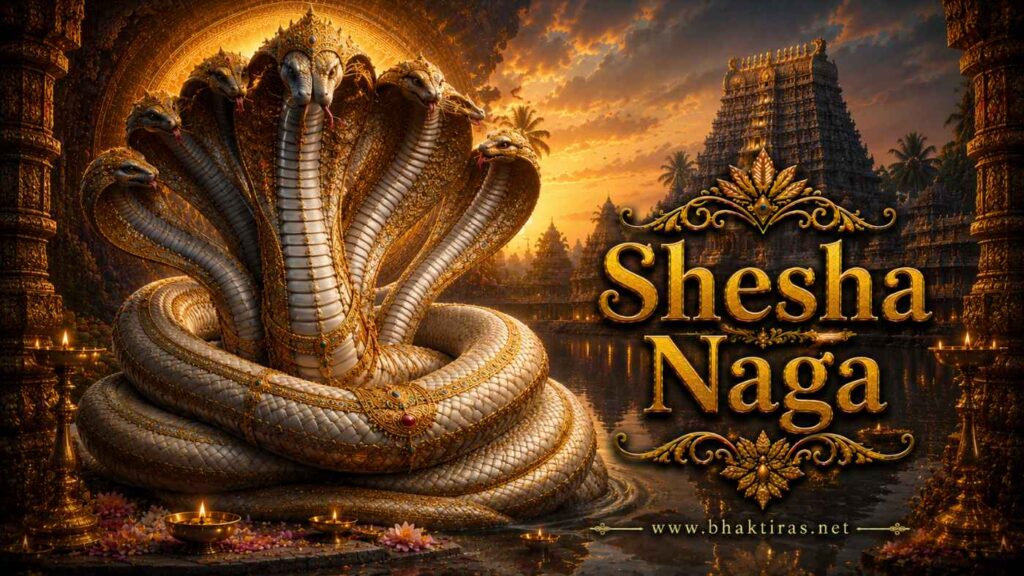
Who Is Shesha Naga
Before the sun and the stars, before the dry land rose from the waters, there was a serpent floating upon the endless ocean of milk. His coils were folded one upon another like the layers of a sleeping mountain, and upon that living bed rested Lord Vishnu, wrapped in yoga-nidra, the deep sleep of the divine. This serpent is Shesha, the great naga whose thousand hoods spread above the sleeping god like a canopy of raised heads, each one turned inward toward the one he loves.
Shesha belongs to the oldest layer of Hindu memory. The Puranas and the Mahabharata name him the eldest son of the sage Kashyapa and his wife Kadru, and so the firstborn and the king of all serpents. Where his younger brothers grew wild and venomous, Shesha turned away from the quarrels of his kin. He chose stillness, meditation and single-minded service instead.
He is not a god who acts through drama or conquest. His power is the power of holding, of bearing weight without complaint across ages that have no measure. When people speak of a support that never tires, a patience that never breaks, a foundation beneath everything visible, they are describing the nature of Shesha.
To understand him is to understand two ideas the tradition treasures: that something eternal underlies the changing world, and that the highest strength can look like quiet, faithful service rather than force.
Ananta, the Endless One
Shesha carries two names, and each opens a different window onto who he is. The first is Ananta, which means the endless or the infinite. He is called this because his coils have no reckoning and his length has no far shore. However far the mind travels along his body, there is always more serpent beyond. He is a picture of that which cannot be exhausted, the eternity that outlasts every counting.
The second name is Shesha itself, which means the remainder or that which is left over. At the end of a cosmic age comes pralaya, the dissolution, when the worlds fold back into the waters and even time seems to pause. Everything that was made returns to the unmade. Yet something is not destroyed. What remains, floating on the shoreless deep while the universe waits to be born again, is Shesha. He is the leftover that is never used up, the ground that stays when all the building has been swept away.
Put together, the two names hold a single truth. Beneath the world of coming and going there is a base that neither comes nor goes. Ananta-Shesha is that base given a face and a form, so that the human heart, which cannot love an idea, can love a companion of Vishnu instead.
The Couch of Vishnu
The most beloved image of Shesha is also the most peaceful. On the Kshira Sagara, the ocean of milk, Lord Vishnu lies at ease upon the serpent’s coils. His eyes are half closed, his body dark as a rain-cloud, his consort Lakshmi pressing his feet beside him. This posture has a name of its own, Anantashayana or Sheshashayana, the reclining upon Ananta.
Here Shesha is more than furniture. He is a chosen servant who has made his own body into a resting place for the one he adores. His coils are the mattress, his raised hoods are the parasol that shades the sleeping god, and the gentle sway of his breathing rocks Vishnu through the long night between the worlds. When creation is to begin again, a lotus rises from Vishnu’s navel bearing Brahma, and the new cycle unfolds. Through all of it Shesha simply holds and waits.
Devotees see in this a lesson about the shape of true devotion. Shesha asks for no throne and no worship of his own. His joy is to be near, to be useful, to be the quiet ground on which the divine can rest. To serve without seeking reward, and to find that service itself is the reward, is the wisdom his coiled body teaches.
Bearer of the Worlds
There is a second, mightier way the tradition pictures Shesha. In this vision he does not merely cradle a sleeping god. He carries the whole of creation. The Puranas describe him coiled deep beneath the lowest of the underworlds, in a region called Patala, holding the earth and all the planets steady upon a single one of his many hoods.
The scale of it is meant to overwhelm. The mountains, the oceans, the seven worlds above and below, the wheeling stars, all of it rests as lightly on Shesha as a mustard seed on the palm of a hand. He bears this burden without strain, and the texts say that when he grows weary and shifts even slightly, the ground trembles and earthquakes ripple across the land. So even the great movements of the earth are gathered into his story.
This is why Shesha is honoured as the foundation of the cosmos, the still support on which the noisy, moving world depends. It is a humbling picture. Everything a person builds, everything that seems solid underfoot, is finally held up by a patience deeper than sight, a strength that neither boasts nor rests. In Shesha the tradition places the unshakable ground beneath a shaking world.
The Incarnations of Shesha
Shesha’s devotion to Vishnu is so complete that he refuses to be parted from him, not even across the ages. When Vishnu descends to the earth as an avatar, Shesha descends alongside him, taking a human form so that he can go on serving. Three of these descents are dear to the tradition, and each shows a different colour of his faithfulness.
- As Lakshmana, the younger brother of Rama in the Ramayana. When Vishnu came as Rama, Shesha came as the brother who followed him into fourteen years of forest exile, who stood guard through sleepless nights, and who loved Rama past his own comfort or safety. The devoted couch of Vishnu became the devoted brother of Rama.
- As Balarama, the elder brother of Krishna, also called Sankarshana. In Krishna’s story Shesha is the fair, plough-bearing brother of immense strength, steady where Krishna is playful, the calm elder presence beside the divine cowherd.
- As the sage Patanjali by an old tradition, the compiler of the Yoga Sutras. In this telling the serpent who upholds the worlds also gave humanity the discipline of yoga, folding cosmic support into a path the seeker can walk. This is why Patanjali is sometimes shown with a serpent’s coils below the waist and many hoods above.
Across all three, one thread holds. Whether as brother, as strength, or as teacher, Shesha’s role is to stand beside the divine and support its work in the world.
Iconography and Symbols
Artists across India have returned to Shesha for centuries, and a few features mark him wherever he appears.
The Many Hoods
Shesha is shown with a crown of raised serpent hoods, most often numbered as a thousand or simply beyond counting. Fanned open above Vishnu, they form a living canopy. Each hood is a reminder of his endlessness and of the countless worlds he shelters.
The Coiled Body
His long body is wound into layered coils that make a bed, a seat or a spiral throne. The coils speak of containment and of cycles that fold back upon themselves, the same folding that leaves him as the remainder when an age dissolves.
Vishnu at Rest
The defining image places Vishnu asleep upon the coils, Lakshmi at his feet, a lotus rising from his navel. Shesha here is servant, bed and guardian at once, his whole form arranged around the comfort of the one he loves.
The White Serpent
Shesha is usually painted a pale, luminous white, set apart from ordinary nagas. The colour marks his purity and his link to the milk-white ocean on which he floats, gleaming softly in the dark before creation.
How Shesha Is Honoured
Shesha rarely receives temples of his own, yet he is present in worship wherever the serpent-powers, the nagas, are revered. As their king he is honoured within the wider tradition of naga devotion that runs across the whole of India.
- On Nag Panchami, the serpent festival of the monsoon month of Shravan, devotees offer milk, flowers and prayers to the nagas, and Shesha as their sovereign is remembered first among them.
- In Vishnu temples the reclining Anantashayana form is worshipped, and to bow before the sleeping Vishnu is also to bow before the serpent who upholds him.
- Serpent stones and naga shrines beneath sacred trees, common in South India and beyond, carry offerings meant for the naga world of which Shesha is the crowned lord.
- Practitioners of yoga honour him through the figure of Patanjali, opening their study with a verse of salutation to the sage who wears the serpent’s hoods.
- The name Ananta is chanted in the litanies of Vishnu, so that every recitation of the god’s thousand names brushes against the endless serpent who never leaves his side.
Prayers and Mantras
Because Shesha is endless and steady, his mantras are called upon for patience, for stability in an unsettled life, and for the strength to serve without seeking reward. The simplest and most widely spoken salutation is this.
ॐ अनन्ताय नमः
Om Anantaya Namah
Salutations to Ananta, the endless one.
To say these words is to remember that beneath every changing thing there is a ground that does not change, and to ask that some of that steadiness settle into the one who prays. Devotees also invoke him for protection from the fear of serpents, for release from the venom of anxiety, and for the calm, unhurried faith that Shesha embodies as he holds the worlds and waits.
Frequently Asked Questions about Shesha Naga
Who is Shesha Naga?
Shesha Naga is the primordial thousand-hooded serpent of Hindu cosmology and the king of the nagas. Lord Vishnu reclines upon his coils in cosmic sleep on the ocean of milk between the cycles of creation. Shesha upholds all the worlds on his hoods and serves Vishnu with complete devotion as his bed, canopy and companion.
Why is Shesha called Ananta?
Ananta means the endless or the infinite. Shesha is given this name because his coils and his length have no measure and no far end, however far the mind travels along his body. The name marks him as a symbol of eternity, the unending base that outlasts every cycle of creation and dissolution.
Why is he called Shesha, the remainder?
Shesha means the remainder, that which is left over. At the end of a cosmic age comes pralaya, the dissolution, when all the worlds fold back into the waters. Everything made returns to the unmade, yet Shesha alone remains, floating on the deep. He is what stays when all else has passed away.
Which avatars are incarnations of Shesha?
By tradition Shesha incarnates alongside Vishnu's avatars so as never to be parted from him. He is born as Lakshmana, the devoted brother of Rama, and as Balarama, the elder brother of Krishna, also called Sankarshana. He is also honoured as the sage Patanjali, the compiler of the Yoga Sutras.
What is the relationship between Shesha and Vishnu?
Shesha is the utterly devoted servant of Vishnu. He offers his own body as Vishnu's couch on the ocean of milk, his hoods as a shading canopy, and follows him into the world as sandals, companion and brother across the ages. Their bond is the tradition's model of loving, selfless service.
Who are the parents of Shesha?
Shesha is named the eldest son of the sage Kashyapa and his wife Kadru, and so the firstborn and king of all the nagas. Where his younger serpent brothers were quarrelsome, Shesha turned to meditation and devotion, withdrawing from their strife to serve Lord Vishnu instead.
What does Shesha symbolise?
Shesha stands for eternity, patience, cosmic support and steadfast service. As the endless serpent he is the ground that holds the universe and the remainder that survives every dissolution. His life teaches that the highest strength can take the form of quiet, faithful service rather than force or display.
May the endless one who holds the worlds without weariness lend you his patience and his quiet, unshakable calm.