
Lord Balarama
बलराम
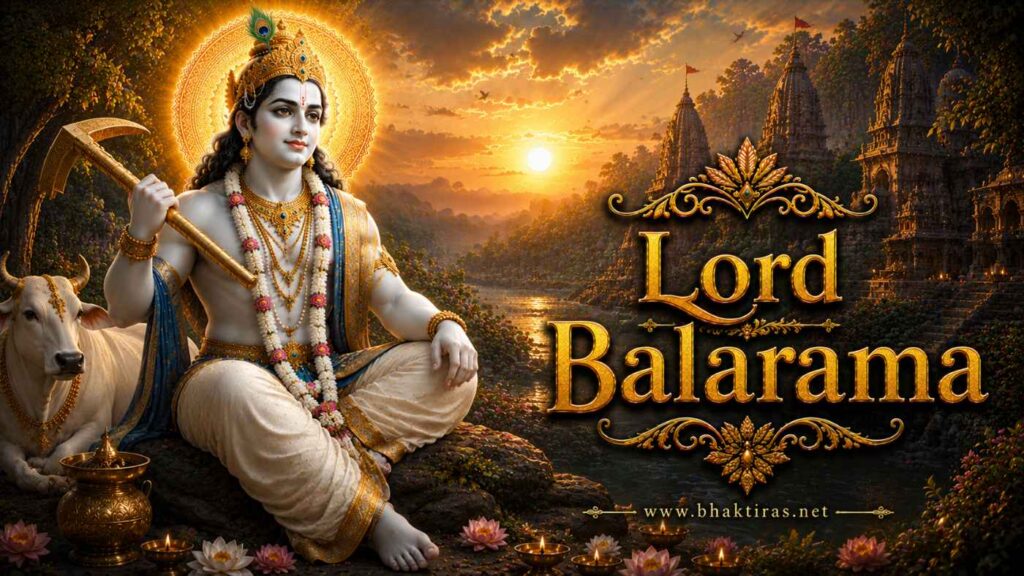
Lord Balarama is the elder brother of Krishna, a fair-skinned deity of immense strength who carries the plough and the mace. Revered as an avatar of the cosmic serpent Shesha and known as Sankarshana, he is worshipped as Dauji in the Braj region and enshrined beside Krishna and their sister Subhadra at Puri.
Who Is Lord Balarama
Lord Balarama walks through the Krishna story as the steady presence beside the flute-player everyone remembers. Where Krishna is dark as a rain cloud, Balarama is fair as moonlight; where Krishna charms with cleverness, Balarama moves the world with the simple weight of his strength. He is the elder brother, the one who watches over Krishna from the cradle in Gokul to the marble halls of Dwarka, and Hindu tradition holds the two of them as two halves of a single divine purpose.
His very name carries his gift. Bala means strength, and so Balarama is the Rama of strength, a being whose power is spoken of in the same breath as the mountains he is said to have shifted with his plough. He is worshipped as an avatar of Shesha, the endless serpent on whom Vishnu reclines across the ocean of eternity, which is why devotees feel in him something ancient and unshakable, a foundation on which the divine play of Krishna rests.
Yet for all his might, the stories keep his heart soft. He is loyal past reason, tender with those he loves, quick to anger when wronged but quicker still to forgive his brother. Farmers pray to him because he lifted the plough and made it holy. Wrestlers and warriors honour him because he taught the greatest fighters of his age. Across the Braj villages he is simply Dauji, the big brother, and that affectionate name says as much about him as any scripture.
To know Balarama is to understand that gentleness and power are not opposites. He shows that the strongest one in the room can also be the most devoted, the most protective, and the most quietly kind.
The Avatar of Shesha
Long before he was born as a boy in Mathura, Balarama existed as Shesha, also called Ananta and Adishesha, the thousand-headed serpent whose coils form the resting couch of Lord Vishnu. In the cosmic imagery of the Puranas, when Vishnu sleeps upon the milky ocean between the ages, it is Shesha who cradles him, holding the sleeping Lord and the weight of all creation upon his hoods. He is the ground beneath the ground, the support that never tires.
When Vishnu chose to descend as Krishna to lighten the earth’s burden, Shesha came with him, unwilling to be parted from the one he serves. This descent is remembered as Sankarshana, a name that means ‘the one who was drawn across’, for the divine child was transferred from Devaki’s womb to Rohini’s before his birth. In this way the serpent of eternity took human shape as the elder brother, so that Krishna would never be alone in the world.
Because of this origin, Balarama is often shown with a canopy of serpent hoods spreading above his head, a quiet reminder of who he truly is. Devotees who understand this see in him the very stability of the universe made warm and personal, the eternal support who chose to become family.
Elder Brother and Companion of Krishna
The bond between Balarama and Krishna is one of the tenderest in all of Hindu lore. Both were sons of Vasudeva, born in the shadow of the tyrant Kamsa, who had sworn to kill Devaki’s children. To save the elder child, the unborn Balarama was mystically drawn into the womb of Rohini, Vasudeva’s other wife, and so he came into the world in safety. Soon after, the infant Krishna too was carried across the Yamuna to Gokul, and the two brothers grew up together in the care of Nanda and Yashoda.
Their childhood in the pastures of Braj is a garland of shared adventures. They herded cattle side by side, wrestled with cowherd friends, and faced the demons Kamsa sent one after another. When Krishna danced on the hood of the serpent Kaliya, it was Balarama who watched over him from the bank. When the boys uprooted the twin arjuna trees, they did it together. Balarama’s strength was always the shield behind Krishna’s daring.
Later, when the family founded the shining city of Dwarka by the western sea, the brothers ruled and lived as one heart in two bodies. Through wars and weddings, through the long Mahabharata years, Balarama remained Krishna’s confidant, sometimes disagreeing, once even torn over which side to support in the great war, yet never for a moment less than devoted. To picture Krishna without Balarama is to picture a story missing its steady older hand.
The Wielder of the Plough and Mace
No image of Balarama is complete without his two great weapons. In one hand he carries the Hala, the plough, and in the other the Gada, the heavy mace. From the plough come his loving titles Haladhara and Halayudha, ‘the plough-bearer’ and ‘the one whose weapon is the plough’. It is a strange and beautiful choice of arms, for the plough is a farmer’s tool, an instrument of harvest rather than of war, and this ties Balarama forever to the soil, to agriculture, and to the abundance of the fields.
His strength was the stuff of legend. The Puranas tell of how he once dragged the entire river Yamuna toward himself with his plough when its waters would not come at his call, bending the landscape to his will. In another tale he tossed aside the demon Dhenukasura with bare hands. Such feats gave him a reputation as the mightiest of his age, a giant whose power was matched only by his temper when he was crossed.
As master of the mace he became the teacher of the two greatest mace-fighters in the world, and here lay one of his private sorrows. He trained Duryodhana of the Kauravas and Bhima of the Pandavas, and loved them both. When the two finally faced each other in their terrible duel at the end of the great war, Balarama could not bear to choose between his students, and he left on pilgrimage rather than watch. His teaching shaped the outcome of an age, even as his heart refused to take a side.
Balarama and Revati
The tale of Balarama’s marriage to Revati is one of the most charming in the Puranas. Revati was the daughter of King Kakudmi, a ruler so proud of her beauty and virtue that he could find no suitor worthy of her. Seeking guidance, he took Revati to the realm of Brahma to ask the creator himself which prince she should wed. But time flows differently in the higher worlds, and while father and daughter waited only a short while there, many ages passed upon the earth below.
When Brahma finally heard the request, he smiled and gently explained that every prince Kakudmi had considered was long dead, their very dynasties turned to dust across the yugas. The world had changed beyond recognition. Brahma advised the king to give Revati in marriage to Balarama, who was present upon the earth in that later age as Krishna’s elder brother.
There was one small difficulty. Revati, born in an earlier era when people were taller, towered over the men of the new age. With a gentle touch of his plough, Balarama pressed lightly upon her so that she came down to the stature of the time, and the two were happily wed. Their story, tender and a little wondrous, shows Balarama as the patient husband whose strength was always used with care.
Dauji of Braj, Balabhadra of Puri
Across the villages and towns of Braj, Balarama is worshipped with deep affection as Dauji, an endearment that simply means ‘elder brother’. The great temple at Baldeo near Mathura draws crowds who come to seek his blessing, and here he is loved not as a distant god but as the protective big brother of the region, watching over Krishna’s homeland. Farmers of the area feel a special closeness to him, for the deity of the plough is also the deity of their harvests.
Far to the east, in the coastal town of Puri in Odisha, Balarama takes his place in one of the most famous shrines in all of India. Here he is called Balabhadra, and he stands enshrined beside his brother Krishna, worshipped as Jagannath, and their beloved sister Subhadra. During the grand Rath Yatra, when the three deities ride out on towering chariots through streets thick with devotees, Balabhadra rides in his own great chariot, tall and white, leading the way for his younger siblings.
These two homes of worship, one in the west and one in the east, show how far his devotion reaches. Whether as the affectionate Dauji of the northern plains or the majestic Balabhadra of the eastern coast, he is honoured everywhere as the elder who protects, provides, and never leaves his family’s side.
Iconography & Symbols
Fair Complexion
Balarama is almost always shown with a fair, moonlike complexion, a deliberate contrast to the dark blue of Krishna. The two brothers together, one bright and one dark, form a striking pair that devotees describe as day beside night, each completing the other.
The Plough (Hala)
The plough resting on his shoulder is his most distinctive emblem, marking him as the deity of agriculture and abundance. It is a weapon of peace and provision, tying him to the earth, the fields, and the honest labour that feeds the world.
The Mace (Gada)
In his other hand he holds the heavy mace, the sign of his unmatched martial skill. As the teacher of the finest mace-fighters of his age, the Gada speaks of a power that could shatter armies yet was guided by discipline and loyalty.
The Serpent Hood
Above his head a canopy of serpent hoods often spreads, revealing his true nature as the avatar of Shesha, the cosmic serpent. This quiet detail reminds the worshipper that the strong elder brother is also the eternal support of all creation.
How Lord Balarama Is Worshipped
Devotees honour Balarama both alongside Krishna and in his own dedicated observances. His worship carries a distinctly earthy, familial warmth, celebrated by farmers, families praying for the wellbeing of their children, and all who seek strength tempered with gentleness.
- Balarama Jayanti marks his birth anniversary, falling on the sixth day of the bright fortnight in the month of Shravana. Devotees fast, sing his praises, and visit temples such as Dauji at Baldeo to celebrate the coming of the mighty elder brother.
- Hala Shashthi, also known as Balarama Shashthi or Lalahi Chhath, is observed especially by mothers who fast for the long life and welfare of their children. On this day the plough of Balarama is honoured, and rituals connected to farming and family blessings take centre stage.
- Rath Yatra at Puri carries Balabhadra out in his own towering chariot alongside Jagannath and Subhadra, one of the most beloved public festivals in India, drawing millions who wait to glimpse the three siblings ride through the streets.
- Daily worship in Braj keeps him close as Dauji, where devotees offer prayers, sweets, and affection to the protective elder brother of their beloved Krishna.
In every form of his worship the same feeling returns: gratitude for a strength that shelters rather than threatens, and love for a brother who is always near.
Prayers & Mantras
Chanting the name of Balarama is said to fill the heart with courage and steadiness. His simple mool mantra is easy to remember and can be repeated during daily prayer, before beginning any task that calls for strength, or as a quiet offering of devotion to the elder brother of Krishna.
Devanagari: ॐ बलरामाय नमः
Transliteration: Om Balaramaya Namah
Meaning: I bow to Lord Balarama, the mighty elder brother of Krishna, the bearer of the plough and the eternal support of all creation. May his strength protect me and his loyalty inspire me.
Frequently Asked Questions about Lord Balarama
Who is Lord Balarama?
Lord Balarama is the elder brother of Krishna, a fair-complexioned deity celebrated for his immense strength. He is revered as an avatar of the cosmic serpent Shesha, carries the plough and mace, and is worshipped as Dauji in Braj and as Balabhadra beside Jagannath at Puri.
Is Balarama an avatar of Vishnu?
Balarama is primarily understood as an avatar of Shesha, the serpent on whom Vishnu rests. Some traditions also count him among the Dashavatara, listing him as the eighth or, in place of the Buddha, the ninth avatar of Vishnu, so he is deeply linked to Vishnu in both roles.
Why does Balarama carry a plough?
The plough, called Hala, ties Balarama to agriculture, the soil, and the abundance of the harvest, which is why farmers hold him dear. It gives him the names Haladhara and Halayudha, and legend says he once used it to draw the river Yamuna toward himself.
What is Balarama's relationship to Krishna?
Balarama is Krishna's elder brother and inseparable companion. Both were sons of Vasudeva, and they grew up together in Gokul and Vrindavan under Nanda and Yashoda. Through the childhood pastimes and the Dwarka years, Balarama remained Krishna's protector and closest confidant.
Who was Balarama's wife?
Balarama married Revati, daughter of King Kakudmi. In a well-loved Puranic tale, Revati was born in an earlier age and stood far taller than the people of Balarama's time, so with a gentle touch of his plough he brought her to the stature of that era before their happy marriage.
Why is Balarama called Dauji?
Dauji is an affectionate name meaning 'elder brother', used across the Braj region where Balarama is worshipped as Krishna's protective older sibling. The famous temple at Baldeo near Mathura is dedicated to him, and devotees there relate to him with the warmth reserved for family.
How is Balarama worshipped at Puri?
At the Jagannath Temple in Puri, Balarama is enshrined as Balabhadra beside his brother Jagannath and their sister Subhadra. During the grand Rath Yatra he rides out in his own towering chariot, leading the procession that draws millions of devotees each year.
May Lord Balarama, the gentle giant of loyalty and might, bless your home with strength, abundance, and the unshakable love of family.