
Rishi Kashyapa
कश्यप
Rishi Kashyapa is one of the Saptarishi and a Prajapati, a lord of creatures. Son of the sage Marichi and grandson of Brahma, he married several daughters of Daksha and through them fathered the devas, asuras, nagas, birds and countless creatures. For this reason he is honoured as the father of nearly all living beings.
Who Is Rishi Kashyapa
Rishi Kashyapa holds a place at the very root of Hindu cosmology. He is counted among the Saptarishi, the seven great seers who anchor dharma across the ages, and he is also a Prajapati – a lord of creatures charged with the work of filling the worlds with life. Few figures in the Vedas and Puranas carry as wide a shadow, because so many streams of living beings are traced back to his household.A grandson of Brahma
Kashyapa was born to the sage Marichi, one of the mind-born sons of Brahma. This makes him a grandson of the creator himself, standing only a generation removed from the origin of the cosmos. His descent places him among the earliest sages, active when the shape of the created order was still being settled.
Sage and progenitor together
What sets Kashyapa apart is that he is both a rishi and a father of races. Many seers are remembered for their austerities or their hymns; Kashyapa is remembered above all for his offspring. Through him the gods, the anti-gods, the serpents and the winged creatures all entered the world, which is why later texts simply call him the father of beings.
The Father of All Beings
The title Prajapati, ‘lord of creatures’, is earned in the Puranas through Kashyapa’s marriages. Daksha, another Prajapati, gave many of his daughters to Kashyapa, and each union opened a different line of creation. The result is a family tree that reaches into almost every corner of the living world.A household of many wives
The Puranas name thirteen or more daughters of Daksha as wives of Kashyapa, among them Aditi, Diti, Danu, Kadru, Vinata, Arishta, Surasa, Ira, Muni and Krodhavasha. Each carried a distinct temperament, and each became the mother of a distinct family of creatures. In this way a single sage stands behind gods and demons, serpents and birds, cattle and forest animals alike.
Why he is called the father of beings
Because so many classes of life descend from these unions, Kashyapa is spoken of as the common ancestor of the created order. The Mahabharata and the Puranas return again and again to his name when they explain where a race of beings came from. He is less a figure of dramatic adventures than a fixed point in genealogy – the source from which the lists of living kinds are drawn.
The Ancestor of Devas and Asuras
The clearest way to see Kashyapa’s importance is to follow his wives and the children each of them bore. The devas and the asuras, eternal rivals in Hindu myth, are here shown as cousins born of the same father through different mothers.- With Aditi he fathered the Adityas, the shining devas – including Surya the sun and, in a later age, Vishnu himself descending as the dwarf Vamana.
- With Diti he fathered the Daityas, a race of powerful asuras who stood in opposition to the gods.
- With Danu he fathered the Danavas, another great line of asuras.
- With Kadru he fathered the nagas, the serpent races who dwell in the waters and the underworld.
- With Vinata he fathered Garuda, the mighty eagle who bears Vishnu, and Aruna, the dawn charioteer of the sun.
Kashyapa and the Land of Kashmir
One of the most enduring traditions about Kashyapa ties his name to the valley of Kashmir. The old story explains not only how the land came to be habitable, but how it came to be called by his name.The great lake Satisar
According to the tradition preserved in works like the Nilamata Purana, the valley of Kashmir was once a vast lake called Satisar, held by a water-demon named Jalodbhava who tormented the surrounding people. The waters made the land unusable, and no settlement could take hold while the demon ruled the lake.
The draining of the waters
Kashyapa, moved by the suffering, undertook great effort and, with divine help, had the mountains cut open so the lake could drain away. Once the waters ran off, the demon was destroyed and fertile land was revealed. Grateful tradition named the valley Kashyapa-mira, ‘the lake of Kashyapa’, and from this, it is held, the name Kashmir descends.
The Kashyapa Gotra
In the world of ritual and family identity, Kashyapa’s name lives on through the gotra system, which traces households back to a founding sage.A lineage claimed by many
The Kashyapa gotra is one of the most widely held of all Brahmin lineages, and it is claimed across many regions and communities. When a person of this gotra recites their descent in ritual, they name Kashyapa among their pravaras, the ancestral seers invoked to establish who they are before the sacred fire.
Why the lineage spread so far
The breadth of the gotra fits the character of Kashyapa in the texts. A sage remembered as the father of so many kinds of beings naturally became the claimed ancestor of a very large human family as well. To this day, marriages within the gotra are avoided, since members regard themselves as kin descended from the same rishi.
Iconography & Symbols
Kashyapa is not worshipped through a fixed temple image the way the great gods are, but tradition and art give him a recognisable form, along with symbols that recall his nature as a sage and a father.The form of an elder seer
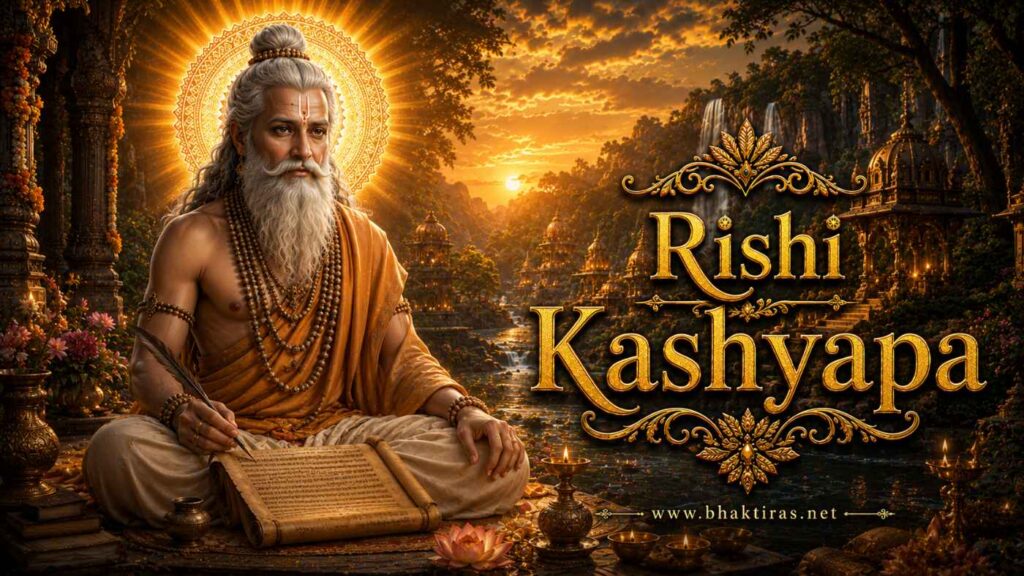
He is pictured as an aged and serene ascetic, with matted hair coiled on his head, a long white beard, and rudraksha beads about his neck. His body is often lean from austerity, and his expression is calm – the look of one who has seen the beginning of things.
The water pot and the scroll
A kamandalu, the ascetic’s water pot, marks his life of penance, while a palm-leaf manuscript or scroll marks his standing as a keeper of sacred knowledge. Some depictions place him in a hermitage setting, surrounded by animals and birds, a reminder that all creatures count him as their ancestor.
The tortoise association
The name Kashyapa is traditionally linked with the tortoise, and this connection gives him a further layer of meaning as a steady, deep-rooted figure – patient, enduring, and bearing the weight of many worlds of descendants upon him.
How Rishi Kashyapa Is Remembered
The memory of Kashyapa reaches far beyond a single festival or shrine. It survives in genealogy, in place-names, in ritual speech and in the great story-collections of the tradition.- As one of the Saptarishi, whose names are recited among the seven stars of the Great Bear and invoked in daily worship.
- As the claimed ancestor of the widespread Kashyapa gotra, named at weddings and sacred rites across India.
- As the sage behind the name of Kashmir, through the story of the draining of Satisar.
- As a recurring authority in the Puranas and the Mahabharata, cited whenever the descent of gods, demons and creatures is explained.
- As a model of the sage-householder, whose greatness lies in giving life to the world rather than in renouncing it.
Prayers & Mantras
Devotees who honour the Saptarishi, or who belong to the Kashyapa lineage, remember him with a simple salutation. The mantra below offers reverence to the great progenitor sage.Kashyapa Mantra
ॐ कश्यपाय नमः – Om Kashyapaya Namah. ‘I bow to Kashyapa.’ This short salutation is offered in reverence to the sage as one of the seven seers and as the ancestor of beings. It is fitting for those who honour the Saptarishi or who trace their descent through the Kashyapa gotra.
Frequently Asked Questions about Rishi Kashyapa
Who is Rishi Kashyapa?
Rishi Kashyapa is one of the Saptarishi and a Prajapati, a lord of creatures. He is the son of the sage Marichi and grandson of Brahma. Through his marriages to daughters of Daksha he became the father of the devas, asuras, nagas, birds and many other classes of beings.
Why is Kashyapa called the father of beings?
He earned this title because so many races of creatures descend from him. Each of his wives bore a different family of beings – Aditi the devas, Diti the asuras, Kadru the nagas, Vinata the birds. Since these lines cover almost all living kinds, tradition honours Kashyapa as their common ancestor.
Who were the wives of Rishi Kashyapa?
The Puranas name several daughters of Daksha as his wives, including Aditi, Diti, Danu, Kadru and Vinata, among others. Each became the mother of a distinct family of creatures, which is how a single sage came to stand behind gods, demons, serpents and birds.
Is Kashmir named after Kashyapa?
Tradition holds that it is. According to old accounts, the valley was once a lake called Satisar, which Kashyapa had drained to make the land habitable. The valley was then called Kashyapa-mira, 'the lake of Kashyapa', and from this the name Kashmir is said to descend.
How is Kashyapa related to the gods?
The devas are his children through his wife Aditi and are called the Adityas. Surya the sun is among them, and Vishnu is said to have taken birth as the dwarf Vamana as a son of Kashyapa and Aditi. In this sense the sage is a direct ancestor of the shining gods.
What is the Kashyapa gotra?
The Kashyapa gotra is a lineage that traces its descent to the sage Kashyapa. It is one of the most widely claimed of all Brahmin gotras, recited in rituals and named at weddings. Members regard one another as kin, so marriage within the gotra is traditionally avoided.
In which texts does Rishi Kashyapa appear?
Kashyapa appears across the Vedas, the major Puranas and the Mahabharata. These works cite him when they explain the descent of gods, demons and creatures, and they preserve the stories of his marriages, his offspring and his connection to the land of Kashmir.
From a single hermitage sprang the gods, the demons and the creatures of the world – and in that wide family, Rishi Kashyapa is remembered as the patient father of them all.