
Goddess Aditi
अदिति
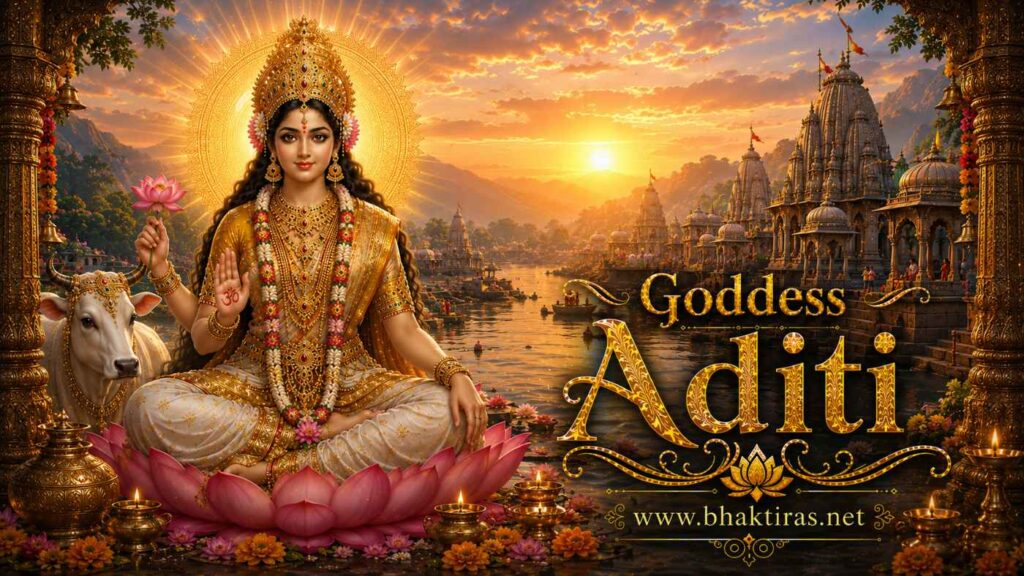
Aditi is the great mother goddess of the Rigveda, whose name means the boundless and the limitless. She is the cosmic mother of the Adityas, the shining solar gods, and is called Devamata, mother of the devas. Devotees invoke her for protection, forgiveness, the wellbeing of children, and release from every kind of bondage.
Who Is Goddess Aditi?
Among the earliest deities named in the Rigveda, Aditi holds a place that is quiet and enormous at once. Her hymns do not describe a battle or a weapon; they reach instead for the widest thing the poets could imagine – the open sky, the space without walls, the freedom that has no edge. That is what her name carries. Aditi means the unbounded, the limitless, the one who cannot be tied.She is a mother above all else. From her are born the Adityas, the shining sons who become the sun, the guardian of cosmic order, the god of friendship, and more. For this reason the tradition calls her Devamata, the mother of the gods. To speak of Aditi is to speak of the ground on which the whole family of light stands – the space that holds the stars, the width that lets the day open, the freedom in which a soul can breathe.
Where later goddesses are painted with clear faces and named attributes, Aditi stays closer to an idea made tender. The Vedic seers turned to her when they wanted forgiveness for a fault, safety for a child, or release from a bond they could not break themselves. She answers not by force but by openness – by making room.
The Boundless One – Goddess of Infinity
The heart of Aditi is hidden in her name, and the name is worth pausing over.The word breaks into two parts. Diti means that which is divided, cut, bound, or given limits. Add the prefix a- and it reverses into its opposite: a-diti, that which is undivided, uncut, without bound. So her very name is a denial of every fence. She is what remains when you remove all the walls a mind can build.
The Rigveda leans into this openly. In one famous verse the poet piles image on image to reach her fullness: Aditi is the sky, Aditi is the air between, Aditi is the mother and the father and the son; Aditi is all the gods, Aditi is what has been born and what is yet to be born. It is not confusion. It is the deliberate speech of people trying to point at infinity with human words – and admitting that no single word will hold her.
To worship Aditi, then, is to worship space itself as something living and kind. She is the room that lets everything else exist. The sun can only rise because there is sky for it to rise into. A prayer can only be offered because there is a listener wide enough to receive it. That receiving wideness is her nature.
Mother of the Adityas
If Aditi is infinity, the Adityas are what infinity gives birth to – the ordered, shining powers that govern the moral and natural world.The Adityas are her sons, and the tradition counts them in different numbers across different texts – sometimes seven, sometimes eight, and in the later reckoning twelve, one for each month of the sun’s year. Among them stand some of the greatest names of the Vedic sky. Surya, the sun himself. Varuna, keeper of cosmic law and the guardian of oaths. Mitra, the lord of friendship and agreement. Aryaman, patron of custom and marriage. Bhaga, giver of good fortune. Each is a face of order, and each is a child of the boundless mother.
There is a well-loved story of her eighth son, Martanda, who was born imperfect and cast away, then taken up again to become the sun – a reminder that even what seems flawed can be lifted into light. And in the later Puranic vision, Aditi’s motherhood reaches its highest point when Vishnu himself is born to her as Vamana, the dwarf who grows to span the three worlds in three strides. In that telling she is the mother not only of the solar gods but of the Preserver of the universe, come down at her prayer to restore what an overreaching king had taken.
The pattern is clear across all these tales. Aditi does not act by striking; she acts by giving birth. Her power is generative. The bright, law-keeping, world-saving gods all flow out of her boundlessness the way rivers flow from a mountain that never runs dry.
Aditi and Diti – Mothers of Gods and Asuras
Aditi is rarely spoken of alone in the Puranas. Beside her stands her sister Diti, and between the two women the whole balance of the cosmos is set.Both are daughters of Daksha and both are wives of the sage Kashyapa, and from these two sisters the two great families of the mythic world descend. From Aditi come the Adityas, the devas, the shining ones who uphold order. From Diti come the daityas, the powerful asuras who so often stand against them. The names themselves tell the story: Aditi the unbounded, Diti the bounded and divided. One is openness, the other is grasping.
This is not simply a tale of good against evil. The sisters are two sides of a single reality. Creation needs both the expansive force that lets things flourish and the contracting force that gives them shape and struggle. The endless contest between deva and asura – churning the ocean, warring over the three worlds – is in a sense the long argument between two mothers, each raising her children to their own nature.
Devotees who turn to Aditi are, in the language of this myth, choosing the side of unboundedness. They ask to be counted among her children – to live in freedom and light rather than in the divided, hungry, bound condition that Diti’s line represents.
Freedom and Release from Bondage
For all her cosmic size, Aditi meets the ordinary worshipper at a very human place: the wish to be free of what holds us down.The Vedic hymns to her return again and again to the language of loosening and release. She is asked to free the singer from sin, from sickness, from debt, from the tightening grip of guilt. Her name for this is deeply fitting – the unbound one is exactly the goddess you call on when you feel bound. She is invoked to widen a narrow place, to open a locked door, to set a captive at liberty.
This release works on several levels at once, and the tradition never separates them cleanly. There is physical freedom – from illness, from danger, from confinement. There is moral freedom – forgiveness for a wrong done, the lifting of the weight of a fault. And there is the deepest freedom of all, release from the bonds of karma and the narrowness of a small self, the liberation that lets the soul rest in something as wide as the sky.
She is also, tenderly, a protector of children and of the household’s wellbeing. A mother this vast is a safe one. Parents in the old texts commend their little ones to her keeping, trusting that the goddess who holds the stars can surely hold a child. In her, protection and freedom are the same gift, because to be truly kept safe is to be given room to grow.
Iconography & Symbols
Aditi belongs to an age older than the great sculptural traditions, so she has no single fixed image the way later goddesses do. Her symbols are drawn instead from the wide, elemental things she is.The Open Sky
Her clearest symbol is space itself – the unwalled sky and the air between earth and heaven. Where a later deity holds an emblem in her hand, Aditi is the emblem: the boundless expanse in which all forms appear.
The Cow
The Vedas often speak of Aditi as a great cow, the nourishing mother whose milk feeds the gods. The cow stands for abundance without limit, a giving that never empties – a fitting form for the mother of the shining ones.
Light and the Sun
As mother of the Adityas and of Surya, she is bound up with light and the dawn. Sunrise is in a quiet way her signature, the daily proof that the boundless keeps bringing forth the bright.
The Serene Mother
In later devotional imagery she is shown as a calm, seated maternal figure, gentle-faced and generous, sometimes with her divine sons gathered near – openness given a mother’s warmth.
How Goddess Aditi Is Remembered
Aditi is honoured less through grand festivals than through the deep respect of scripture and the quiet prayers of those who seek freedom and forgiveness. Her presence runs beneath much of Hindu worship, even where her name is not spoken aloud.- In the hymns of the Rigveda: She is invoked in some of the oldest verses of the tradition, praised as the boundless mother and asked to loosen the bonds of sin and sorrow.
- As Devamata: Wherever the Adityas or Surya are worshipped, Aditi is remembered as their source – the mother behind the shining gods.
- In the Vamana story: During the telling of Vishnu’s dwarf avatar, she is honoured as the mother whose prayer brought the Preserver down to earth.
- In prayers for children: Parents commend the safety and wellbeing of their little ones to her, trusting the vast mother who guards the young.
- In seeking release: Those burdened by guilt, illness, or hardship turn to her name for forgiveness and for freedom from what binds them.
- In the Puranas: Later texts weave her into the great genealogies of gods and sages, keeping alive her role as the ancestress of the devas.
Prayers & Mantras
To pray to Aditi is to open oneself to space and to ask, gently, to be made free. Her mantras are simple, meant to be repeated in a calm mind while turning toward light. The core invocation honours her as the boundless mother and source of the gods.- ॐ अदित्यै नमः
Om Adityai Namah
Salutations to Aditi, the boundless mother. A short daily invocation of her protection and grace. - ॐ देवमात्रे नमः
Om Devamatre Namah
Salutations to the mother of the gods, honouring her as the source of the shining ones. - अदितिर्द्यौरदितिरन्तरिक्षम्
Aditir dyaur aditir antariksham
‘Aditi is the heaven, Aditi is the mid-air’ – the great Rigvedic verse that names her as all things, recited in praise of her infinity.
Recited with attention, these words are less a request for a thing than a turning of the heart toward openness. In calling on the unbound one, the worshipper asks to become a little less bound.
Frequently Asked Questions about Goddess Aditi
Who is Goddess Aditi?
Aditi is a great mother goddess of the Rigveda whose name means the boundless or limitless. She is the cosmic mother of the Adityas, the solar gods, and is called Devamata, mother of the devas. She personifies infinity, the sky, freedom, and release from every bondage, and is invoked for protection and forgiveness.
Who are the children of Aditi?
Aditi is the mother of the Adityas, the shining solar deities. Among them are Surya the sun, Varuna the guardian of cosmic law, Mitra the lord of friendship, Aryaman, and Bhaga. In later texts Vishnu himself is born to her as the dwarf avatar Vamana, making her the mother of the Preserver.
What is the difference between Aditi and Diti?
Aditi and Diti are sisters, both wives of the sage Kashyapa. Aditi, the unbounded, is mother of the devas, the gods of light and order. Diti, whose name means the bounded or divided, is mother of the daityas or asuras. Together the two sisters embody the balance between openness and constraint in creation.
What does the name Aditi mean?
The name Aditi comes from the prefix a-, meaning 'not', joined to diti, meaning 'bound' or 'divided'. So Aditi means the unbounded, the undivided, the limitless one. Her name is itself a denial of every limit, which is why she personifies infinity, freedom, and the open sky.
Who is the husband of Goddess Aditi?
Aditi is the wife of the great sage and Prajapati Kashyapa. Through their union she becomes the mother of the Adityas and the ancestress of the gods. Her sister Diti is also married to Kashyapa and becomes, by contrast, the mother of the asuras.
Why is Aditi called Devamata?
Devamata means 'mother of the gods'. Aditi earns this title because the devas, especially the solar Adityas, are born from her. She is the boundless source from which the shining, order-keeping gods emerge, so the tradition honours her as their common mother and origin.
What do devotees pray to Aditi for?
Devotees invoke Aditi for protection, forgiveness, and freedom. She is asked to release people from sin, sickness, debt, and every kind of bondage, whether physical, moral, or karmic. She is also a guardian of children and household wellbeing, trusted as the vast mother who keeps the young safe.
May Goddess Aditi, the boundless mother, hold you in her wide and gentle keeping, and loosen every bond that keeps your heart from the light.