
Goddess Diti
दिति
Diti is a Vedic goddess, a daughter of Daksha and wife of the sage Kashyapa. She is the mother of the Daityas, a line of asuras that includes Hiranyakashipu and Hiranyaksha. Sister of Aditi, she embodies the earthward, material pull that balances the devas, and by her grace her lost sons became the Maruts, the storm-gods.
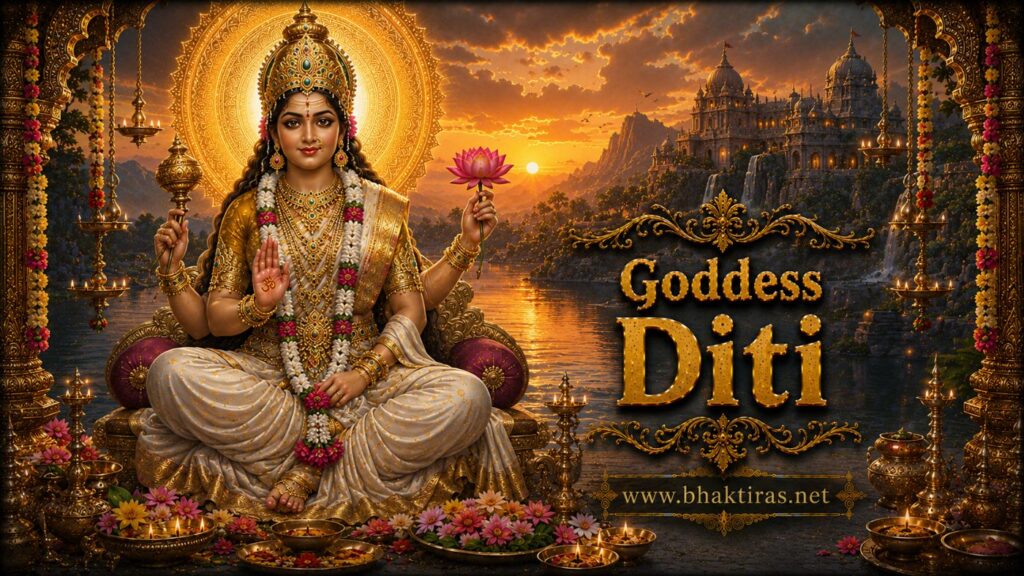
Who Is Goddess Diti?
Diti belongs to the oldest layer of Hindu memory, the world of the Vedas, where the gods and their rivals are still being sorted out and the lines between them are not yet hard. She is a daughter of Daksha, that restless progenitor whose many daughters seeded much of the cosmos, and she is given in marriage to the sage Kashyapa, one of the great mind-born seers. From this union descend the Daityas, the children of Diti, a race counted among the asuras.A daughter of Daksha
Like her many sisters, Diti was born to Daksha and married into the household of Kashyapa. Her name is usually understood in contrast with her sister Aditi: where Aditi is the unbounded, the free expanse of sky, Diti is read as the bound, the limited, the divided. The two names are almost a single idea split in half.
Mother of a line, not a monster
It is easy to reduce Diti to ‘the mother of demons’, but the older texts are more careful. Her sons are powerful, ambitious, and often opposed to the devas, yet she herself is drawn with the dignity of a mother and a wife who keeps her vows. Her sorrow and her devotion are treated as real, not as villainy.
A Vedic presence
Diti appears in hymns of the Rig Veda and is developed at length in the Puranas. She is less a goddess of temples and festivals than a goddess of story and meaning, someone through whom the tradition thinks about balance, loss, and the place of the asuras in the order of things.
Mother of the Daityas
The Daityas take their name from Diti herself. Chief among her sons are the two brothers Hiranyakashipu and Hiranyaksha, figures whose fame reaches far beyond their mother’s story. To understand Diti, it helps to see her children not as simple evildoers but as beings of enormous power whose ambition ran against the grain of the devas.Hiranyaksha
Hiranyaksha, whose name suggests ‘golden-eyed’, is remembered for dragging the earth beneath the cosmic waters. Vishnu took the form of Varaha, the boar, to lift the earth back into place and to end him. In that telling Diti’s son becomes the occasion for one of Vishnu’s great rescues of the world.
Hiranyakashipu
Hiranyakashipu, ‘clothed in gold’, won a boon that made him almost impossible to kill and turned him against all worship of Vishnu, even in his own house. His son Prahlada’s unshakable devotion, and the fierce Narasimha form Vishnu took to end the father, make this one of the most beloved of all Puranic episodes.
The asuras in their own light
The asuras are the counterparts of the devas, not their moral opposites in any simple sense. Many are learned, disciplined, and capable of the fiercest penance. Their conflict with the gods is more like a rivalry between two branches of one family than a fight between good and pure evil, and Diti sits at the head of one of those branches.
Diti and Aditi – the Two Sisters, the Two Sides
No figure explains Diti better than her sister. Aditi is the mother of the Adityas, the shining devas; Diti is the mother of the Daityas. Two sisters, one husband in Kashyapa, and two lines of children who will spend ages contending with each other. The tradition seems to have set them up as a deliberate pair.The boundless and the bound
Aditi’s name means the free, the infinite, the whole; Diti’s suggests the cut, the bounded, the portioned-out. Read together, they describe a single cosmos that has both an open, expansive aspect and a limited, defined one. Neither can be removed without collapsing the picture.
Not good versus evil
It would be a mistake to map the sisters onto a tidy contrast of light and darkness in a moral sense. The devas are not flawless and the asuras are not merely wicked. What the two lines really mark is a tension in the very structure of the world, between force that reaches outward and force that holds and grounds.
A shared household
That both races spring from the same father, Kashyapa, is the quiet heart of the whole scheme. Devas and asuras are cousins. Their long enmity is a family enmity, which is part of why the stories carry so much feeling and why Diti’s grief, when it comes, is not the grief of a stranger.
The Story of the Maruts
The tale most closely bound to Diti’s name is the birth of the Maruts, and it is a story of grief turned, against all expectation, into grace.A mother's grief
After Indra, king of the devas, killed her sons, Diti was consumed by sorrow. She went to her husband Kashyapa and asked for a son who could stand against Indra himself, a child mighty enough to answer the loss she had suffered. Kashyapa, moved by her pain, agreed, but he set conditions.
The vow of purity
Diti undertook a severe penance, a vow with strict rules of cleanliness, conduct, and timing that she was to keep without a single lapse for the whole term of her pregnancy. She held to it with great discipline, and as the child within her grew in power, the devas grew uneasy, for they could feel the strength gathering.
The lapse and the entry
Late in her observance, after long effort, Diti’s guard slipped for a short while. In that one unguarded moment Indra found his opening and entered her womb. With his thunderbolt he cut the unborn child not into two but into many pieces, meaning to be sure that no single rival could rise against him.
Grief becomes the storm
Yet the story does not end in cruelty. By Diti’s grace, and by the compassion that turned the moment, the forty-nine pieces did not perish and did not become enemies. They became the Maruts, the swift storm-gods, and rather than remaining foes of Indra they became his bright companions, riding the winds beside him. A mother’s love had reshaped even the wound into something luminous.
The Deeper Meaning – the Necessary Counterweight
Once the shock of the story settles, Diti opens into something larger. She is one of the ways the tradition thinks about balance, about the fact that a whole world needs more than one kind of force to hold together.The earthward pull
If the devas represent the upward, luminous, expansive drive, Diti and her line hold the opposite pole: the material, the earthbound, the pull toward form and limit. Creation cannot be all sky. It needs weight and ground, and Diti is where the tradition keeps that ground in view.
The shadow that frames the light
The asuras are the shadow, but a shadow is not the absence of meaning; it is what lets the light have shape and depth. Without an opposing force there is no test, no motion, no story. Diti’s children give the devas something to reach past, and in doing so they keep the cosmos alive rather than static.
Grief that transforms
On the human scale, Diti’s story is about grief and its strange fruit. She wanted vengeance and set out to breed a weapon; what she received instead were the Maruts, wind-riders who blessed the very sky. Her longing was answered, but transfigured, as if the tradition were saying that even the fiercest sorrow can be turned toward light.
Iconography & Symbols
Diti is more a presence in narrative than a fixed image in stone, so her symbolism lives mostly in what surrounds her rather than in a standard sculptural form.The mother figure
Where she is imagined at all, Diti is a matron, a wife and mother of the sage’s household, dignified and often sorrowful. Her power is maternal and generative rather than martial; she creates and she mourns rather than fighting on the field herself.
Earth and limit
Her associations run to the earth, to enclosure, to the bounded field. Where Aditi is open sky, Diti is the ground beneath it, and the imagery around her tends toward the solid, the rooted, and the contained.
The storm as aftermath
The Maruts, wind and thunder and rushing cloud, are the great symbol that trails behind her. The storm becomes a kind of emblem of Diti’s whole story: turbulence born of grief, and yet moving in company with the light.
How Diti Is Remembered
Diti is not a goddess of large public cults, yet she stays alive in the tradition through the stories that need her and the ideas she anchors. She is remembered chiefly in these ways:- As the ancestress of the Daityas, the line of asuras whose contests with the devas fill so much of Puranic narrative.
- As the mother whose two sons, Hiranyakashipu and Hiranyaksha, occasioned two of Vishnu’s most celebrated avatars, Varaha and Narasimha.
- As the central figure in the birth of the Maruts, a story recited to show how grief can be turned to grace.
- As the counterpart of Aditi, invoked whenever teachers explain the balance of the bound and the boundless in the cosmic order.
- As a reminder, in temple and family teaching alike, that the asuras are not cartoon villains but a necessary part of a living, contending world.
Prayers & Mantras
Diti receives no grand liturgy of her own, but she can be honoured with a simple salutation that acknowledges her place among the mothers of the cosmos. A short mantra of reverence is enough to bring her to mind.A mantra of salutation
ॐ दित्यै नमः – Om Dityai Namah – ‘Om, salutations to Diti.’ Spoken quietly, it offers respect to the mother of the Daityas and to the earthward, holding power she represents within the wholeness of creation.
How it is used
Such a salutation is offered less to ask for a boon than to acknowledge a truth: that the bound and the boundless, the deva and the asura, are both woven into the single fabric the tradition venerates. To name Diti with respect is to accept that the shadow, too, has its dignity.
Frequently Asked Questions about Goddess Diti
Who is Goddess Diti?
Diti is a Vedic goddess, a daughter of Daksha and wife of the sage Kashyapa. She is the mother of the Daityas, a line of asuras, and the sister of Aditi, mother of the devas. She represents the material, earthbound force that balances the gods within the cosmic order.
Who are the children of Diti?
Diti's best-known children are the asura brothers Hiranyakashipu and Hiranyaksha. She is also the mother of the Maruts, the storm-gods, who were born from a child conceived to defeat Indra but transformed, by her grace, into Indra's shining companions.
What is the story of the Maruts?
Grieving after Indra killed her sons, Diti undertook a strict penance to bear a child who could defeat him. When her observance briefly lapsed, Indra entered her womb and cut the unborn child into forty-nine pieces. By her grace these became the Maruts, storm-gods who befriended Indra rather than fighting him.
How is Diti related to Aditi?
Diti and Aditi are sisters, both daughters of Daksha and both wives of the sage Kashyapa. Aditi is mother of the Adityas, the devas, while Diti is mother of the Daityas, the asuras. Their names contrast the boundless with the bound, expressing a balance built into the cosmos.
Is Diti a demon-goddess?
It is more accurate to call her the mother of the asuras than a demon-goddess. The asuras are the rivals of the devas, not simple evildoers, and Diti herself is drawn as a dignified wife and grieving mother. She stands for the earthward counterweight that a whole cosmos requires.
In which texts does Diti appear?
Diti appears first in the hymns of the Vedas, especially in the pairing of Diti and Aditi, and is developed more fully in the Puranas. There her lineage of Daityas, the deeds of Hiranyakashipu and Hiranyaksha, and the birth of the Maruts are told at length.
What does Diti symbolize?
Diti symbolizes the material, bound, and earthward pull of existence, the necessary counterweight to the luminous devas. She embodies limit, ground, and a mother's fierce grief, and her story shows how even sorrow and opposition have their place in a balanced, living creation.
May the story of Diti remind us that grief can be transformed, and that even the shadow has a dignity within the wholeness of creation.