
Surya Dev
सूर्य
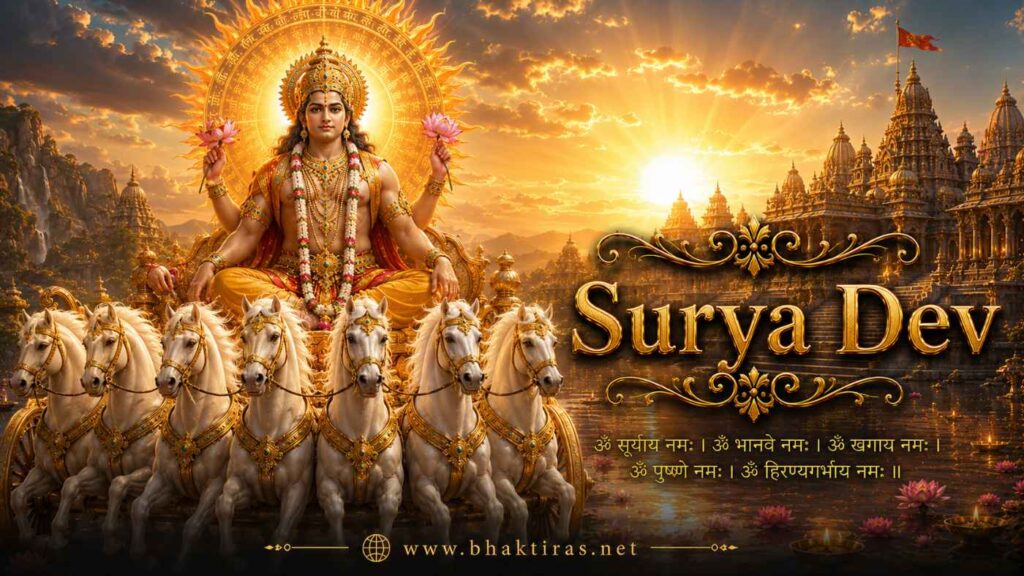
Surya is the Hindu sun god, the visible bringer of light, life, health and the passage of time. Riding a chariot pulled by seven horses and driven by Aruna, he is honoured as an Aditya and as the only Navagraha who is fully a deva. Devotees greet him each dawn with water offerings, the Gayatri Mantra and Surya Namaskar.
Who Is Surya Dev?
Surya is the Hindu god of the sun, worshipped as the visible face of the divine that anyone can see, feel and greet each morning. Unlike deities known only through story and image, Surya rises over every home, ripens every field and measures out the day, so his presence is direct and daily. Ancient hymns of the Rigveda praise him as the eye of the gods and the soul of all that moves and does not move.
He belongs to a group of solar deities called the Adityas, the shining sons of the goddess Aditi. Among them Surya is the chief, the one whose light sustains the worlds. He is also counted among the Navagraha, the nine celestial influences that shape human destiny – and he holds a special place there as the only Navagraha who is fully a deva, a true god rather than a shadowy or demonic force.
People turn to Surya for health, vitality and clarity. His warmth is linked to good digestion, strong eyesight, courage and a steady mind. This is why the practice of facing the rising sun, offering water and reciting his names has stayed alive for thousands of years, long before anyone spoke of vitamin D or the value of morning light.
In art he appears as a radiant figure of red and gold, seated on a chariot that crosses the sky. His story is woven through the great epics: he fathers heroes and judges, he teaches wisdom, and his hymn gives Rama the strength to win the greatest of wars. To understand Surya is to see the sun not as a distant ball of fire but as a living, generous god.
The Seven-Horse Chariot & Its Meaning
The most beloved image of Surya is of the god riding a golden chariot across the heavens. Every part of that chariot carries meaning, turning a simple picture into a lesson about time and the cosmos.
Seven horses pull the chariot forward. They are often read as the seven colours hidden inside sunlight, the same colours that fan out in a rainbow, and also as the seven days of the week that the sun’s journey creates. In some tellings the horses represent the seven notes of music or the meters of Vedic chant, so that the sun’s ride becomes a kind of song across the sky.
The chariot famously runs on a single wheel. That one wheel is understood as the wheel of the year, or the turning circle of time itself, with its spokes marked as seasons and months. A single wheel also suggests that the sun follows one unbroken path, never straying, never stopping.
Guiding the horses sits Aruna, the charioteer, whose name means the reddish glow of dawn. Aruna is the elder brother of Garuda and is shown without legs, seated close to Surya, holding the reins. He is the soft light that comes just before the sun appears, the herald who clears the way. Because Aruna sits in front, devotees say the gentle red of daybreak is always the first sign that Surya’s chariot is near.
Iconography & Symbols
Two Lotuses
Surya usually holds a fully open lotus in each hand. The lotus opens with sunlight and closes at dusk, so it stands for the way life responds to the sun. It also marks him as pure and unstained, rising bright above the world he warms.
Red-Gold Body
His form glows the deep red-gold of the rising and setting sun. This colour signals heat, energy and life force. Worshippers offer red flowers, red sandal paste and red cloth to match his fiery, generous nature.
Radiant Halo
A ring of light, or prabhamandala, surrounds his head and body. It shows that he is the source of all brightness. No lamp is needed near Surya, for he is light itself and gives it freely to gods and mortals alike.
Seven Horses
The seven steeds harnessed to his chariot are his constant companions in art. Whether carved in stone at Konark or painted in a calendar, the team of seven horses instantly tells a viewer that this is Surya and no other god.
The Chariot
Surya is almost always seated, not standing, because his place is on the moving chariot that carries daylight around the earth. The chariot separates him from ground-based deities and marks him as the ever-travelling sun.
Aruna the Charioteer
Small and legless, holding the reins at the front, Aruna appears as the personified dawn. His presence in the image reminds devotees that soft morning light always announces the coming of the full sun.
Surya's Divine Family
Surya’s household is one of the richest in Hindu myth, filled with famous children whose own stories shape the epics. His first wife is Sanjna (also called Saranyu), the daughter of the divine craftsman Vishvakarma. Their marriage produced Yama, the lord of death and the just judge of souls, and Yamuna, the sacred river goddess. From this union also came Vaivasvata Manu, the ancestor of the present age of humanity.
Sanjna, however, found the sun’s blaze too fierce to bear. Before withdrawing to gather her strength, she created a shadow double of herself called Chhaya and left her in the palace, asking her to take her place. Chhaya became mother to Shani, the slow-moving planet Saturn and the stern dispenser of karma, as well as to other children. The tension between the bright father and his shadowy consort is often read as a family echo of light and shade themselves.
Surya is also the divine father of Karna, the tragic and noble warrior of the Mahabharata, born to the princess Kunti and marked from birth with golden armour and earrings that shone like his father. And in the Vedic layer of tradition, the twin healing gods called the Ashvins are counted among his offspring. Through these children – death, rivers, karma, mankind and heroism – Surya’s light reaches into nearly every corner of Hindu story.
How Surya Dev Is Worshipped
Worship of Surya is unusually hands-on, because the god himself is visible in the sky. Devotion does not wait for a temple or an idol – it can begin the moment the sun clears the horizon. A few practices have carried this reverence forward for centuries:
- Surya Namaskar – the sun salutation, a flowing sequence of twelve yoga postures done facing the rising sun, each linked to one of the sun’s names and to steady breathing.
- Arghya at sunrise – standing in early light and pouring water from a small vessel toward the sun, often through cupped hands, as a simple daily offering.
- The Gayatri Mantra – the most revered Vedic verse, addressed to the sun’s radiant power (Savitr-Surya), chanted at dawn to awaken clarity and wisdom.
- Aditya Hridayam – a hymn of praise to the sun recited for courage, healing and success, especially by those facing a great challenge.
Chhath Puja & Solar Festivals
Some of the most heartfelt festivals in India are dedicated entirely to the sun, and they draw millions to riverbanks and rooftops each year.
Chhath Puja is the greatest of all Surya festivals, celebrated with deep devotion across Bihar, Uttar Pradesh, Jharkhand and beyond. Over four disciplined days, devotees fast, bathe in rivers and ponds, and stand waist-deep in water to offer arghya to the setting sun and again to the rising sun. It is one of the few festivals that honours the sun at both dusk and dawn, and its purity, fasting and quiet dignity make it unforgettable.
Ratha Saptami falls on the seventh day of the bright half of the month of Magha and is regarded as the birthday of Surya, or the day his chariot began its northward turn. Homes draw the seven-horse chariot in rice flour, and people bathe at dawn while balancing leaves on their heads as a mark of respect for the sun’s healing warmth.
Makar Sankranti marks the sun’s shift into the sign of Capricorn and the start of its northward journey, called Uttarayana. Celebrated as a harvest festival with sesame sweets, kite-flying and holy dips, it thanks the sun for lengthening days and the promise of a good season ahead.
The Sun Temples
India built some of its most ambitious temples for Surya, shaping stone itself into his chariot. Three of them remain famous far beyond their regions:
- Konark Sun Temple, Odisha – a thirteenth-century masterpiece carved as a giant chariot, with twenty-four great stone wheels and teams of horses straining to pull it. A UNESCO World Heritage Site, it was designed so the first rays of dawn would strike the sanctum.
- Modhera Sun Temple, Gujarat – an eleventh-century temple with a stepped water tank and a hall aligned so that at the equinox the sunrise lights the inner shrine. Its carved pillars and dancing figures make it a favourite of pilgrims and artists.
- Martand Sun Temple, Kashmir – a grand eighth-century temple in the Kashmir valley, now in ruins but still striking, built on a high plateau with wide views. Its scale shows how deeply the sun was honoured in the far north.
A Story Every Devotee Knows
Aditya Hridayam Before the War
In the Ramayana, on the final day of battle, Rama stands exhausted before the mighty Ravana and the outcome hangs in doubt. The sage Agastya appears and teaches him the Aditya Hridayam, a secret hymn of praise to Surya. Rama sips water, faces the sun and recites it three times. Filled with fresh strength and clear resolve, he lifts his bow and defeats Ravana. Devotees still recite this hymn when they need courage to face a hard task, trusting the sun to steady the heart.
Sanjna and the Shadow
Unable to bear her husband’s overwhelming heat, Sanjna created her shadow-self Chhaya to stand in for her and quietly went away to gather strength. Surya did not notice the swap until Chhaya treated the children unequally. When the truth came out, Surya searched for Sanjna and found her. To make their union bearable, the craftsman Vishvakarma trimmed away a portion of Surya’s dazzling light, softening his glare so the family could be together. The trimmings, it is said, were forged into the weapons of the gods.
Hanuman's Sun Teacher
As a young and eager student, Hanuman chose Surya himself as his guru, for who could teach the scriptures better than the all-seeing sun? But Surya could never pause his chariot. So Hanuman flew alongside it, facing his teacher and moving backward across the sky, absorbing every lesson while the sun kept travelling. His devotion so pleased Surya that Hanuman mastered the sacred knowledge, a tale that shows learning is possible for anyone who will keep pace with a worthy guide.
Prayers & Mantras
Prayer to Surya can be as short as a single name or as full as an ancient Vedic verse. The simplest daily mantra is ॐ सूर्याय नमः – Om Suryaya Namah, meaning salutations to the sun – repeated while offering water at dawn. Many devotees add the twelve holy names of the sun (the Dvadasha Aditya), one for each posture of Surya Namaskar: Mitra, Ravi, Surya, Bhanu, Khaga, Pushan, Hiranyagarbha, Marichi, Aditya, Savitr, Arka and Bhaskara. The most exalted prayer connected to the sun is the Gayatri Mantra, which asks the radiant Savitr-Surya to inspire and enlighten the mind. Reciting these at sunrise, facing east, is believed to bring health, focus and a calm, generous spirit.
Frequently Asked Questions about Surya Dev
Who is Surya Dev in Hinduism?
Surya is the Hindu god of the sun, worshipped as the visible source of light, life, health and time. He is chief among the Adityas, the solar deities, and rides a chariot pulled by seven horses. He is also one of the nine Navagraha and the only one of them who is fully a deva.
Why does Surya's chariot have seven horses?
The seven horses are widely understood as the seven colours hidden in sunlight, which spread out as a rainbow, and also as the seven days of the week that the sun's journey creates. Some traditions link them to the seven notes of music or the meters of Vedic chant, so the sun's ride becomes a kind of cosmic song.
Who are Surya's children?
Surya's children include Yama, the lord of death, and Yamuna, the river goddess, born to his wife Sanjna. From her shadow-form Chhaya came Shani, the planet Saturn. He is also the divine father of the Mahabharata hero Karna and, in Vedic tradition, of the twin healer gods called the Ashvins.
What is Chhath Puja?
Chhath Puja is the greatest festival dedicated to Surya, celebrated mainly in Bihar, Uttar Pradesh and Jharkhand. Over four days devotees fast, bathe in rivers and stand in water to offer arghya to both the setting and the rising sun. Its discipline, purity and quiet devotion make it one of India's most moving observances.
How is Surya worshipped daily?
The most common daily practice is offering arghya – pouring water toward the rising sun at dawn, often with red flowers. Many people also perform Surya Namaskar, the twelve-posture sun salutation, and recite the Gayatri Mantra or Om Suryaya Namah while facing east to invite health and clarity.
What is the Aditya Hridayam?
The Aditya Hridayam is a hymn praising Surya, taught to Rama by the sage Agastya on the final day of his war with Ravana. After reciting it three times, Rama regained his strength and won. Devotees still chant it for courage, healing and success when facing a great challenge.
Which are the most famous Surya temples?
The best known are the Konark Sun Temple in Odisha, carved as a giant stone chariot and a UNESCO World Heritage Site; the Modhera Sun Temple in Gujarat, with its stepped water tank; and the ancient Martand Sun Temple in Kashmir. All three were designed to honour the sun's light and movement.
Why is Surya both a Deva and a Navagraha?
Surya belongs to two overlapping traditions. As a deva he is a full god, the shining Aditya who sustains the worlds. As a Navagraha he is one of the nine celestial influences that shape fate. He is the only Navagraha considered a complete deva, which makes him especially auspicious to worship among the planets.
What is the best day to worship Surya?
Sunday, or Ravivar, is dedicated to Surya, and many devotees keep a Sunday fast in his honour. The festival of Ratha Saptami is regarded as his birthday and is thought to be the most powerful day for sun worship, when offering arghya and bathing at dawn bring special blessings of health.
May the first light of dawn find you well, and may Surya Dev fill your days with warmth, health and a heart that never loses its brightness.