
Rishi Durvasa
दुर्वासा
Rishi Durvasa is a powerful sage of Hindu tradition, born as a portion of Lord Shiva to the sage Atri and his devoted wife Anasuya. He is known above all for his fierce temper and the curses and boons he grants readily. Though his anger seems harsh, his words repeatedly move the wheel of destiny in the great epics.
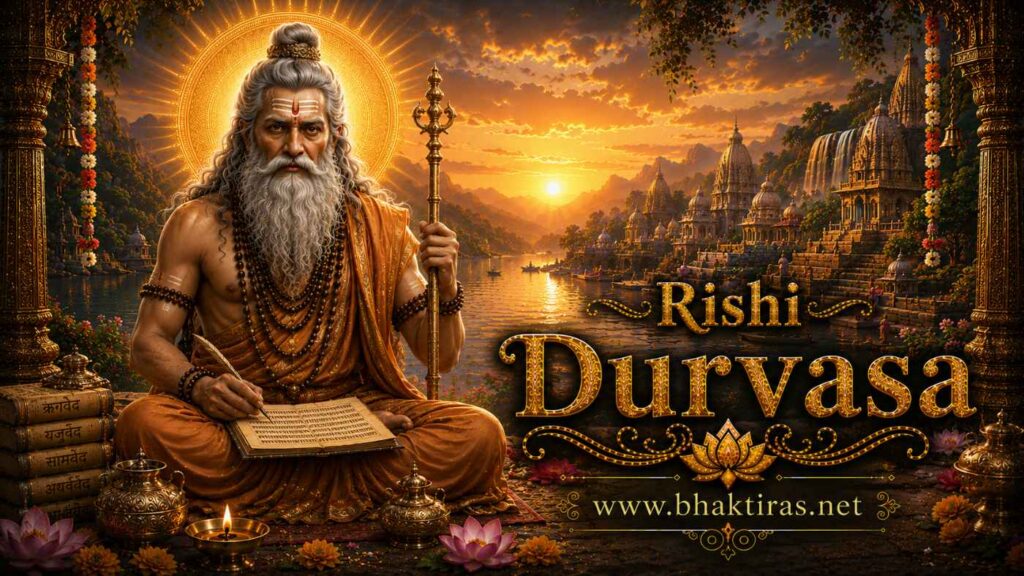
Who Is Rishi Durvasa
Among the great sages of Hindu memory, few are spoken of with the mixture of awe and caution that surrounds Durvasa. He is a maharishi of immense spiritual power, a master of long and severe tapas, and a figure whose presence in a story usually signals that fate is about to turn. His name itself carries the sense of one who is hard to be around, and the tradition does not soften this. What it does instead is show, again and again, that behind the flare of his anger lies a purpose larger than any single moment of offense.A sage born of Shiva's energy
Durvasa is described as an amsha, a portion, of Lord Shiva himself. This lineage explains much about him. Like the deity whose energy he carries, he holds within him both the power to destroy and the readiness to bless without limit. His moods move quickly, and those who meet him find that the same fire can burn or illuminate depending on how they conduct themselves.
A word that cannot be unspoken
In the world of the epics, the speech of a realized sage carries the force of law. When Durvasa grants a boon it is unfailing, and when he pronounces a curse it takes hold. This is why his appearances matter so much. He is not merely a quick-tempered ascetic; he is a hinge on which stories, dynasties and even the fortunes of the gods are made to swing.
A Portion of Shiva, Son of Atri and Anasuya
The story of Durvasa’s birth is inseparable from the devotion of his parents. Sage Atri, one of the seven great rishis, and his wife Anasuya were known for a purity of conduct so complete that it drew the attention of the highest gods.The devotion of Anasuya
Anasuya’s faithfulness became so celebrated that the three great deities, Brahma, Vishnu and Shiva, chose to test her. Disguised as wandering ascetics, they arrived at her hermitage and asked to be served food while she set aside her modesty. Rather than refuse a guest or compromise her virtue, she used her spiritual power to turn the three visitors into infants, and only then attended to them with a mother’s care. Pleased and humbled, the gods revealed themselves and granted that portions of their own being would be born as her sons.
Three sons, three energies
From this blessing came three children. Dattatreya carried the energy of Vishnu and became a beloved teacher of yoga and detachment. Chandra, the moon, carried the cool light of Brahma. And Durvasa carried the fierce, transformative fire of Shiva. The three brothers together embody the balance of creation, preservation and dissolution, and Durvasa’s temper is best understood as the Shiva-portion of that balance made flesh.
The Sage Whose Anger Shaped Destiny
It would be easy to read Durvasa’s episodes as a string of overreactions. A closer look shows something more careful at work. His anger is rarely idle. In story after story it becomes the very mechanism by which a larger design unfolds.Curses that open doors
When Durvasa curses a king or a god, the immediate effect is loss or suffering. Yet the same curse often clears the way for events that had to happen. His anger at Indra strips the devas of their prosperity, but that very loss sets in motion the churning of the cosmic ocean and the recovery of amrita. His curse on Dushyanta separates him from Shakuntala, yet the reunion that follows, sealed by the recovered ring, is what the epic needed. The pattern repeats too often to be accidental.
The teacher of hospitality and humility
Many of Durvasa’s angry moments are triggered by a lapse in hospitality or respect. In a culture that held the guest to be worthy of reverence, his reactions read as stern lessons in a value the tradition prized. Those who treat him with sincerity, patience and care, like King Ambarisha, are ultimately vindicated. Those who slight him learn the cost. His temper becomes a mirror, showing each person the quality of their own conduct.
The Boon to Kunti
A young girl's patient service
When Durvasa once stayed as a guest in the palace of King Kuntibhoja, it was the young princess Kunti who was given the task of caring for him. His demands were exacting and his moods unpredictable, yet she attended to him through every whim with unfailing patience, never once showing irritation or fatigue. Where others might have failed the test, she passed it with grace.
The mantra that summons the gods
Delighted by her devotion, Durvasa gave her a rare gift: a sacred mantra by which she could call upon any deity she wished, and that deity would appear and grant her a child. This single boon would echo through the Mahabharata. In her curiosity Kunti first summoned Surya, and Karna was born. Later the same mantra brought her Yudhishthira, Bhima and Arjuna through Dharma, Vayu and Indra, and she shared it with Madri, who bore the twins. The Pandava brothers, whose story is the spine of the epic, exist because a fierce sage was moved by a girl’s quiet kindness.
The Curse That Led to the Samudra Manthan
A garland offered and ignored
On one of his journeys Durvasa received a fragrant, divine garland and, in a rare gesture of goodwill, offered it to Indra, the king of the gods, as he passed by on his elephant Airavata. Indra, careless in his pride, took the garland and set it upon the head of his mount. The elephant, troubled by its scent, threw it to the ground and trampled it. Durvasa saw his gift crushed underfoot and his anger blazed.
The devas lose their fortune
The sage cursed Indra and the devas that their strength, their prosperity and the goddess of fortune herself would abandon them. The heavens grew weak, and the asuras began to gain the upper hand. Brought low, the gods turned to Vishnu, who counselled the great churning of the ocean of milk. It was this loss, born of a single moment of disrespect toward Durvasa, that led to the Samudra Manthan and the eventual recovery of amrita. His anger, harsh as it was, moved one of the grandest events in all of Hindu cosmology.
Ambarisha, Draupadi and the Lessons of Hospitality
Two of Durvasa’s best loved episodes place him at the table of a devotee, and in both the outcome turns not on his power but on the quiet strength of faith.- The testing of King Ambarisha. Ambarisha was a devoted worshipper of Vishnu who once undertook a sacred fast. Durvasa arrived as a guest and, before the meal, went to bathe in the river, delaying past the moment when the king had to break his fast to honour the vow. Ambarisha, caught between two duties, sipped only water, meaning to eat once the sage returned. Durvasa took this as an insult and, in fury, created a fiery demon to destroy him.
- The Sudarshana Chakra intervenes. Vishnu’s discus, the Sudarshana Chakra, appeared to protect his devotee, consumed the demon and then pursued Durvasa himself. The sage fled across the worlds seeking refuge, but none of the gods could stop the discus. In the end he was told that only Ambarisha’s forgiveness could save him. Humbled, the great sage returned and sought the pardon of the very king he had wronged. The story shows that even Durvasa’s power bows before sincere devotion, and that humility can reach where anger cannot.
- The Akshaya Patra and Draupadi. During the Pandavas’ exile, Durvasa arrived with a large body of disciples, sent to test them, expecting a full meal. The Akshaya Patra, the vessel that fed them endlessly each day, had already given its last for that day, and the Pandavas had no way to feed so many hungry guests. Draupadi, in distress, prayed to Krishna.
- A single grain saves them. Krishna came, asked for the pot, and found clinging to its rim one small grain of rice and a shred of vegetable. He ate it, declaring himself satisfied, and by his grace the hunger of Durvasa and all his disciples was stilled at that very moment. Fearing to face the Pandavas after having eaten so well, the sage and his followers quietly departed. Once again devotion, not force, turned aside his test.
Iconography and Symbols
The ascetic's form
Durvasa is most often pictured as a lean, weathered ascetic with matted hair coiled high, a long flowing beard and eyes that seem to hold a banked fire. He wears the simple garments of a forest sage, and his very posture suggests a man who has spent lifetimes in penance far from human comfort.
Kamandalu and staff
In his hands he commonly bears the kamandalu, the water pot of the renunciate, and a staff or danda. These mark him as a wandering sage bound by no household, carrying his hermitage with him wherever he walks. The retinue of disciples that often accompanies him signals both his stature and the demands his presence places on any host.
The fire within
The recurring visual note in depictions of Durvasa is intensity. Where other sages are shown serene, he is shown alert and charged, as if the tapas he has gathered might spill over at any instant. This inner heat is the outward sign of his Shiva-born nature and of the potency of every word he speaks.
How Rishi Durvasa Is Remembered
Across the Puranas, the Mahabharata and the Ramayana, Durvasa appears wherever a story needs a turning point that carries the full weight of a rishi’s word. Over the centuries he has come to stand for a cluster of ideas that Hindu culture returns to often.- A living reminder that a guest is to be honoured, and that hospitality is a sacred duty, not a courtesy.
- A figure whose anger, though feared, is never wasted, and whose curses repeatedly serve the unfolding of a larger design.
- The patron of the value of patience, for those who bear with him, like Kunti and Ambarisha, are the ones who are ultimately blessed.
- An emblem of the power of speech, teaching that the words of the wise carry consequences that cannot be recalled.
- A sage whose severity is balanced by his readiness to bless without measure, showing that even the sternest heart can be won by sincere devotion.
Prayers and Mantras
Devotees who honour Durvasa do so with reverence for his spiritual power and his link to Lord Shiva. A simple mantra of salutation is offered to seek his blessings and, above all, his forgiveness where one has faltered in duty or devotion.Durvasa Mantra
ॐ दुर्वाससे नमः
Om Durvasase Namah
This is a mantra of salutation, meaning ‘I bow to the sage Durvasa.’ It is chanted with humility, honouring the fierce ascetic and asking that his blessing, rather than his displeasure, rest upon the devotee.
Frequently Asked Questions about Rishi Durvasa
Who is Rishi Durvasa?
Rishi Durvasa is a powerful sage of Hindu tradition, born as a portion of Lord Shiva to the sage Atri and his wife Anasuya. He is best known for his fierce temper and for the curses and boons he grants, which repeatedly turn the course of events in the great epics of India.
Why is Durvasa known for his anger?
As a portion of Lord Shiva, Durvasa carries within him the same fierce, transformative energy. His anger is usually triggered by a lapse in hospitality or respect. The tradition presents it not as mere bad temper but as an instrument of dharma that teaches humility and the sacred duty owed to a guest.
What are the famous curses of Durvasa?
His best known curses include the one on King Dushyanta, which made him forget Shakuntala until a ring was found, and the one on Indra over a trampled garland, which drained the gods of fortune and led to the churning of the ocean. Each curse ultimately served a larger cosmic purpose.
Who were the parents and brothers of Durvasa?
Durvasa was the son of the great sage Atri and his devoted wife Anasuya. His brothers were Dattatreya, a portion of Vishnu and a revered teacher of yoga, and Chandra, the moon, a portion of Brahma. The three sons embodied the energies of Shiva, Vishnu and Brahma.
What boon did Durvasa give to Kunti?
Pleased by young Kunti's patient service, Durvasa gave her a mantra by which she could summon any deity and receive a child. This boon led to the birth of Karna through Surya and later to the Pandava brothers through Dharma, Vayu and Indra, shaping the whole course of the Mahabharata.
How did King Ambarisha humble Durvasa?
When Durvasa cursed the devotee Ambarisha with a fiery demon, Vishnu's Sudarshana Chakra destroyed it and pursued the sage across the worlds. No god could stop the discus, and Durvasa was told that only Ambarisha's pardon could save him. The proud sage returned and humbly sought the king's forgiveness.
What is the story of Durvasa and the Akshaya Patra?
During the Pandavas' exile, Durvasa arrived with many disciples to test them after their food vessel had emptied for the day. Draupadi prayed to Krishna, who ate a single grain of rice clinging to the pot and declared himself full, satisfying the hunger of all the guests and sparing the Pandavas.
Is Durvasa's anger ever seen as a good thing?
Yes. The tradition holds that his anger, though harsh, is never wasted. His curses repeatedly clear the way for events that had to unfold, from the great churning of the ocean to the reunion of Dushyanta and Shakuntala. His wrath is understood as a purposeful instrument of destiny rather than cruelty.
May the fire of Rishi Durvasa teach us the grace of hospitality and the quiet strength of patience, so that his blessing, not his displeasure, walks with us.