
Rishi Atri
अत्रि
Rishi Atri is one of the seven great Saptarishi and a mind-born son of Brahma. He is honoured as a seer of the Rigveda, with the fifth mandala traditionally linked to his family. Married to the pure and devoted Anasuya, he is the father of Dattatreya, Durvasa and Chandra, and a lasting model of piety and truth.
Who Is Rishi Atri?
Rishi Atri belongs to the small circle of sages the Hindu tradition holds dearest – the Saptarishi, the seven seers who anchor the cosmic order and carry the light of knowledge from one age to the next. He is counted among the mind-born sons of Brahma, brought into being not through ordinary birth but by the will and thought of the creator himself. From that origin, Atri took up the quiet, demanding life of a rishi: long tapasya, careful ritual, and the patient listening that lets a seer receive the hymns of the Veda.
His name is often read as ‘the one who devours,’ understood in the spiritual sense of consuming sin, ignorance and the shadows that cloud the mind. That reading fits the man the texts describe. Atri is remembered less for grand deeds of power and more for steadiness – a heart fixed on truth, a home built on hospitality, and a marriage that became the very definition of virtue.
Around Atri gather some of the most cherished stories in Hindu memory. His wife Anasuya is spoken of in the same breath as the greatest of chaste and devoted women. His three sons carry portions of the divine itself. And when Rama walked into the forest in exile, it was Atri and Anasuya who opened their door to him. To speak of Atri is to speak of a whole household of grace.
He is, in short, a sage whose greatness is measured in devotion, welcome and the wisdom he gathered and gave away.
A Saptarishi and Seer of the Vedas
To be named among the Saptarishi is to be placed at the foundation of the Vedic world. These seven sages are said to preside over the ages, guiding humanity in dharma and preserving the sacred sound of the Veda across the turning of time. In many traditional lists Atri sits securely among them, alongside Bharadvaja, Vishvamitra, Gautama, Jamadagni, Vasishtha and Kashyapa. Their names are chanted at the start of study and ritual, and their gotras still run through countless families today.
Atri’s particular gift was that of the seer, the drashta, one who perceives the eternal hymns rather than composing them by cleverness. The Rigveda preserves a rich body of verses connected to him and his descendants, and by long tradition the entire fifth mandala of the Rigveda is associated with the Atri family. Hymns to Agni, Indra, the Ashvins and the Vishvedevas flow through these verses, marked by a distinctive warmth and metrical care.
One famous account has Atri himself aiding the sun during a period of darkness, restoring light through the force of his prayer and penance. Whether read as legend or as symbol, it captures how the tradition saw him: a sage whose inner fire could push back the dark and steady the world.
Atri and Anasuya – the Ideal Couple
No account of Atri is complete without Anasuya, and no account of Anasuya stands apart from Atri. Their marriage is held up across the Puranas and the Ramayana as the pattern of what a devoted union should be. Anasuya’s very name means ‘free from jealousy or ill-will,’ and the sages praised her as a woman whose purity had grown so strong that it carried real power in the world.
Together they kept an ashrama known for its simple abundance. Guests were fed, students were taught, and the daily rites were never neglected. Anasuya’s chastity and single-minded devotion to her husband, her pativrata dharma, were spoken of by gods and sages alike. Atri, for his part, gave her the respect and companionship that let her virtue flourish. Theirs was not a story of one great figure and a quiet partner; it was a partnership of two people whose goodness reinforced each other.
Later generations would tell young couples to remember Atri and Anasuya – not as distant deities, but as an example of how faith, patience and mutual honour can turn an ordinary home into a place the divine itself chooses to visit.
The Test of the Trimurti
Three gods come as guests
The most beloved story of the household begins in heaven. The greatness of Anasuya’s chastity had spread so far that it reached the ears of the three supreme gods themselves – Brahma the creator, Vishnu the preserver and Shiva the destroyer. Some tellings say the goddesses, curious or unsettled by the praise heaped on a mortal woman, urged their husbands to see whether her virtue was truly as unshakable as people claimed. And so the Trimurti agreed to put Anasuya to the test.
An impossible request
Disguised as three wandering sages, the gods arrived at Atri’s ashrama while he was away and asked Anasuya for food, as any guest might. But then they set a condition meant to trap her: they would only accept the meal if she served them while unclothed. It was a demand designed to force a choice between the sacred duty of hospitality and her own modesty and marital vow – a snare from which there seemed no honourable escape.
Purity turns gods to infants
Anasuya’s answer came not from cleverness but from the strength of her devotion. Calling on the truth of her chastity and her love for Atri, she declared that if her purity was real, these three guests should become as small children before her. In that instant, by the power of her word, Brahma, Vishnu and Shiva were transformed into three helpless infants. Free now of any impropriety, she took them up with a mother’s tenderness, bathed them and nursed them at her breast.
The blessing of three sons
When Atri returned and the truth was revealed, the goddesses came seeking their husbands, and the three gods resumed their true forms. Humbled and delighted by Anasuya’s virtue, they offered the couple a boon. Atri and Anasuya asked that the gods themselves be born as their children. So it came to be: three sons were granted, each carrying a portion of the divine. From Vishnu came Dattatreya, from Shiva came Durvasa, and from Brahma came Chandra, the Moon. What began as a test ended as the greatest of blessings.
Their Three Divine Sons – Dattatreya, Durvasa and Chandra
The three sons born of the Trimurti’s blessing each grew into a figure of lasting importance, and through them the household of Atri and Anasuya became a channel through which the divine entered the world.
- Dattatreya – the portion of Vishnu, and in many traditions a combined form of all three gods of the Trimurti. He is revered as a great guru of the Nath and Avadhuta lineages, a wandering teacher who found lessons in all of nature, and one of the most widely worshipped guru-deities in western and southern India.
- Durvasa – the portion of Shiva, a sage famous for his intense tapasya and his fiery, quick temper. His anger drives many pivotal moments in Hindu narrative, from curses that shape the Mahabharata and the churning of the ocean to episodes in the Ramayana, yet his blessings were as potent as his displeasure.
- Chandra (Soma) – the portion of Brahma, who became the Moon god himself. From Chandra descends the great Chandravamsha, the Lunar dynasty, from which the heroes of the Mahabharata and many royal houses traced their line.
- Through these three, the small forest ashrama of Atri became the source of a guru tradition, a line of powerful sages, and a royal dynasty – a legacy far larger than any single lifetime.
Sheltering Rama in the Forest
The Ramayana brings Atri and Anasuya into one of its gentle, luminous moments. Early in their forest exile, Rama, Sita and Lakshmana came to the ashrama of the aged sage Atri in the Chitrakoot region. The old rishi and his wife received the royal exiles with open hearts, offering the hospitality for which their home was known.
Anasuya took a special liking to Sita. She spoke with her at length about the dharma of a devoted wife, sharing the wisdom of her own long and faithful marriage, and she gave Sita divine gifts – garments, ornaments and unguents that would never fade or soil. The scene is remembered tenderly: one great pativrata passing counsel and blessing to another, the elder of the two shaping the courage the younger would soon need.
That the aged Atri and Anasuya could offer refuge and guidance to the very avatar of Vishnu, whose own son Dattatreya carried a portion of that same Vishnu, gives the episode a quiet depth. It is a reminder that in the Hindu imagination, holiness recognises holiness, and the truly devoted are honoured even by the gods they serve.
Iconography & Symbols
The sage's form
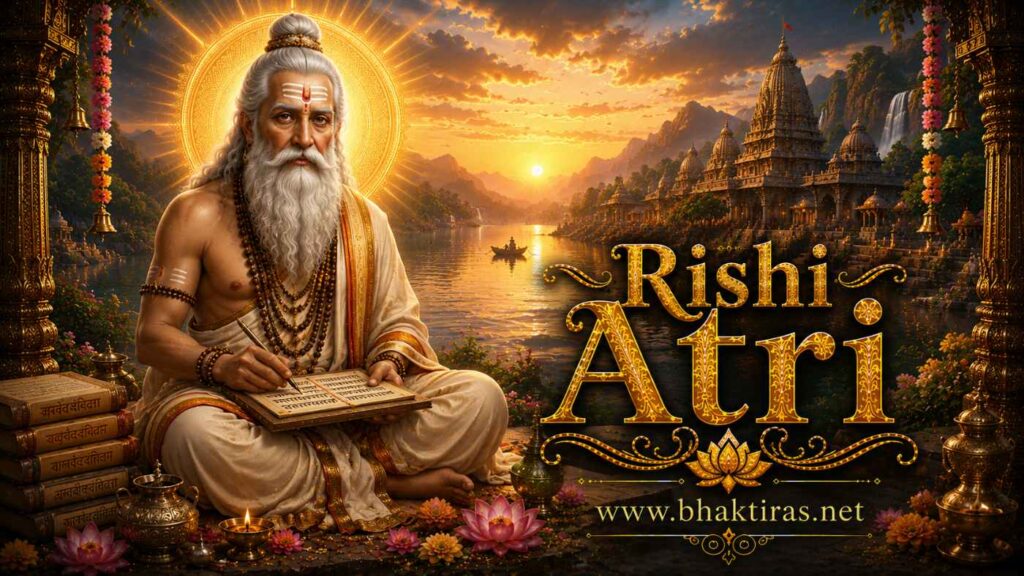
Atri is usually shown as a serene, white-bearded rishi with matted locks of hair coiled upon his head, seated in meditation. His face is calm and his eyes often half-closed, suggesting the inward gaze of one absorbed in the eternal.
Rudraksha and simple robes
He wears the rudraksha beads of the ascetic and the plain ochre or bark garments of a forest-dweller, marking a life stripped of luxury and given wholly to tapasya, study and prayer.
Kamandalu and sacred fire
In many depictions he holds a kamandalu, the water pot of the wandering sage, and is shown near the ritual fire. These signal his role as a keeper of the Vedic rites and a man of daily discipline.
Beside Anasuya
Very often Atri is not shown alone but seated with Anasuya, and sometimes with the three infant gods or their grown sons nearby. The pairing itself is the message: his greatness is inseparable from his devoted wife and their sacred household.
How Rishi Atri Is Remembered
The memory of Atri lives on in many quiet ways, woven into daily worship, lineage and pilgrimage rather than into grand temples of his own.
- As one of the Saptarishi whose names are invoked at the beginning of Vedic study, ritual and the tarpana offerings made to the ancestors.
- As the founder of the Atri gotra, still carried by countless families who trace their descent to him and honour him in their genealogy.
- As a seer of the Rigveda, whose hymns of the fifth mandala are recited and studied wherever the Veda is preserved.
- Through his ashrama sites, especially in the Chitrakoot region associated with the Ramayana, where pilgrims remember his welcome of Rama and Sita.
- Above all, as one half of the ideal couple – Atri and Anasuya are held up in stories and sermons as the enduring pattern of hospitality, marital devotion and quiet holiness.
Prayers & Mantras
Devotees who wish to honour Rishi Atri turn to simple, reverent invocations. Chanting his name is a way of asking for the sage’s steadiness of mind, purity of heart and love of learning. The following mantra is offered with folded hands and a settled spirit, ideally after a bath and before the morning rites.
ॐ अत्रये नमः
Om Atraye Namah
‘Salutations to the sage Atri.’ To recite this is to bow before the seer’s wisdom and to invite his calm, sin-consuming light into one’s own study and devotion.
Frequently Asked Questions about Rishi Atri
Who is Rishi Atri?
Rishi Atri is one of the seven great Saptarishi and a mind-born son of Brahma. He is a revered seer of the Rigveda, especially its fifth mandala. Married to the virtuous Anasuya, he is the father of Dattatreya, Durvasa and Chandra, and is honoured as a model of devotion, hospitality and Vedic wisdom.
Who was Atri's wife Anasuya?
Anasuya was Atri's wife, praised across the Puranas and Ramayana as the very ideal of chastity and devotion. Her name means 'free from jealousy.' Her purity was said to be so powerful that she once turned Brahma, Vishnu and Shiva into infants when they came to test her, and she later blessed Sita during Rama's exile.
Who are the sons of Atri and Anasuya?
Atri and Anasuya had three divine sons, each a portion of one of the Trimurti. Dattatreya came from Vishnu and became a great guru-deity, Durvasa came from Shiva and is known for his fierce tapasya and temper, and Chandra came from Brahma and became the Moon god, ancestor of the Lunar dynasty.
Why is Rishi Atri one of the Saptarishi?
Atri is counted among the Saptarishi, the seven seers who uphold cosmic order and preserve the Veda across the ages. As a mind-born son of Brahma and a great seer of sacred hymns, he earned his place through profound tapasya, ritual mastery and the wisdom he passed to later lineages through his gotra and students.
What is the story of the Trimurti testing Anasuya?
To test Anasuya's famed chastity, Brahma, Vishnu and Shiva came disguised as sages and asked to be fed while she was unclothed. By the power of her purity she turned the three gods into infants, freeing herself of any impropriety, and nursed them. When they revealed themselves, they blessed the couple with three divine sons.
Which part of the Vedas is linked to Atri?
By long tradition the entire fifth mandala of the Rigveda is associated with the Atri family. Many of its hymns to Agni, Indra, the Ashvins and other deities are attributed to Atri and his descendants, making his lineage one of the important seer-families whose verses shaped the oldest layer of Hindu scripture.
How did Atri and Anasuya help Rama?
During their forest exile, Rama, Sita and Lakshmana visited the aged Atri and Anasuya at their Chitrakoot ashrama. The couple welcomed them warmly. Anasuya counselled Sita on the dharma of a devoted wife and gave her divine garments and ornaments that would never fade, a cherished moment of grace in the Ramayana.
How is Rishi Atri worshipped today?
Atri is honoured chiefly as one of the Saptarishi invoked in Vedic rites, ancestor offerings and daily prayer, and as the founder of the Atri gotra carried by many families. Pilgrims also remember him at ashrama sites in the Chitrakoot region. A simple mantra, Om Atraye Namah, is chanted to seek his wisdom and purity.
May the calm wisdom of Rishi Atri and the pure devotion of Anasuya bless every home that welcomes the sacred with an open heart.