
Khandoba
खंडोबा
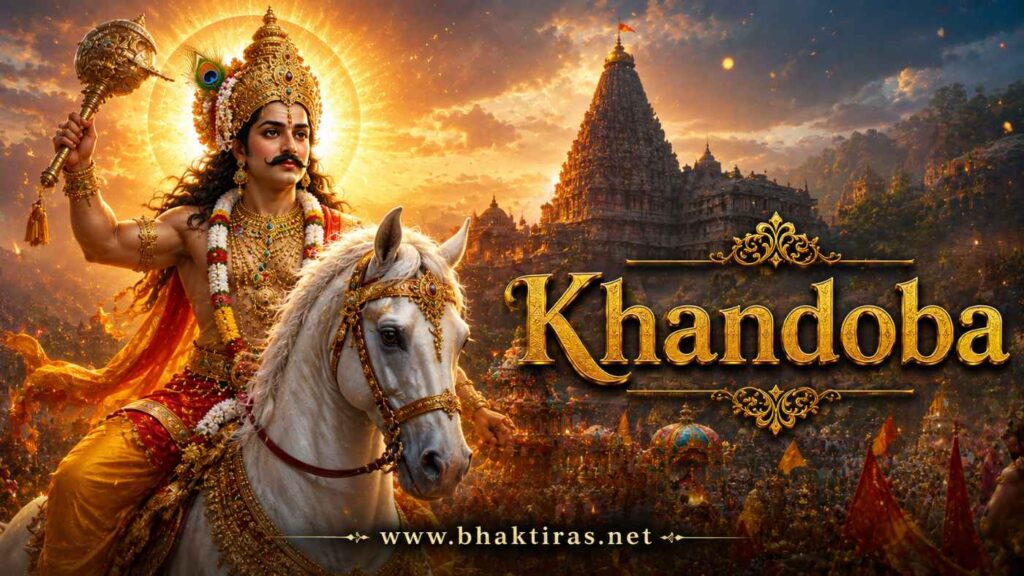
Khandoba is a folk warrior form of Lord Shiva, worshipped across Maharashtra, Karnataka and the Deccan. Riding a white horse and carrying a sword, he is the beloved kuldevta of countless families. He is famous for slaying the demons Mani and Malla, and his golden hill shrine at Jejuri glows yellow with turmeric.
Who Is Khandoba?
Khandoba (खंडोबा) is one of the most loved folk deities of the Deccan, a mighty warrior god riding a white horse with a sword raised against the darkness. Farmers in the fields, shepherds on the hills, and traders in the towns all turn to him, and for millions of families across Maharashtra and northern Karnataka he is the kuldevta – the guardian deity passed down through generations, invoked at weddings, births, and every turning point of life.
Though he wears the face of a local hero, Khandoba is understood by his devotees as a form of Lord Shiva himself. In the temple traditions he is Martanda Bhairava, a radiant sun-Bhairava, Shiva descended to earth in fierce and shining form to rid the land of demons. This double nature – divine yet close, cosmic yet local – is exactly why his worship feels so warm and immediate.
His name carries his story. Khanda means sword and ba means father or lord, so Khandoba is quite simply ‘the lord of the sword.’ Other names crowd around him too: Mallari and Malhari from the demons he slew, Khanderao in the folk songs, and Mailara or Mailaralinga in the Kannada country to the south.
What makes Khandoba so distinctive is how he binds people together. His two wives come from different worlds, his devotees cross every caste and calling, and his great festival at Jejuri turns an entire hillside gold. He is a god of the soil and the saddle, worshipped with turmeric, horses, drums, and a full-throated cry of joy.
A Warrior Form of Shiva
To understand Khandoba, one begins with Shiva. The temple texts, especially the Malhari Mahatmya, tell that when the demons Mani and Malla grew unbearable, the gods and sages went to Shiva for help. Shiva took a burning, sun-bright form to meet them, and in that form he is called Martanda Bhairava – Martanda the sun, and Bhairava the fierce, protective aspect of Shiva. Khandoba is that shining warrior stepping out of the heavens onto the Deccan hills.
This is why his worship carries strong solar and martial colours. He is imagined at the head of a great army, mounted and armed, moving at dawn. The turmeric that devotees shower on him – golden, sun-coloured – echoes this radiant character. Where the classical Kaal Bhairava guards the sacred city of Kashi, Martanda Bhairava as Khandoba guards the fields, herds, and villages of the Deccan.
So Khandoba is not a rival to Shiva or a separate god competing for devotion. He is Shiva in a particular mood and mission – the protector who rides out to fight, the lord who has made his home among ordinary working people rather than remaining distant on Kailasa. The great Mahadeva and the horseman of Jejuri are, for his devotees, one and the same.
The Slaying of Mani and Malla
The heart of Khandoba’s legend is his battle with two demon brothers, and it explains several of his names.
The Terror of the Demons
Mani and Malla were powerful demon brothers who had won boons and grown arrogant, tormenting sages in their forest hermitages and terrifying the people of the land. Sacrifices were disrupted, the countryside lived in fear, and the ordinary rhythm of farming and herding was thrown into chaos. When the sages could bear no more, they carried their appeal to the highest place they knew – the seat of Lord Shiva.
Shiva Rides Out
Moved by their suffering, Shiva took the burning form of Martanda Bhairava. Crowned and armed, he mounted a white horse and rode down with a host of divine warriors. A great battle followed across hill and plain, the demon armies scattering before the sword of the sun-Bhairava. The struggle was long, but the outcome was never in doubt.
Mercy and the Names
In the end Malla was struck down, and it is from him that Khandoba takes the names Mallari (‘enemy of Malla’) and Malhari. Mani, wounded and repentant, begged for mercy. Khandoba, fierce in war but generous in victory, granted it – and Mani offered his own white horse and asked that his name be remembered at the god’s shrine. This is why, in many tellings, Mani stands forgiven beside the very lord who defeated him, a reminder that Khandoba destroys evil but welcomes the surrendered heart.
Mhalsa and Banai – Uniting the Communities
One of the most beautiful things about Khandoba is that he has two consorts, and each connects him to a different world of people.
His first wife is Mhalsa (म्हाळसा), regarded as a form of the goddess Parvati. In the folk stories she is born into a wealthy Lingayat merchant family, and her marriage to Khandoba ties him to the trading and farming communities of the towns. She stands beside him in much of his iconography, the settled, dignified queen at the warrior’s side.
His second wife is Banai (also Banu, बानाई), a Dhangar shepherdess of the open grazing lands. The tale of how Khandoba, smitten by her, takes service as a herdsman to win her is a favourite of the folk songs. Through Banai he is bound to the pastoral Dhangar community, for whom he is the supreme family god.
Read together, the two marriages carry a quiet social meaning. Mhalsa brings the world of the merchant and the farmer; Banai brings the world of the shepherd. Their shared husband becomes a meeting point – a god whose household itself unites castes, occupations, and ways of life that might otherwise keep apart. In Khandoba’s worship a Brahmin priest, a Maratha farmer, a Lingayat trader, and a Dhangar herder all bow before the same lord, and that inclusiveness is written into the very legend of his family.
Jejuri, the Golden Hill
If Khandoba has a home on earth, it is Jejuri, a temple town on a hill about fifty kilometres from Pune. This is his most famous shrine and the beating heart of his worship, reached by a long climb of stone steps up to the fortress-like temple crowning the rise.
What Jejuri is truly known for is bhandara – fragrant yellow turmeric powder. Pilgrims arrive carrying it by the sackful and shower it over the deity, over the temple, and joyously over one another, until the steps, the walls, the priests, and the pilgrims themselves are dusted gold. On a busy festival day the whole hill seems to catch fire with colour, and the air itself turns yellow. Devotees call out ‘Yelkot Yelkot Jai Malhar’ and ‘Sonyachi Jejuri’ – Jejuri of gold – as the turmeric flies.
This turmeric worship is deeply fitting for a sun-bright god. The gold of the bhandara mirrors the radiance of Martanda Bhairava, and offering it is an act of pure celebration rather than solemn ritual. Alongside Jejuri stand other important shrines of the same lord: Malhargad and Pali in Maharashtra, and the temples of the south where he is worshipped as Mailara or Mailaralinga in Karnataka. Each carries the same warrior-on-horseback into its own region, but Jejuri, the golden hill, remains the great gathering place of his devotees.
Iconography and Symbols
Khandoba is easy to recognise once you know his signs. Each element of his image tells part of his story.
The White Horse
Khandoba is above all a horseman, most often shown galloping on a white steed. The horse marks him as a mobile warrior god who rides out to defend his people, and in his temples a horse – carved, cast, or living – is honoured as sacred to him.
The Sword
His chief weapon is the sword (khadga), the source of the very name Khanda-ba. It is the blade that cut down Mani and Malla, and it stands for the protective, evil-destroying power of Shiva turned toward the safety of the ordinary world.
Turmeric (Bhandara)
Golden turmeric powder is his signature offering. Sun-coloured and auspicious, it links him to Martanda, the sun, and turns his worship into a festival of colour. To be showered in bhandara at Jejuri is to be blessed by the god himself.
Mhalsa and the Dog
Khandoba is often shown with his consort Mhalsa riding behind him, and with a faithful dog at the horse’s feet. The dog is his loyal companion in the hunt and the battle, another sign of his closeness to Bhairava, whose animal is likewise the dog.
The Festivals and Devotees of Khandoba
The great festival of Khandoba is Champa Shashthi, kept in the month of Margashirsha, which celebrates his victory over Mani and Malla. It runs across six days, the temples ablaze with lamps and turmeric, and at Jejuri huge crowds climb the golden hill to sing his praises. Somvati Amavasya, the new-moon day that falls on a Monday – Shiva’s own day – also draws great gatherings, since Khandoba is Shiva in warrior form.
Two remarkable traditions of devotees are tied to him. The Waghya are men and the Murali are women who dedicate their lives to Khandoba’s service, singing his ballads, keeping his stories alive, and performing at his shrines and in the villages. Their songs are a living archive of his legends, carried from door to door and from generation to generation.
Then there are the Dhangars, the shepherd community for whom Khandoba – through his wife Banai – is the supreme kuldevta. Their folk songs, their annual visits to Jejuri, and their offerings of the flock knit the pastoral world tightly to this god. Around all of them gather the countless ordinary families of Maharashtra and Karnataka who name Khandoba as their household deity, offering bel leaves, breaking coconuts, and raising the cry of ‘Yelkot’ whenever his blessing is sought.
How Khandoba Is Worshipped
Worship of Khandoba is warm, physical, and full of colour. It ranges from the grand pilgrimage to Jejuri down to the simple daily prayer in a village home. Some of its most characteristic practices are:
- Offering bhandara (turmeric): Showering or applying golden turmeric powder on the deity and on fellow devotees, the single most beloved act of Khandoba worship.
- Offering bel leaves and coconuts: Bel (bilva) leaves sacred to Shiva, along with coconuts and simple flowers, are placed before the god as gifts of devotion.
- Pilgrimage to Jejuri: Climbing the stone steps of the golden hill, especially at Champa Shashthi, to have darshan of the lord and cry ‘Yelkot Yelkot Jai Malhar.’
- Honouring the horse: Worshipping the sacred horse of Khandoba and, in some families, keeping horse imagery in the household shrine.
- Kuldevta rituals: Seeking Khandoba’s blessing at weddings, first haircuts, and other family milestones, since he is the guardian deity of the lineage.
- Waghya-Murali songs: Listening to and supporting the ballads and performances of Khandoba’s dedicated devotees, which keep his legends alive.
- Lighting lamps and drums: Illuminating his temples with oil lamps and celebrating with drums and joyous shouts, treating worship as festivity.
Prayers and Mantras of Khandoba
Devotees invoke Khandoba both through Sanskrit mantras that name his Bhairava form and through the joyous folk cries of the Deccan. A simple and powerful mantra addresses him as the radiant sun-Bhairava:
ॐ श्री मार्तण्ड भैरवाय नमः
Om Shri Martanda Bhairavaya Namah
‘Om, salutations to Martanda Bhairava, the radiant sun-form of Shiva.’
Beyond this, the most familiar sound of his worship is the ringing folk cry raised on the golden hill and in every gathering of his devotees:
Yelkot Yelkot Jai Malhar!
A joyous shout of victory and praise to Malhari – Khandoba – that lifts the spirits of pilgrims and turns his worship into celebration. To chant his names, offer turmeric, and raise this cry with a sincere heart is, for his devotees, to feel the warrior-lord riding close.
Frequently Asked Questions about Khandoba
Who is Khandoba?
Khandoba is a popular folk and Puranic warrior god of the Deccan, worshipped as a form of Lord Shiva. He rides a white horse, carries a sword, and is the kuldevta (family deity) of countless families across Maharashtra and Karnataka. His most famous shrine is at Jejuri.
Is Khandoba a form of Shiva?
Yes. Khandoba is understood as a manifestation of Lord Shiva in the form of Martanda Bhairava, a radiant sun-Bhairava. According to the Malhari Mahatmya, Shiva took this fierce, shining warrior form to destroy the demons Mani and Malla and protect the sages and people.
Why is turmeric offered at Jejuri?
Turmeric, called bhandara, is Khandoba's signature offering because its golden colour mirrors his radiant sun-Bhairava nature. At Jejuri devotees shower it over the deity and one another until the whole hill glows yellow, giving it the name 'the golden hill' and 'Sonyachi Jejuri.'
Who are Mhalsa and Banai?
They are Khandoba's two consorts. Mhalsa is regarded as a form of Parvati, born into a Lingayat merchant family, while Banai is a Dhangar shepherdess. Together they connect Khandoba to trading, farming and herding communities, so his worship binds different castes and callings.
What is the significance of Mani and Malla?
Mani and Malla were demon brothers who tormented the sages and people. Khandoba, as Martanda Bhairava, defeated them in battle. From Malla he takes the names Mallari and Malhari. The repentant Mani was spared and offered his white horse, so he is often remembered at Khandoba's shrines.
When is Khandoba's main festival celebrated?
The great festival of Khandoba is Champa Shashthi, held in the month of Margashirsha, which celebrates his victory over Mani and Malla. It runs across six days with lamps, turmeric and large pilgrim gatherings, especially at Jejuri. Somvati Amavasya is also an important day for his devotees.
Who are the Waghya and Murali?
The Waghya (men) and Murali (women) are devotees who dedicate their lives to Khandoba's service. They sing his ballads, keep his legends alive, and perform at his shrines and in villages. Their songs form a living archive of Khandoba's stories, passed down through generations.
What does 'Yelkot Yelkot Jai Malhar' mean?
It is the joyous devotional cry of Khandoba's worshippers, especially at Jejuri. 'Jai Malhar' means 'victory to Malhari,' one of Khandoba's names, while 'Yelkot' is a traditional shout of praise. Raising this cry while showering turmeric turns his worship into a celebration of the warrior-lord.
May the warrior-lord of Jejuri ride close to your home, guarding your family as he has guarded the Deccan for generations. Yelkot Yelkot Jai Malhar!