
Kaal Bhairava
काल भैरव
Kaal Bhairava is the fierce form of Lord Shiva, the lord of time (Kaala) and the guardian of sacred space. He destroys ego, fear and ignorance, and rides a dog. As Kotwal of Kashi, pilgrims seek his permission before worshipping Vishwanath. Devotees pray to him for protection and freedom from untimely death.
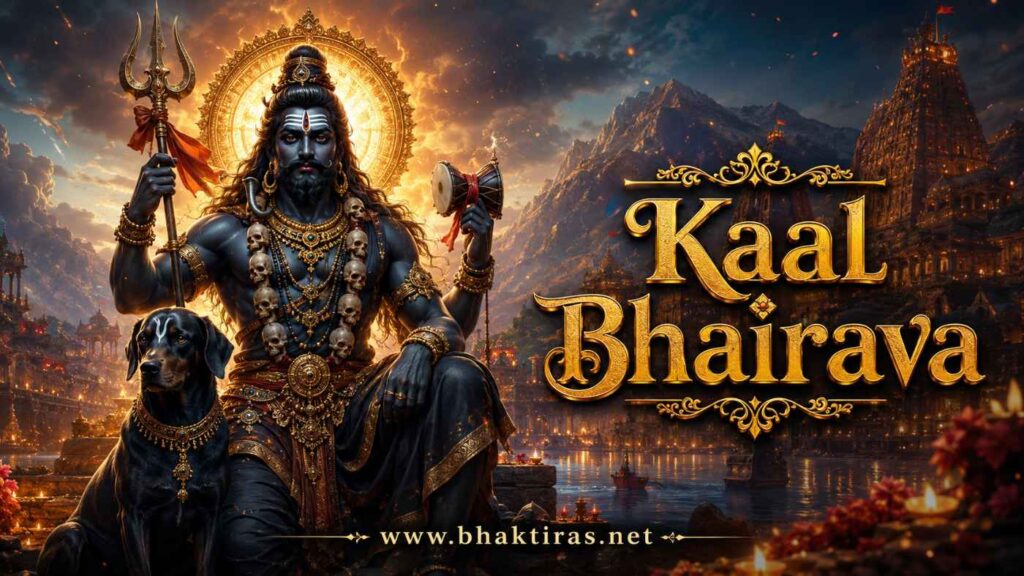
Who Is Kaal Bhairava
Kaal Bhairava is the fierce face of Lord Shiva, the one who appears when gentleness is no longer enough. His images can look frightening at first glance – a dark or deep-blue body, wild hair, wide eyes, a garland of skulls, a dog waiting at his feet. Yet everything about that fierceness points inward. What he destroys is not the devotee but the devotee’s fear, arrogance and confusion.
The name carries two ideas. Bhairava comes from a root that suggests something terrifying and awe-inspiring, the presence that makes a person stop pretending. Kaal means time itself. Put together, Kaal Bhairava is the lord of time in its most honest form – the force that dissolves everything false and outlasts everything that thinks it is permanent. To meet him in worship is to be reminded that pride and fear have an expiry date, and that Shiva stands beyond both.
Because he is so closely tied to Shiva, Bhairava is never worshipped as a rival deity. He is understood as an aspect, a particular mood of the same infinite Shiva – the mood that protects the boundary, guards the threshold, and clears away obstacles that block a sincere seeker. Tantric traditions hold him in special regard, but his worship reaches far beyond any single school. Ordinary families keep his image at doorways and crossroads for safety, and pilgrims across India know him as a guardian who answers quickly.
Approached with respect, the fierce imagery becomes a teaching rather than a scare. The skull he carries is a reminder of mortality. The dog beside him is loyalty without ego. The trident in his hand is the same trishula Shiva carries. He is fierce so that the devotee can be fearless.
The Lord of Time
To call Bhairava Kaal is to give him charge of the one thing no one can bargain with. Time takes empires, bodies and reputations without exception, and Hindu thought does not treat this as cruelty. It treats it as the great cleansing power that keeps the universe honest. Kaal Bhairava embodies that power. He is the aspect of Shiva that lets nothing false remain standing.
This is why his worship is aimed so directly at the ego. Pride tells a person they are the exception, that their achievements or fears are permanent and unshakeable. Kaal Bhairava answers that quietly by being time itself: whatever the ego clings to, he will one day take. Devotees who understand this do not fear him, they turn to him. Handing over one’s fear to the lord of time is a way of setting it down.
The same logic explains why he is prayed to for protection from akaal mrityu, untimely or unnatural death. As the master of time, Bhairava is asked to guard the natural span of life and to keep away accidents, sudden loss and the influence of harmful forces. There is a deep comfort in this. The being who could take everything is precisely the being asked to protect it.
Fear, in his presence, is not denied but transformed. He does not promise that nothing will end. He offers something steadier – the knowledge that endings belong to Shiva too, and that a heart which has surrendered its fear to the lord of time has very little left to lose.
The Story of Brahma's Fifth Head
A word spoken in pride
The Puranas tell of a moment when the creator-god Brahma grew proud. In one telling, the gods were debating who among them was supreme, and Brahma, carried away by his own importance, spoke of Shiva with contempt – even claiming a rank above him. In the old accounts Brahma had five heads, and it was the fifth head that uttered the arrogant, disrespectful words. Pride had turned a great god into someone who could belittle the source of all things.
A being born of wrath
From Shiva’s anger a fierce figure sprang into being – dark, blazing, unafraid. This was Bhairava, wrath made conscious and purposeful. He was not born to punish for its own sake but to correct a specific offence: arrogance aimed at the divine. With a swift stroke he severed Brahma’s fifth head, the one that had spoken the proud words. The lesson was not the death of the creator but the removal of ego. Brahma lived on with four heads, humbled and restored to right understanding.
The skull that would not leave
Cutting off a head of Brahma, even a proud one, is no small act. The sin of Brahmahatya – the gravest transgression – clung to Bhairava, and the severed skull stuck fast to his hand and would not fall. So the fierce lord became a wanderer, a mendicant carrying that skull as his begging bowl, walking the earth as a Kapali. His fearsome errand had a cost, and he bore it openly rather than hiding it.
Release at Kashi
Bhairava wandered from place to place, and the skull remained stuck, until at last he reached the holy city of Kashi – Varanasi, the city of Shiva. There, at a sacred spot later known as Kapal Mochan, the skull finally fell from his hand and the sin was lifted. Kashi had done what no other place could. In gratitude and by Shiva’s will, Bhairava stayed on as the guardian of the city that had freed him, and Kashi gained its fierce protector.
Read carefully, the story is less about violence and more about correction. Pride is cut down, the price is paid honestly, and grace is found in the holiest city. It is the arc every devotee is invited to walk – ego humbled, burden carried without pretence, release granted where surrender is complete.
The Kotwal of Kashi
Having been released of his burden in Kashi, Bhairava never left. He became the Kotwal of the city – a word that means the chief guardian or magistrate, the officer responsible for keeping order and watching every gate. In the sacred geography of Varanasi, Kaal Bhairav is not a minor figure. He is the one who holds authority over the city on Shiva’s behalf.
This gives rise to one of Kashi’s most enduring customs. Traditional pilgrims hold that before you worship Lord Vishwanath, the presiding Shiva of Kashi, you should first pay your respects to Kaal Bhairav and seek his permission. He is the guardian at the threshold; the pilgrimage is considered complete and rightly ordered only when his blessing has been taken. Many devotees still begin their Kashi yatra at the Kaal Bhairav temple for exactly this reason.
His role as Kotwal also carries a moral weight. As guardian-magistrate, he is said to keep account of right and wrong within the city, protecting the sincere and unsettling the deceitful. To live under his watch is to live somewhere that fear and wrongdoing find no easy footing. This is why he is loved rather than merely feared – a strict guardian is exactly what a sacred city needs, and Kashi has kept him at his post for centuries.
Iconography & Symbols
Every element of Bhairava’s form is a lesson in disguise. What looks fearsome is, on closer reading, a set of reminders about ego, time and protection.
The dog (shvan)
Bhairava’s vahana is the dog, an animal others often overlook. The dog is loyalty without pride and devotion without pretence – it does not calculate status or reward. As Bhairava’s mount it teaches that the way to reach the fierce lord is through humble, faithful surrender, and it reminds devotees that even the humblest creature has a place at Shiva’s feet.
The trishula (trident)
He carries Shiva’s trident, the three-pronged spear that stands for the three qualities of nature and the mastery of creation, preservation and dissolution. In Bhairava’s hand it marks him unmistakably as Shiva, and shows that his fierceness serves the same cosmic order – cutting through what obstructs the seeker’s path.
The damaru (drum)
The small two-headed drum is the sound of Shiva, the rhythm from which language and creation are said to arise. In Bhairava’s grip it links terror and music, ending and beginning. The same lord who dissolves the false also beats the drum from which new understanding is born.
The kapala (skull-bowl)
The skull he holds is at once the mark of the old story and a constant teaching. It is a reminder that the body ends and that clinging to it is folly. Carried openly as a begging bowl, it also shows a lord who has renounced everything – the very picture of the ego dissolved.
The dark, fierce form
His deep-blue or black body, wild hair, garland of skulls and blazing eyes are the face of time itself, unflinching before what must end. The darkness is not evil; it is the boundless space that swallows all colour and fear. Approached with reverence, that fierce form becomes the safest place to lay down one’s own dread.
The Ashta Bhairava and Great Shrines
Bhairava is not a single figure alone. Tradition speaks of the Ashta Bhairava, eight forms that guard the eight directions and preside over different powers – each with its own name, colour and temperament, together forming a protective ring around creation. Through these eight, Bhairava keeps watch over every quarter of space, which is why he is honoured as Kshetrapala, the protector of the field or sacred ground.
His great shrines carry this guardian character. In Kashi (Varanasi) stands the temple of the Kotwal himself, where pilgrims seek his permission before the Vishwanath darshan and where the story of his release is remembered at Kapal Mochan. His presence there defines the city’s sacred order.
In Ujjain, in Madhya Pradesh, the ancient Kaal Bhairav temple is famous for a striking practice – the deity is offered liquor, which the priests present at his lips, a custom drawn from the older Tantric and Kapalika modes of worship that many pilgrims witness with wonder. Ujjain, itself a Shiva city and home to the Mahakaleshwar Jyotirlinga, treats Kaal Bhairav as its guardian just as Kashi does.
Across Nepal, and especially in the Kathmandu Valley, Bhairava is worshipped with great intensity. Towering Bhairava masks and images stand in the old royal squares, and festivals bring his fierce, protective presence into the heart of public life. From the ghats of Varanasi to the courtyards of Kathmandu, the same fierce guardian is honoured as the one who keeps the sacred safe.
How Kaal Bhairava Is Worshipped
Worship of Kaal Bhairava is direct and heartfelt, often turned toward protection and courage. Devotees approach him to shed fear, clear obstacles and guard against harm, and his rites keep a plain, unfussy character that suits his role as guardian.
- Kaal Bhairav Ashtami: His most important day, falling on the eighth day of the waning moon in the month of Margashirsha (usually November or December). Devotees fast, keep vigil, visit Bhairava temples and offer prayers for protection through the coming year.
- Lighting lamps and offering flowers: A simple mustard-oil or sesame-oil lamp before his image is a common and beloved offering, along with black or dark flowers and sindoor, marking the devotee’s request for his watchful care.
- Feeding dogs: Because the dog is his vahana, feeding street dogs – especially black dogs – is considered a direct and pleasing act of devotion to Kaal Bhairava, one any household can perform.
- Chanting his names and mantra: Repeating Om Kaalabhairavaya Namah or reciting the Kaal Bhairav Ashtakam is a favoured practice for those seeking his protection and the removal of fear.
- Seeking permission at Kashi: Pilgrims to Varanasi traditionally begin at the Kaal Bhairav temple, taking his darshan and blessing before proceeding to worship Vishwanath.
- Prayers for protection and victory: Devotees turn to him against enemies, negativity, black magic and untimely death, trusting the lord of time to guard the natural span and dignity of life.
Whatever the form of worship, the spirit stays the same – a fierce lord approached with humility, asked not for indulgence but for courage, safety and freedom from fear.
Prayers & Mantras
The heart of Bhairava worship is his name, spoken with faith. His mantras are short and forceful, meant to steady the mind and place the devotee under his protection. The most widely chanted is his simple mool mantra, offered before a lamp or during his sacred days.
ॐ कालभैरवाय नमः
Om Kaalabhairavaya Namah
“Om, salutations to Kaal Bhairava, the fierce lord of time.” To utter this is to bow before the aspect of Shiva that dissolves fear and pride, and to ask his guardianship over one’s life. Devotees also recite the Kaal Bhairav Ashtakam, an eight-verse hymn traditionally sung in praise of the Kotwal of Kashi, whose closing verses promise freedom from grief and fear to those who chant it with devotion.
Frequently Asked Questions about Kaal Bhairava
Who is Kaal Bhairava?
Kaal Bhairava is the fierce form of Lord Shiva, known as the lord of time (Kaala) and the guardian of sacred space. He destroys ego, fear and ignorance, rides a dog, and carries a trident and skull-bowl. As Kotwal of Kashi he guards the holy city and is worshipped for protection and courage.
Why is Bhairava the Kotwal of Kashi?
After the sin of severing Brahma's proud head was lifted from him in Kashi, Bhairava stayed on as the city's guardian. Kotwal means chief guardian or magistrate. He watches over Varanasi on Shiva's behalf, which is why pilgrims traditionally seek his permission before worshipping Lord Vishwanath there.
Why is the dog associated with Bhairava?
The dog (shvan) is Bhairava's vahana or mount. It stands for loyalty and devotion without pride, since a dog serves faithfully without calculating status or reward. This is why feeding dogs, especially black ones, is considered a pleasing act of worship to Kaal Bhairava.
How did Kaal Bhairava originate?
When Brahma grew proud and spoke disrespectfully of Shiva with his fifth head, a fierce being sprang from Shiva's wrath and cut off that arrogant head. This being was Bhairava. The severed skull stuck to his hand as the burden of the deed until he was released in Kashi.
What do Bhairava's weapons and symbols mean?
The trishula marks him as Shiva and cuts through obstacles; the damaru is the sound of creation; the pasha (noose) binds negativity; and the kapala (skull-bowl) reminds us of mortality and the dissolved ego. Together they show a fierce lord whose power serves protection and inner freedom.
When is Kaal Bhairav Ashtami observed?
Kaal Bhairav Ashtami falls on the eighth day of the waning moon in the month of Margashirsha, usually in November or December. Devotees fast, keep a night vigil, visit Bhairava temples, light lamps and pray for protection and freedom from fear through the year ahead.
What are the Ashta Bhairava?
The Ashta Bhairava are the eight forms of Bhairava who guard the eight directions of space. Each has its own name, colour and power, and together they form a protective ring around creation. This is why Bhairava is honoured as Kshetrapala, the protector of sacred ground.
Why is Kaal Bhairava worshipped for protection?
As the lord of time, Bhairava is asked to guard the natural span of life and keep away untimely death, accidents, enemies and negative forces. Devotees pray to him to remove fear and obstacles, trusting that the guardian who could take everything is the safest one to protect it.
May the fierce and faithful guardian of Kashi lift your fear, humble your pride, and keep the light of your life safe under his watch.