
Goddess Bhairavi
भैरवी
Bhairavi is the fifth of the ten Mahavidyas, the fierce goddess of tapas, transformation and the burning away of impurity. Red-complexioned and often shown with a garland of severed heads, a book and rosary, she is the feminine counterpart of Bhairava, Shiva's fierce form. Devotees turn to her for courage, protection and the inner discipline that dissolves ego.
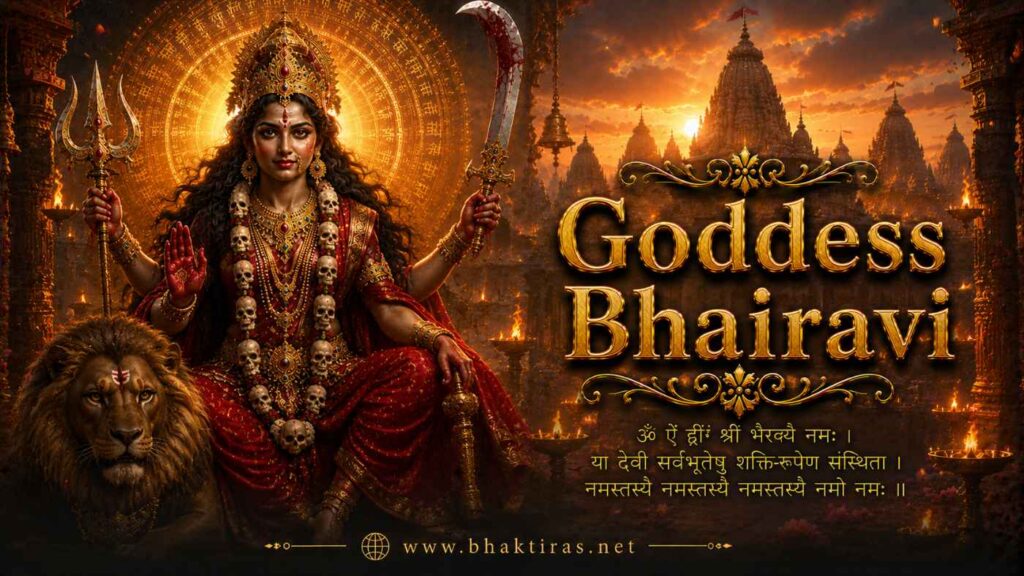
Who Is Goddess Bhairavi?
Bhairavi is the fifth Mahavidya, one of the ten great goddesses of wisdom whose forms carry the Divine Mother through every shade of light and shadow. Her name comes from Bhairava, the fierce, roaring aspect of Shiva, and the feminine ending marks her as his living counterpart – not a shadow of him, but the active heat that his stillness holds. Where he is the calm ground, she is the fire that moves across it.
She is most often called Tripura Bhairavi, the fierce one who reigns over the three worlds and the three states of waking, dream and deep sleep. In her the Mother turns her attention to what is difficult: decay, endings, the slow rot of habit, and the ego that clings past its season. Bhairavi does not soothe these away. She meets them with heat.
To those who only glance at her red skin and her garland of severed heads, she can seem frightening. But the tradition that shaped her is precise about what those images mean. The severed heads are not trophies of violence. They are the false selves a seeker must set down. The fire is not destruction for its own sake – it is the fire a goldsmith uses, burning off everything that is not gold.
She belongs to the Tantric stream of Hindu worship, where the sacred is found not by avoiding intensity but by passing through it with awareness. Bhairavi is the goddess you turn to when comfort has run out and only courage will do.
The Fire of Tapas
At the heart of Bhairavi is tapas – a word usually translated as austerity, though its root simply means heat. In the old cosmology, the universe itself was warmed into being by tapas, the concentrated inner fire of the divine mind. Bhairavi is that heat made personal, the force that ripens whatever it touches, whether that is a seed, a discipline, or a stubborn human will.
Anyone who has kept a hard practice knows this fire from the inside. The friction of doing what is difficult, again and again, generates warmth in the mind. Old attachments grow uncomfortable in that heat. Excuses dry up. What could not be reasoned away simply burns off. This is the work Bhairavi presides over – not punishment, but refinement, the way fever burns through an illness or a kiln hardens soft clay into something that will hold water.
Because her heat is also the heat of kundalini, the coiled energy said to rest at the base of the spine, she is closely tied to the inward rising of awareness. As that energy wakes and climbs, it is felt as warmth, and the tradition names Bhairavi as its guardian. She is invoked by those who want intensity in their spiritual life rather than ease, who would rather be tested than left comfortable.
She is also linked to speech – to the fire in a true word, the vibration of mantra that can reshape the one who repeats it. In this she is close to the power of Vak, sacred sound, and her worship often centres on chanting held steady until the sound itself becomes heat.
Iconography and Symbols
Every detail of Bhairavi’s form is a teaching. Read slowly, her fierce image becomes a map of inner work rather than a scene of terror.
Red Complexion
Her skin is red, the colour of dawn, blood and living flame. It marks her as the goddess of heat and vitality – the warmth of tapas, the flush of concentrated energy, the first red light that burns away the dark of night.
Garland of Severed Heads
The mala of heads she wears is often read as the letters of the Sanskrit alphabet, the whole power of speech strung around her. It is also the seeker’s discarded identities – each false self set down as the ego is loosened, one head at a time.
Book and Rosary
In two hands she holds a pustaka (book) and an aksamala (rosary). These are the quiet tools of the fierce goddess: study and repetition, knowledge and steady practice. Her fire is not blind – it is guided by wisdom and disciplined by prayer.
Sword or Abhaya-Varada
Her remaining hands hold either a sword, which cuts through ignorance in a single stroke, or form the gestures of abhaya (do not fear) and varada (I give). The same goddess who burns is the one who reassures and grants.
Corpse or Lotus Seat
She may be seated on a lotus rising from calm water, or on a corpse. The lotus shows purity unspoiled by the mud it grows from; the corpse shows her mastery over death itself, seated serenely on what others fear most.
Wide, Steady Eyes
Her eyes are open wide and unblinking. This is not anger but total attention – the alert, unwavering gaze of one who sees clearly and looks away from nothing, including the parts of ourselves we would rather hide.
Bhairavi and Bhairava
Bhairavi cannot be fully understood apart from Bhairava, the fierce form of Shiva whose name she carries. The two are a single reality seen from two sides: he the awareness, she the energy; he the silence, she the sound that moves within it. In Tantric thought neither is complete without the other, and the fierce pair together represent the meeting of stillness and force.
Bhairava is the guardian who roams the boundaries – of villages, of the mind, of life and death – unafraid of what lives at the edges. Bhairavi shares that fearlessness, but turns it inward. If Bhairava guards the outer thresholds, Bhairavi guards the crossings within: the difficult passages where an old self must die for a new one to be born.
Their union is often described as the reason nothing in creation stands still. His presence gives her fire a ground to burn upon; her fire gives his stillness something to witness. Worshippers who honour Bhairavi frequently honour Bhairava alongside her, and many fierce temples hold shrines to both, understanding that the destruction of impurity needs both the flame and the calm that holds it.
Among the Ten Mahavidyas
The ten Mahavidyas are ten faces of the one Divine Mother, ranging from the gentle to the terrifying, each teaching a different truth about reality. Kali is time and the dissolution of all forms; Tara is the saving guide across the dark water; Tripura Sundari is beauty and blissful awareness. Within this circle, Bhairavi holds the place of transformation through heat.
She sits at the point where the pleasant goddesses give way to the fierce ones. Some traditions count her as fifth, the hinge of the group, the moment where the Mother’s compassion takes on an edge. Her particular lesson is that growth is not always comfortable – that the same love which cradles us will also, when we are ready, set us in the fire to be refined.
Understood together, the Mahavidyas insist that the divine is not only sweetness. Wisdom includes the power to end things, to face decay, to burn away what has outlived its use. Bhairavi carries that truth without apology. To meditate on her is to accept that the sacred can look fierce and still be entirely on our side.
How Goddess Bhairavi Is Worshipped
Bhairavi’s worship belongs mainly to the Tantric tradition and is often taken up under the guidance of a teacher. Even so, her simpler devotions are open to anyone drawn to her fierce grace. Common practices include:
- Chanting her seed mantra Hreem and her mool mantra Om Hreem Bhairavyai Namah, held steady until the sound settles the mind.
- Lighting a red or ghee lamp before her image, offering red flowers such as hibiscus, and burning fragrant incense to honour her nature as goddess of fire.
- Observing her worship especially during Navaratri and on Bhairavi Jayanti, when devotees fast and chant through the night.
- Taking up a personal tapas in her name – a difficult discipline kept faithfully, offered to her as the fire that ripens the seeker.
- Reading or reciting the hymns and stotras addressed to her, which praise her as the burner of impurity and the granter of courage.
- Approaching her fiercer rites only with an initiated teacher, since Tantric worship of Bhairavi is precise and best learned in guided steps.
Whatever the form, sincerity matters more than elaborateness. Bhairavi is said to respond less to the size of the offering than to the honesty of the one who makes it.
Temples and Sacred Sites
Bhairavi is honoured across India, most strongly where the Shakta and Tantric traditions run deep. A number of important sites carry her presence:
- The Bhairavi shrine at Kamakhya in Assam, part of the great Mahavidya complex where all ten Wisdom Goddesses are venerated together.
- Temples in Bengal, where fierce goddess worship is woven into local life and Bhairavi is honoured alongside Kali and Tara.
- Himalayan and northern shrines where she is worshipped as Tripura Bhairavi and linked to the fierce forms of the Mother.
- Shakti Peetha sites where the fierce aspect of the goddess, including her Bhairavi form, is enshrined with an accompanying Bhairava guardian.
- Countless smaller village and forest shrines where she is kept as the fierce protector of thresholds and the burner of harm.
In many of these places her shrine sits close to one of Bhairava, keeping the fierce pair together as tradition intends.
Prayers and Mantras
Sound is central to Bhairavi’s worship. Her mantras are held to carry her fire directly into the practitioner, warming and steadying the mind. Her principal invocation is:
ॐ ह्रीं भैरव्यै नमः
Om Hreem Bhairavyai Namah
‘I bow to Bhairavi, the fierce goddess, through the sound of Hreem.’
The seed Hreem is the bija of the inner power that veils and reveals, and repeating it with attention is said to kindle courage and clarity. Devotees often chant this mantra a fixed number of times each day, letting the repetition build into a quiet heat that the goddess herself is felt to fan.
Frequently Asked Questions about Goddess Bhairavi
Who is Goddess Bhairavi?
Bhairavi is the fifth of the ten Mahavidyas, the fierce Hindu goddess of tapas, transformation and the destruction of impurity. She is the feminine counterpart of Bhairava, Shiva's fierce form, and is worshipped for courage, protection and the inner discipline that burns away the ego.
Why is Bhairavi shown with a garland of severed heads?
The garland is symbolic, not gruesome. The heads are often read as the letters of the Sanskrit alphabet, representing the power of speech, and also as the false selves and attachments a seeker must set down. Each head marks another layer of ego released on the path of transformation.
What does tapas mean in relation to Bhairavi?
Tapas means spiritual heat or disciplined austerity, and its root simply means heat. Bhairavi personifies this fire – the warmth generated by hard, steady practice that ripens the seeker and burns away impurity. She is invoked by those who want intensity and refinement in their spiritual life.
How is Bhairavi related to Bhairava?
They are two sides of one reality. Bhairava is the fierce form of Shiva, pure awareness and stillness; Bhairavi is his energy and fire. Bhairava guards outer thresholds, while Bhairavi guards the inner crossings where an old self dies and a new one is born. Neither is complete without the other.
What is Bhairavi's main mantra?
Her principal mantra is Om Hreem Bhairavyai Namah (ॐ ह्रीं भैरव्यै नमः), which means 'I bow to the fierce goddess Bhairavi.' The seed syllable Hreem carries her inner power, and chanting it steadily is said to build courage, clarity and spiritual heat in the practitioner.
What blessings do devotees seek from Bhairavi?
Devotees turn to Bhairavi for courage, protection from harm, and victory over enemies both outer and inner. Above all she is sought for spiritual intensity – the strength to face difficulty, endure hard discipline, and let the fire of transformation burn away ego, fear and attachment.
Is Bhairavi worship only for advanced practitioners?
Her fiercer Tantric rites are precise and best learned from an initiated teacher, but her simpler devotions are open to anyone. Chanting her mantra, lighting a lamp, offering red flowers, and keeping a sincere personal discipline in her name are all traditional ways to honour her.
May Goddess Bhairavi kindle in you the courage to face what is hard and the steady fire that burns away all that keeps you small.