
Garuda
गरुड
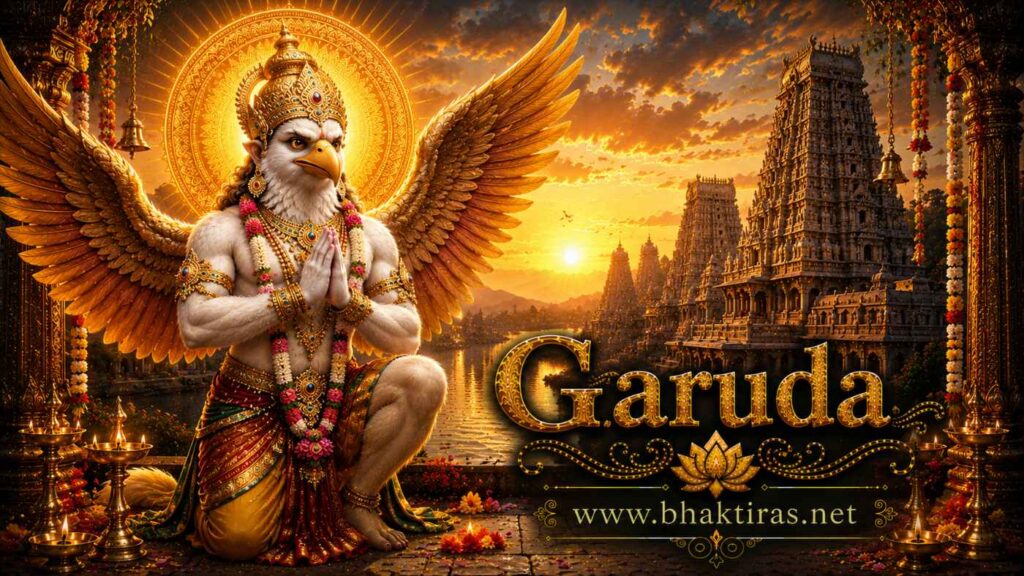
Garuda is the mighty king of birds, the celestial eagle who carries Lord Vishnu across the worlds. Born to the sage Kashyapa and Vinata, he freed his enslaved mother by seizing the nectar of immortality from the gods. Radiant, swift and fierce, he is the sworn foe of serpents and a guardian against poison and fear.
Who Is Garuda?
Garuda is the great eagle of the heavens, the king of all birds, and the tireless mount who carries Lord Vishnu wherever he must go. When you picture Vishnu soaring through the sky to answer a devotee’s cry, it is Garuda’s outstretched wings beneath him. He is speed made visible, loyalty given feathers and flame.
In the oldest tellings he is a being of blinding radiance. When Garuda was born, his golden light was so fierce that the gods mistook him for Agni, the fire itself, and bowed to him in confusion. He is not a small or quiet figure. He fills the sky, and even the mightiest of the Devas learned to respect the beat of his wings.
Yet Garuda is more than raw power. His story begins with a son’s love for his mother and a promise to set her free. That promise carried him into a war with the gods and to the very jar of immortality, and it is this devotion, first to his mother and then to Vishnu, that makes him beloved. Worshippers turn to him for courage, for swiftness in trouble, and above all for protection from serpents, poison and dread.
Across India his eagle form guards the entrances of Vishnu temples, and his name is spoken wherever a snake is feared or a journey needs safe passage. He is fierce to enemies and gentle to those he protects, which is exactly the sort of guardian the heart wants nearby.
Son of Kashyapa and Vinata
Garuda’s father was the sage Kashyapa, one of the great progenitors of creation, from whom gods, demons, birds and serpents all descend. His mother was Vinata, one of Kashyapa’s wives. Her sister and co-wife was Kadru, who would become the mother of the thousand nagas. From this single family the ancient enmity between eagle and serpent was born, and Garuda grew up carrying it in his blood.
The tale of his birth is unusual and telling. Vinata was given two eggs and, in her impatience, cracked one too soon. From it came Aruna, her first son, only half formed, who became the charioteer of the Sun and is glimpsed as the red glow of dawn. Vinata, chastened, waited long and patiently for the second egg. When it finally opened, out came Garuda, whole, immense and shining.
His arrival shook the heavens. His body blazed like the fires that end an age, and the frightened Devas prayed to him, unsure whether he was a new destroyer come among them. Garuda calmed his own brightness at their request, dimming his radiance so the worlds could look upon him. Even then, everyone understood that a new and extraordinary power had entered creation, one that would not be commanded lightly by anyone.
The Bondage of Vinata and the Quest for the Nectar
A cruel wager
The trouble began with a bet. Kadru and Vinata argued over the colour of the tail of Uchchaihshravas, the divine horse that rose from the churning of the ocean. Kadru claimed part of its tail was black; Vinata insisted it was purely white. They wagered their freedom on the answer, the loser to become the winner’s slave. To be certain of victory, Kadru ordered her serpent sons to cling to the horse’s tail and darken it. Some obeyed; through their deceit the tail appeared black, and Vinata lost. She was bound into servitude to her own sister.
A son's promise
Garuda found his mother enslaved and his heart turned to stone with resolve. He went to the serpents and asked what price would free her. Their answer was staggering: bring us the amrita, the nectar of immortality, from the halls of the gods. It was an errand meant to be impossible, guarded as the nectar was by fire, by a spinning wheel of blades, and by two great serpents whose gaze was death. Garuda did not flinch. He set out to win it.
Storming the heavens
He crossed the worlds and fell upon the guardians of the nectar. He drank rivers to smother the ring of flame, shrank his mighty body to slip through the whirling blades, and blinded the two watching serpents with dust before he struck them down. Even Indra hurled his thunderbolt, the vajra, and Garuda barely shed a single feather. The gods, seeing they could not stop him by force, chose to bargain instead.
The nectar carried, the mother freed
Garuda took the jar of amrita but did not drink a drop for himself. That restraint, in one strong enough to take whatever he wished, is the heart of his greatness. He carried the nectar back and set it before the serpents to buy his mother’s freedom. But he had struck a quiet arrangement with Indra along the way: the nectar would be reclaimed. As the serpents purified themselves before drinking, the jar was snatched away. They licked the sharp kusha grass where it had rested, and its edges split their tongues, which is why serpents are forktongued to this day. Vinata walked free, and Garuda had kept his word.
The Mount and Devotee of Vishnu
During his great raid on the heavens, Garuda drew the attention of Lord Vishnu himself. Vishnu was struck by the eagle’s strength and, still more, by his self control, for here was a being who could take the nectar of immortality and yet refused to drink it. Vishnu offered him two boons. Garuda asked to fly above the Lord and to be free of the pull of old age and death. Vishnu granted both, placing Garuda upon his banner so that he rides higher than even the one who carries him.
In return, Garuda offered himself as Vishnu’s vahana, his mount and vehicle, and from that day the two are inseparable. Wherever Vishnu goes to guard the good or humble the wicked, Garuda’s wings bear him there in a heartbeat. This is a devotion of the highest kind: not a servant kept by duty, but a friend and warrior who chose his Lord and never wavered.
It was also Vishnu, or in some tellings a boon won along the way, that sealed the ancient food-order between eagle and snake, making the serpents Garuda’s natural prey. So the enmity that began in his mother’s household became a cosmic role. Garuda keeps the serpent power in check, and the devotee who calls his name calls on that same protecting force.
Protector from Snakes, Poison and Fear
For ordinary devotees, Garuda is above all a shield. Because he is the eternal foe of serpents and the master of their poison, people have prayed to him for centuries against snakebite, against venom of every kind, and against the slow poisons of illness and dread. In villages where cobras were a real danger, the eagle’s name was a real comfort.
His protection is understood widely as well as literally. The serpent has long stood for the hidden fear, the coiled anxiety, the enemy you cannot see. To invoke Garuda is to ask that these be seized and carried off in his talons the way he grasps a snake. Travellers seek his speed for safe journeys, the sick seek his power against poison, and the frightened seek the plain courage that his fearless story gives.
There is a warmth in this. Garuda is fierce, yes, but his fierceness is turned outward, toward whatever threatens those under his wing. To the devotee he is the strong friend who steps in front of danger, the guardian at the gate who will not be moved. That is why his image watches over so many shrines: he is placed there to keep the way safe.
The Garuda Purana and the Garuda Stambha
One of the eighteen great Puranas bears Garuda’s name. The Garuda Purana is told as a dialogue: Lord Vishnu narrates it to Garuda, his ever-attentive mount, and so the eagle becomes the listener through whom the teaching reaches us. Much of the text deals with death, the journey of the soul after it leaves the body, the workings of karma, rebirth, and the rites the living perform for the departed. In many Hindu homes portions of it are read after a death, which is why the Garuda Purana is so closely tied to funeral rites and to questions of what lies beyond this life.
Garuda’s presence is felt in stone as well as in scripture. Before the shrines of Vishnu across India stands the Garuda Stambha, the eagle pillar. Atop it sits Garuda with folded hands, facing the Lord, forever the first and most faithful of Vishnu’s devotees. Worshippers pass this pillar as they enter, and it reminds them of the posture of the whole tradition: to stand before the divine with the humility and readiness that the mighty eagle himself shows.
In the south he is honoured with special affection. There he is called Periya Tiruvadi, and his eagle standard flies over the great Vishnu temples, a sign that the Lord within is watched over by the swiftest and most devoted of guardians.
Iconography & Symbols
Wings of gold
Garuda is shown with vast outspread wings, often golden or aflame with light. They speak of speed, of freedom, and of the ability to cross any distance to reach a devotee in need. The wings are his signature; even where his form is part human, the great pinions rise behind his shoulders.
Beak and eagle's head
A sharp curved beak and piercing eyes mark him as the true king of birds. This raptor’s face is not gentle. It is the face of a hunter fixed on its prey, a reminder that his fierceness is real and turned against the enemies of the good.
Talons that seize
His powerful talons are the tools of his protection. With them he grasps the serpent, lifting the poison-bearer clear off the ground. In devotional terms these same talons snatch away the fears and dangers that trouble his worshippers.
The serpent in his grip
Very often a snake writhes in his claws or coils about his arms, subdued. This is the emblem of his cosmic role: the eagle who masters the serpent, order that holds venom and chaos in check. It is the single image that tells his whole meaning at a glance.
The human-eagle form
Garuda is frequently portrayed as a being who blends man and bird: a human torso and arms with an eagle’s beak, wings and clawed legs, hands folded in devotion before Vishnu. This half-and-half form shows him as both a great person with will and love, and a creature of the sky beyond ordinary limits.
How Garuda Is Worshipped
Garuda is honoured both on his own and as the constant companion of Vishnu. Here are the ways devotees turn to him:
- Offering prayers at the Garuda Stambha, the eagle pillar, before entering a Vishnu temple, folding the hands as Garuda himself does before the Lord.
- Chanting the Garuda mantra and Garuda Gayatri, especially for protection against snakes, poison and unseen fear.
- Wearing or keeping Garuda amulets and images for safety on journeys and against snakebite.
- Reciting or listening to portions of the Garuda Purana, particularly during the rites and mourning period after a death in the family.
- Keeping Garuda Panchami and other observances where his image is bathed and worshipped, in gratitude for his protection.
- Invoking him in Vishnu and Narasimha worship, where the eagle guardian is called upon alongside the Lord he serves.
Prayers & Mantras
The simplest and most loved way to call on Garuda is his root mantra, which honours the great eagle and asks for his swift, protecting presence. It can be chanted quietly for courage, before a journey, or whenever fear or the threat of poison presses close.
ॐ गरुडाय नमः
Om Garudaya Namah
Meaning: I bow to Garuda, the mighty king of birds. This short prayer places the devotee under his wings, invoking his speed, his fearlessness, and his power over serpents and poison. Repeated with faith, it is a call for protection and for the plain courage to meet whatever comes.
Frequently Asked Questions about Garuda
Who is Garuda?
Garuda is the king of birds, a celestial eagle who serves as the vahana or mount of Lord Vishnu. Born to the sage Kashyapa and Vinata, he is a being of great speed, strength and radiance. He is worshipped as a protector, especially against snakes, poison and fear, and one of the eighteen Puranas is named after him.
Why is Garuda the enemy of serpents?
The enmity began in his own family. His mother Vinata was tricked and enslaved by her co-wife Kadru, the mother of the thousand serpents. To free her, Garuda had to bring the serpents the nectar of immortality. Through this ordeal, and by a boon connected with Vishnu, the serpents became his natural prey, and eagle and snake have been foes ever since.
What is the Garuda Purana?
The Garuda Purana is one of the eighteen major Puranas, told as a dialogue in which Lord Vishnu narrates it to Garuda. It deals largely with death, the journey of the soul after it leaves the body, karma, rebirth and the rites for the departed. Portions are often read in Hindu homes after a death, which links the text closely with funeral rites.
How did Garuda become Vishnu's mount?
When Garuda seized the nectar of immortality but refused to drink it, Vishnu was so impressed by his strength and self control that he offered him boons. Garuda asked to fly above the Lord and to be free of ageing and death. In return he offered himself as Vishnu's vehicle. From then on the eagle carries Vishnu across the worlds and rides upon his banner.
What does Garuda protect against?
Devotees pray to Garuda chiefly for protection from snakes, snakebite and poison of every kind. Because the serpent also stands for hidden fear and unseen danger, his protection is sought against dread, illness and misfortune more broadly. Travellers call on his speed for safe journeys, and the frightened draw courage from his fearless example.
What is the Garuda Stambha?
The Garuda Stambha is the eagle pillar that stands before the shrines of Vishnu. Atop it sits Garuda with folded hands, facing the Lord as his first and most devoted servant. Worshippers pass this pillar as they enter the temple, and it reminds them to stand before the divine with humility and readiness, just as the mighty eagle does.
What are Garuda's other names?
Garuda is known by several names. He is called Suparna, meaning the one with beautiful wings, and Vainateya, meaning the son of Vinata. In the Tamil tradition of the south he is honoured as Periya Tiruvadi. Each name points to a part of his story: his radiant wings, his beloved mother, and his cherished place before the temples of Vishnu.
May the great eagle spread his golden wings above you, carrying off every fear and poison, and may his swift, faithful strength keep you and your loved ones safe on every path.