
Thrissur Pooram 2027 – The Pooram of All Poorams
തൃശ്ശൂർ പൂരം
When is Thrissur Pooram in 2027?
Thrissur Pooram 2027 falls on Saturday, 17 April. It is Kerala’s biggest temple festival, held at the Thekkinkadu Maidan around the Vadakkunnathan Temple in Thrissur. The date is fixed by the Pooram nakshatra in the Malayalam month of Medam, so it shifts a little each year.
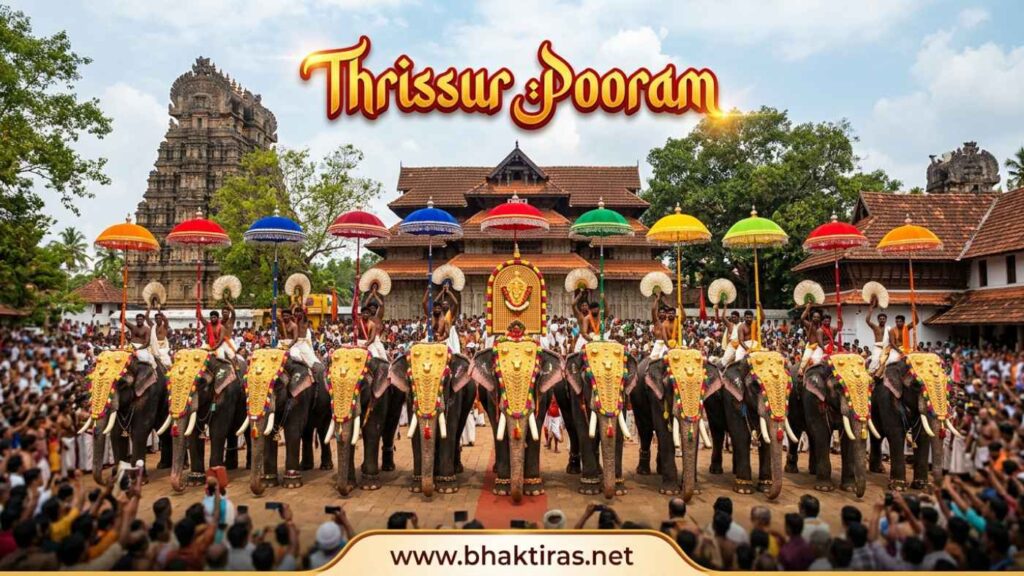
Thrissur Pooram is the festival Keralites call the pooram of all poorams. Every year, on the Pooram star of the Malayalam month of Medam, the ground around the Vadakkunnathan Temple in Thrissur turns into a vast arena of caparisoned elephants, thundering chenda drums and a sea of people. The two rival temple groups, Paramekkavu and Thiruvambady, put on parallel processions that meet in friendly competition, and the whole thing runs for roughly 36 hours, closing with a dawn fireworks display that people wait all night to see.
Thrissur Pooram 2026-2028: Dates & Calendar
The next Thrissur Pooram is on Saturday, 17 April 2027. The festival follows the Malayalam solar calendar and is held on the Pooram nakshatra in the month of Medam, which is why the Gregorian date moves between mid-April and early May each year.
| Year | Date | Day | Notes |
|---|---|---|---|
| 2026 | 27 April | Monday | Pooram nakshatra in Medam |
| 2027 | 17 April | Saturday | Next occurrence |
| 2028 | 4 May | Thursday | Falls later this year |
The public spectacle spans about 36 hours. The rituals begin the previous evening, the main processions and the Kudamattam parasol contest fill the Pooram day itself, and the celebrated fireworks (vedikettu) are set off before dawn on the following morning.
Why Thrissur Pooram Is Celebrated
Thrissur Pooram is celebrated as a grand offering to the goddesses of the surrounding temples, who are believed to visit Lord Shiva at the Vadakkunnathan Temple. It grew into a shared civic festival that unites the town rather than a single-temple ritual.
The festival is popularly traced to the late 18th century and the rule of Sakthan Thampuran, the Maharaja of Kochi, who is said to have brought the smaller poorams of ten nearby temples together into one unified event at Thrissur. That origin story explains its scale: it was designed from the start as a joint celebration.
A goddess's visit to Shiva
The deities of the participating temples, chiefly the Bhagavathi of Paramekkavu and of Thiruvambady, are carried in procession to pay respects to Lord Shiva at the central Vadakkunnathan Temple. The festival is framed as this ceremonial visit.
Friendly rivalry
Paramekkavu and Thiruvambady mount competing displays of elephants, percussion and parasols. The contest is spirited but cooperative, and it is this parallel staging that gives the Pooram its energy and its crowds.
A festival for everyone
Because it was assembled as a town-wide event, Thrissur Pooram is open and secular in spirit. People of every community and faith take part as spectators, and the fireworks and music draw visitors from across India and abroad.
Deities & Figures Worshipped
Thrissur Pooram centres on Lord Shiva at the Vadakkunnathan Temple, who receives the visiting goddesses of the two main participating temples.
Vadakkunnathan (Shiva)
The Vadakkunnathan Temple, one of Kerala’s oldest Shiva temples, sits at the centre of the Thekkinkadu Maidan. The processions form around it, and it is to Shiva that the visiting deities pay their respects.
Paramekkavu Bhagavathi
The goddess of the Paramekkavu Bhagavathi Temple leads one of the two main processions. Paramekkavu is the larger of the two devaswoms and fields its own elephants, percussion troupe and parasols.
Thiruvambady Krishna & Bhagavathi
The Thiruvambady Sri Krishna Temple, whose deity is worshipped alongside its Bhagavathi, leads the rival procession. Thiruvambady faces Paramekkavu in the Kudamattam parasol exchange.
Key Rituals, Step by Step
The Pooram unfolds as a sequence of processions and performances across roughly a day and a half, building from a small opening ritual to the dawn fireworks finale.
- Kodiyettam (flag hoisting). Days before the main event, each participating temple raises its festival flag to formally begin the Pooram season.
- Sample vedikettu. A preview round of fireworks is set off a few days ahead, letting the two sides test their displays and giving crowds an early taste.
- Madathil Varavu panchavadyam. On the Pooram day, the Thiruvambady side stages the Madathil Varavu, a grand panchavadyam ensemble of drums, cymbals, horns and conches lasting several hours.
- Ilanjithara Melam. The Paramekkavu side presents the Ilanjithara Melam, a massive chenda-melam performance under the ilanji tree in the Vadakkunnathan compound, considered a highlight for connoisseurs of percussion.
- Elephant processions. Rows of caparisoned elephants carry the deities and ceremonial parasols, fans and whisks, facing each other across the maidan as the crowd gathers between them.
- Kudamattam. In the afternoon the two sides face off in the Kudamattam, rhythmically raising and swapping brightly coloured decorative parasols atop the elephants, each trying to outdo the other to roars from the crowd.
- Vedikettu (main fireworks). In the small hours before dawn the celebrated fireworks light up the sky over Thrissur, the moment most spectators stay awake all night for.
- Upacharam chollal & Pakal Pooram. The two sides exchange formal farewells the next day, and a closing daytime round marks the end of the festival.
Special Foods Around Thrissur Pooram
Thrissur Pooram is a festival of music and spectacle rather than a home feast, but the season and the crowds bring plenty of Kerala food to hand.
Sadya
Many families and temples serve a sadya, the traditional vegetarian banquet on a banana leaf with rice, sambar, avial, thoran, pickles and payasam, during the festival days.
Payasam
Kerala-style payasams, such as ada pradhaman and palada, are common offerings and treats, made with rice flakes, jaggery or milk and coconut.
Snacks & street food
Stalls around the Thekkinkadu Maidan sell banana chips, tea, sarbath and fried snacks to the crowds who wait through the night for the fireworks.
Related Poorams & Where It's Watched
While Thrissur Pooram itself is specific to Thrissur, the pooram tradition and its diaspora following extend well beyond the town.
Thrissur town
The festival is inseparable from Thrissur and its Thekkinkadu Maidan. Ten temples take part, but Paramekkavu and Thiruvambady are the two principal rivals whose displays anchor the day.
Other Kerala poorams
Many Kerala temples hold their own poorams and vela festivals in the Medam season, such as the Arattupuzha and Peruvanam poorams near Thrissur, but none match the scale of the Thrissur event.
Malayali diaspora
Malayali communities in the Gulf, and in cities across India and abroad, follow the Pooram through live broadcasts and organise smaller cultural events around the same time.
Thrissur Pooram Do's and Don'ts
A few practical points help you enjoy the crowds, heat and noise of the Pooram safely.
Do
- Arrive early and pick a viewing spot for the melam and Kudamattam before the crowds build.
- Carry water and wear light cotton clothing; April in Thrissur is hot and humid.
- Keep phones and valuables secure in the dense crowds.
- Respect the elephants and their mahouts, and keep a safe distance from the animals.
- Plan to stay through the night if you want to watch the dawn vedikettu fireworks.
Avoid
- Do not crowd or startle the elephants, and never use flash near them.
- Avoid blocking procession routes or climbing barriers for a better view.
- Do not bring young children or elderly relatives too close to the fireworks zone.
- Avoid littering the maidan; use the bins provided.
- Do not ignore instructions from police and festival volunteers managing the crowd.
Frequently Asked Questions
When is Thrissur Pooram in 2027?
Thrissur Pooram 2027 falls on Saturday, 17 April. It is held on the Pooram nakshatra in the Malayalam month of Medam, at the Thekkinkadu Maidan around the Vadakkunnathan Temple in Thrissur, Kerala.
When is Thrissur Pooram in 2026 and 2028?
Thrissur Pooram was on Monday, 27 April 2026, and will be on Thursday, 4 May 2028. The date shifts each year because it is fixed by the Pooram star in the Malayalam month of Medam rather than a fixed Gregorian date.
Why is Thrissur Pooram celebrated?
Thrissur Pooram is celebrated as a grand offering in which the goddesses of the surrounding temples are believed to visit Lord Shiva at the Vadakkunnathan Temple. It is popularly traced to Sakthan Thampuran of Kochi, who united the smaller poorams of nearby temples into one shared festival in the late 18th century.
Which god is worshipped at Thrissur Pooram?
Lord Shiva, as Vadakkunnathan, is the central deity, and the festival is held around his temple in Thrissur. The visiting deities are the Bhagavathi of the Paramekkavu temple and the Krishna and Bhagavathi of the Thiruvambady temple.
What is Kudamattam in Thrissur Pooram?
Kudamattam is the rhythmic parasol-exchange contest that is the visual highlight of Thrissur Pooram. The Paramekkavu and Thiruvambady sides, mounted on rows of caparisoned elephants, rapidly raise and swap brightly coloured decorative parasols, each trying to outdo the other for the crowd.
Where is Thrissur Pooram held?
Thrissur Pooram is held at the Thekkinkadu Maidan, the open ground surrounding the Vadakkunnathan Temple in the centre of Thrissur town, Kerala. Ten temples take part, led by the Paramekkavu and Thiruvambady devaswoms.
How long does Thrissur Pooram last?
The main spectacle runs for about 36 hours. It builds from panchavadyam and chenda-melam ensembles and elephant processions through the Kudamattam parasol contest, and finishes with a spectacular fireworks display before dawn.
Can anyone attend Thrissur Pooram?
Yes, Thrissur Pooram is an open, town-wide festival that welcomes visitors of every community and faith. The processions, music and fireworks take place in public spaces, and lakhs of people, including tourists from India and abroad, attend each year.
Whether you come for the drums, the elephants or the fireworks, Thrissur Pooram is Kerala at its most alive. Pooram aashamsakal.