
Taratarini Mela 2027 – Chaitra Jatra of the Twin Goddesses
ତାରା ତାରିଣୀ ମେଳା
When is Taratarini Mela (Chaitra Jatra) in 2027?
The Taratarini Chaitra Jatra 2027 runs across the four Tuesdays of the Odia month of Chaitra, beginning Tuesday 13 April 2027 and continuing on 20 April, 27 April and 4 May. Each Tuesday, called a Mangalabar, lakhs of pilgrims climb the Kumari hill near Purushottampur in Ganjam, Odisha to worship the twin sister goddesses Tara and Tarini. The third Tuesday usually draws the largest crowd.
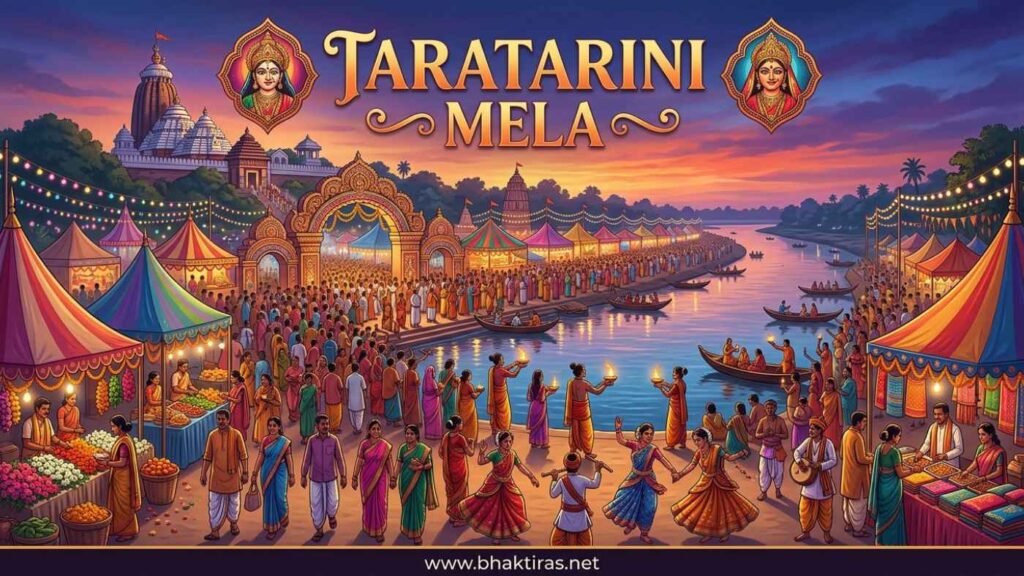
Taratarini Mela, better known locally as the Chaitra Jatra or Chaitra Mangalabar, is Ganjam’s largest religious gathering, held on the Tuesdays of the Odia month of Chaitra at the hill shrine of Tara and Tarini. The temple sits atop the Kumari hill on the bank of the Rushikulya river, near Purushottampur, about 28 km from Berhampur in southern Odisha. Devotees regard Tara and Tarini as twin sister forms of Adi Shakti, and the site is honoured as the breast Shakti Peetha. On each Chaitra Tuesday, lakhs climb the stone steps or ride the ropeway to offer prayers, have their children’s first tonsure done, and share the khichdi prasad.
Taratarini Mela 2026-2028: Chaitra Jatra Dates
The next Chaitra Jatra falls on the four Tuesdays of Chaitra in 2027, starting Tuesday 13 April 2027. The dates move each year because the fair follows the Tuesdays of the lunar month of Chaitra, not a fixed civil date.
| Year | Chaitra Jatra Tuesdays | Main day | Notes |
|---|---|---|---|
| 2026 | 24 & 31 March, 7 & 14 April | Third Tuesday | Already held |
| 2027 | 13, 20 & 27 April, 4 May | 27 April (3rd Tue) | Next occurrence; first Tuesday 13 April |
| 2028 | 28 March, 4, 11 & 18 April | Third Tuesday | Follows Chaitra Tuesdays |
Each Tuesday is a full jatra day in its own right, and the temple stays open through the night before as the khichdi bhoga is prepared. Crowds build steadily, with the third Tuesday generally the busiest of the season. Treat the 2027 and 2028 dates as guidance until the Ganjam district administration issues its formal schedule closer to the fair.
Why Taratarini Mela Is Celebrated
Taratarini Mela honours the twin goddesses Tara and Tarini as living forms of Adi Shakti, and marks the Chaitra Tuesdays as the most auspicious days to seek their blessing on the Kumari hill.
Ganjam holds Tara and Tarini as its guardian mothers, and the Chaitra Jatra is the season when families across the district make the pilgrimage together. For many it is also the occasion to fulfil vows, name a newborn, or bring a child for its first haircut before the goddesses.
The breast Shakti Peetha
Tradition connects the hill to the story of Sati, whose body was scattered across the land after Daksha’s sacrifice. The Kumari hill is revered as the place where her breasts, the stana, fell, which is why Tara and Tarini are worshipped here as the nurturing mothers. This places the shrine among the Adi Shakti Peethas of eastern India.
Twin sisters as one power
Unlike most shrines with a single deity, here two stone faces sit side by side, worshipped as sisters Tara and Tarini. Together they are seen as the complete Adi Shakti, the primordial feminine energy. Their pairing gives the temple its distinctive name and its double-headed emblem.
One of four Odisha peethas
In Odia Shakta belief, Tara Tarini is counted among the state’s principal seats of the goddess, alongside shrines such as Vimala at Puri and the Shakti sites of the coast. The Chaitra Jatra is when this standing is felt most strongly, as the district turns towards the hill.
Deities & Figures Worshipped
The fair centres on the twin goddesses Tara and Tarini, worshipped together as Adi Shakti, the mother power of the district.
Tara
Tara is one of the two presiding sisters, worshipped as a fierce yet protective mother. In the sanctum she is honoured as a stone face crowned with gold and silver ornaments, and devotees turn to her for courage and the safe crossing of life’s difficulties.
Tarini
Tarini sits beside Tara as her sister form, her name carrying the sense of one who ferries devotees across. Together the two are treated as inseparable, and no prayer at the hill is made to one without the other.
Chalanti Pratima
Alongside the fixed stone deities, two portable brass heads known as the Chalanti Pratima represent the goddesses in processions and ritual movement. A small image linked to the Buddhist Tara is also kept, reflecting the shrine’s long and layered history.
Key Rituals, Step by Step
A visit on a Chaitra Tuesday follows a familiar order, from the climb to the offering, the tonsure and the prasad.
- Reach the foot of the hill. Pilgrims arrive at Purushottampur on the Rushikulya bank, where buses and shared vehicles gather. The approach roads and river ghat fill early on jatra Tuesdays.
- Climb or take the ropeway. Many devotees walk up the long flight of stone steps, over 999 in the traditional count, offering prayers on the way. Others use the ropeway, which carries visitors to the hilltop in a few minutes and eases the climb for the elderly and children.
- Offer at the sanctum. At the top, pilgrims join the queue for darshan of Tara and Tarini. Common offerings include coconut, flowers, red cloth, sindoor and sweets placed before the twin deities.
- Mundan (first tonsure). Families bring young children for their first haircut on the hill, considered highly auspicious during Chaitra. Barbers set up in numbers near the temple to perform the mundan for the day’s crowds.
- Share the khichdi bhoga. The special khichdi prasad, cooked through the night before each Tuesday, is offered to the goddesses and then distributed to devotees at a small fixed price. Receiving and eating this prasad is a central part of the visit.
- Circumambulate and rest. Pilgrims take a turn around the shrine, tie threads or leave small tokens for wishes, and pause to take in the view of the Rushikulya winding below before starting the descent.
- Descend and continue the fair. Back at the base, the mela spreads out with stalls of food, toys, bangles and household goods, turning the pilgrimage into a full day out for families from across Ganjam.
Special Foods of Taratarini Mela
Food is part of the pilgrimage, from the temple prasad to the fair stalls at the foot of the hill.
Khichdi bhoga
The signature offering is a simple khichdi of rice and lentils, cooked overnight and offered to the goddesses before dawn on each Tuesday. It is then handed out to devotees for a token amount, and carrying home a share of it is considered a blessing.
Ghuguni
Ghuguni, a spiced curry of dried peas or gram tempered with onion and chilli, is a staple of the fair stalls. Served hot with chopped onion and a squeeze of lime, it is one of the most popular quick meals for the crowds.
Local sweets and snacks
Stalls sell fried snacks, jalebi, and Odia sweets such as chhena and rasgola alongside tea. These treats, bought after darshan, are part of the outing for families who travel long distances to the hill.
Rice-plate meals
Around the base, temporary eateries serve plain rice with dalma, seasonal vegetables and pickles for pilgrims spending the whole day at the fair. Simple, filling and inexpensive, these meals sustain the long queues and climbs.
Regional Names & Context
The fair belongs firmly to Ganjam, but the twin goddesses draw pilgrims from across Odisha and the neighbouring states.
Ganjam and Berhampur
Tara and Tarini are the district goddesses of Ganjam, and Berhampur, the largest city nearby, empties towards the hill on jatra Tuesdays. Shops and offices in the area often adjust to the rhythm of the Chaitra Mangalabar.
Purushottampur and the Rushikulya
The shrine stands on the Kumari hill on the bank of the Rushikulya near Purushottampur. The river below is part of the pilgrimage, and many devotees bathe or offer prayers at the ghat before beginning the climb.
Beyond Odisha
The reputation of the twin Shakti Peetha reaches into Andhra Pradesh and further, and pilgrims from outside the state join the Chaitra crowds. Buses and special services run to Purushottampur through the season.
Taratarini Mela Do's and Don'ts
The hill setting and the huge Tuesday crowds call for a little planning and care.
Do
- Start early to beat the heaviest crowds and the midday heat.
- Wear comfortable footwear if you plan to climb the steps.
- Carry drinking water, a cap and any medicines you may need.
- Keep young children close and consider the ropeway with them.
- Follow the queue system and the temple staff’s instructions at the sanctum.
Avoid
- Do not attempt the climb in the peak afternoon sun without rest.
- Avoid carrying large amounts of cash or valuables in the crush.
- Do not litter on the hill or along the Rushikulya bank.
- Avoid blocking the narrow steps for photos when crowds are moving.
- Do not rely on last-minute transport on the third Tuesday, the busiest day.
Frequently Asked Questions
When is Taratarini Mela (Chaitra Jatra) in 2027?
The Taratarini Chaitra Jatra 2027 falls on the four Tuesdays of the Odia month of Chaitra, starting Tuesday 13 April 2027 and continuing on 20 April, 27 April and 4 May. The fair is held at the Tara Tarini hill shrine near Purushottampur in Ganjam, Odisha. The third Tuesday usually draws the largest gathering.
When is Taratarini Mela in 2026 and 2028?
In 2026 the Chaitra Jatra Tuesdays fell on 24 and 31 March and 7 and 14 April, and that season has already passed. In 2028 the fair is expected on 28 March and 4, 11 and 18 April. The dates shift each year because the mela follows the Tuesdays of the lunar month of Chaitra.
Why is Taratarini Mela celebrated?
Taratarini Mela is celebrated to honour the twin goddesses Tara and Tarini as forms of Adi Shakti on the Chaitra Tuesdays, the most auspicious days to worship them. The Kumari hill is revered as a Shakti Peetha where the breasts of the goddess Sati are believed to have fallen, making it a seat of the nurturing mother.
Which goddess is worshipped at Taratarini Mela?
The twin sister goddesses Tara and Tarini are worshipped at Taratarini Mela, honoured together as Adi Shakti. In the sanctum they appear as two stone faces adorned with gold and silver, and no prayer is made to one without the other.
Where is the Tara Tarini temple and how do you reach it?
The Tara Tarini temple sits atop the Kumari hill on the bank of the Rushikulya river near Purushottampur, about 28 km from Berhampur in Ganjam district, Odisha. Pilgrims reach the base by road from Berhampur or Purushottampur, then climb the stone steps or take the ropeway to the hilltop shrine.
Why do people get children tonsured at Taratarini Mela?
Families bring children to the hill for their first tonsure, or mundan, because it is considered especially auspicious to perform it before Tara and Tarini during Chaitra. Barbers gather near the temple on jatra Tuesdays to carry out the ritual for the day’s pilgrims, who often combine it with fulfilling a vow.
What prasad is offered at the Chaitra Jatra?
The special prasad of the Chaitra Jatra is khichdi bhoga, a rice-and-lentil dish cooked overnight, offered to the goddesses and then given to devotees for a small token price. Carrying home a share of this khichdi is regarded as a blessing from the twin goddesses.
Is there a ropeway at the Tara Tarini temple?
Yes, a ropeway carries pilgrims from the base to the hilltop shrine in a few minutes, alongside the traditional flight of over 999 stone steps. The ropeway is especially useful for the elderly and for families with young children during the crowded Chaitra Tuesdays.
May Maa Tara and Maa Tarini bless all who climb the Kumari hill during the Chaitra Jatra. Jai Maa Tara Tarini.