
Si-Donyi 2027 – Festival of the Sun and Earth in Arunachal
सी-दोन्यी
When is Si-Donyi in 2027?
Si-Donyi is celebrated on 6 January 2027, a fixed calendar date observed every year. It is the principal festival of the Tagin people of Arunachal Pradesh, honouring Si (the Earth) and Donyi (the Sun) as the mother and father forces of nature within the indigenous Donyi-Polo faith.
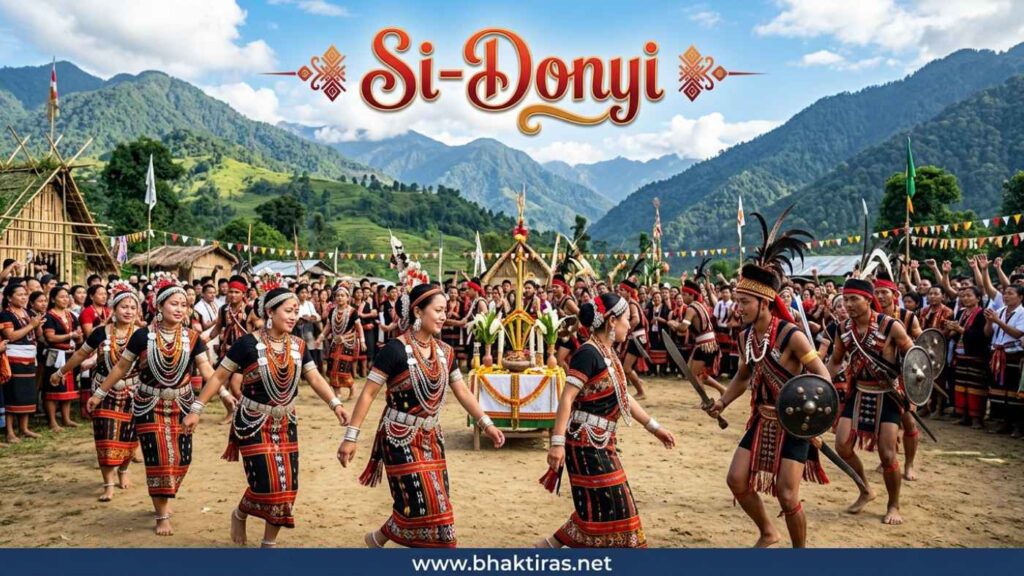
Si-Donyi is the most important festival of the Tagin community of Arunachal Pradesh, held each year on 6 January. The name joins two forces of the Donyi-Polo faith: Si, the Earth, and Donyi, the Sun, revered as the great mother and father of all creation. Led by the Nyibu, the village priest, the festival gathers families to pray for good health, a strong harvest and unity among the Tagin and their neighbouring tribes across the Upper Subansiri hills.
Si-Donyi 2026-2028: Dates & Calendar
Si-Donyi is a fixed-date festival held on 6 January every year, so the main day does not shift with the lunar calendar. The next observance is 6 January 2027.
| Year | Date | Day | Notes |
|---|---|---|---|
| 2026 | 6 January | Tuesday | Fixed annual date |
| 2027 | 6 January | Wednesday | Next occurrence |
| 2028 | 6 January | Thursday | Fixed annual date |
The main rituals fall on 6 January, though gatherings, dances and feasting often extend across the preceding and following days in centres such as Daporijo, Dumporijo, Taliha, Siyum and Itanagar.
Why Si-Donyi Is Celebrated
Si-Donyi is celebrated to honour the Earth and the Sun and to seek their blessing for community wellbeing and a good harvest. It is the central festival of the Tagin people within the Donyi-Polo faith.
Sun and Earth as parents
In the Donyi-Polo world view, Donyi (the Sun) and the Earth are living presences that sustain life. Si-Donyi treats them as the father and mother of nature, and worshippers thank them for warmth, soil and food.
Harvest and wellbeing
The festival is timed to the turn of the agricultural year. Prayers ask for fertile fields, healthy livestock and protection from misfortune for the whole village in the season ahead.
Unity of the tribes
Si-Donyi draws Tagin families and neighbouring communities together for shared rituals and feasting. It reinforces bonds of kinship and cooperation that hold the hill settlements together.
Living indigenous faith
As a Donyi-Polo festival, Si-Donyi keeps an ancient nature-based belief alive in a modern setting, passing songs, dances and priestly knowledge to younger generations.
Forces Worshipped at Si-Donyi
Si-Donyi does not centre on an idol or temple deity. Worship is directed to the natural forces of the Sun and Earth within the Donyi-Polo faith.
Donyi (the Sun)
Donyi, the Sun, is honoured as the source of light, warmth and truth. In the Donyi-Polo tradition the Sun is a witness to human conduct and a giver of life to crops and people.
Si (the Earth)
Si, the Earth, is revered as the mother that holds and feeds all living things. Offerings and prayers thank the Earth for the soil, water and harvest that sustain the Tagin.
Key Rituals, Step by Step
The rituals are led by the Nyibu, the village priest, and centre on offerings, prayer and communal celebration.
- Raising ceremonial flags. The community erects tall ceremonial flags at the festival ground, marking the sacred space where the Sun and Earth are honoured.
- The Nyibu leads the prayers. The Nyibu, dressed in traditional attire, chants invocations to Donyi and Si, seeking blessings for health, harvest and harmony.
- Ritual offerings. Offerings including the mithun and other animals are made according to custom, following the guidance of the Nyibu.
- Community gathering. Families arrive in traditional Tagin dress, bringing rice beer and food to share at the common ground.
- Folk songs and dances. Groups perform traditional songs and dances, retelling the community’s bond with nature and its ancestors.
- Community feasting. Shared meals of meat, rice and rice beer bring everyone together, sealing the day’s prayers with hospitality.
- Blessings and unity. Elders and the Nyibu offer good wishes for the year ahead, and neighbouring tribes join to strengthen ties of friendship.
Special Foods of Si-Donyi
Si-Donyi food is hearty hill fare centred on rice, meat and locally brewed rice beer, prepared for large communal feasts.
Apong (rice beer)
Apong, a mildly fermented rice beer, is central to Tagin hospitality. It is shared among guests and offered during the celebrations.
Mithun and meat dishes
Meat from the ritual offerings, including mithun, is cooked in simple boiled or smoked preparations and served at the communal feast.
Rice and millet
Steamed rice and millet form the base of every meal, often cooked in bamboo or served with green leaves and chillies from the hills.
Bamboo-shoot dishes
Fermented and fresh bamboo shoot, a staple flavour of Arunachali cooking, is added to meat and vegetable dishes during the feast.
Si-Donyi Do's and Don'ts
A few simple customs help visitors take part in Si-Donyi respectfully.
Do
- Respect the Nyibu and follow the order of the rituals.
- Accept food and rice beer graciously when offered as hospitality.
- Dress modestly and appreciate traditional Tagin attire.
- Ask permission before photographing the priest or sacred rites.
- Join the folk songs and dances when invited by the community.
Avoid
- Do not treat the ceremonial flags or ritual ground as casual props.
- Do not disturb or interrupt the Nyibu during the prayers.
- Do not mistake Si-Donyi for a Hindu festival – it belongs to the Donyi-Polo faith.
- Do not litter or damage the festival ground and surroundings.
- Do not photograph people or rites without consent.
Frequently Asked Questions
When is Si-Donyi in 2027?
Si-Donyi is celebrated on 6 January 2027. It is a fixed-date festival observed on the same day every year, making it the main annual celebration of the Tagin people of Arunachal Pradesh.
When is Si-Donyi in 2026 and 2028?
Si-Donyi falls on 6 January in both 2026 and 2028, just as it does every year. Because it is a fixed Gregorian-date festival, the main day does not shift with the lunar calendar.
Why is Si-Donyi celebrated?
Si-Donyi is celebrated to worship Si (the Earth) and Donyi (the Sun) and to seek their blessing for community wellbeing and a good harvest. It is the most important festival of the Tagin community within the indigenous Donyi-Polo faith.
Which community celebrates Si-Donyi?
Si-Donyi is the main festival of the Tagin tribe of Arunachal Pradesh, celebrated mainly in the Upper Subansiri region in towns such as Daporijo, Dumporijo, Taliha and Siyum, as well as in Itanagar. It also fosters unity with neighbouring tribes.
What is the Donyi-Polo faith?
Donyi-Polo is the indigenous nature-based religion of several tribes of Arunachal Pradesh, whose name means Sun (Donyi) and Moon (Polo). It reveres the Sun and other natural forces, and Si-Donyi is one of its major festivals.
Who leads the Si-Donyi rituals?
The Si-Donyi rituals are led by the Nyibu, the traditional Tagin priest. The Nyibu chants invocations to the Sun and Earth, presides over the offerings and guides the community through the ceremony.
How is Si-Donyi celebrated?
Si-Donyi is celebrated with priestly prayers, ritual offerings including mithun, the raising of ceremonial flags, folk songs and dances, and community feasting. Families gather in traditional dress to share food and rice beer and to pray for a prosperous year.
Is Si-Donyi a public festival in Arunachal Pradesh?
Si-Donyi is widely observed across the Tagin areas of Arunachal Pradesh and is marked by large public gatherings each 6 January. Celebrations take place in Daporijo, Dumporijo, Taliha, Siyum and the state capital Itanagar.
May the Sun and Earth bless your home with health and a good harvest – a happy Si-Donyi to the Tagin community and all who celebrate.