
Shankaracharya Jayanti 2027 – Birth of Adi Shankara
शंकराचार्य जयंती
When is Shankaracharya Jayanti in 2027?
Shankaracharya Jayanti falls on about 11 May 2027, on Panchami of the bright half of the Hindu month Vaishakha. It marks the birth anniversary of Adi Shankaracharya, the 8th-century teacher who systematised Advaita Vedanta and founded the four cardinal mathas. The exact date follows the Panchang and can shift by a day.
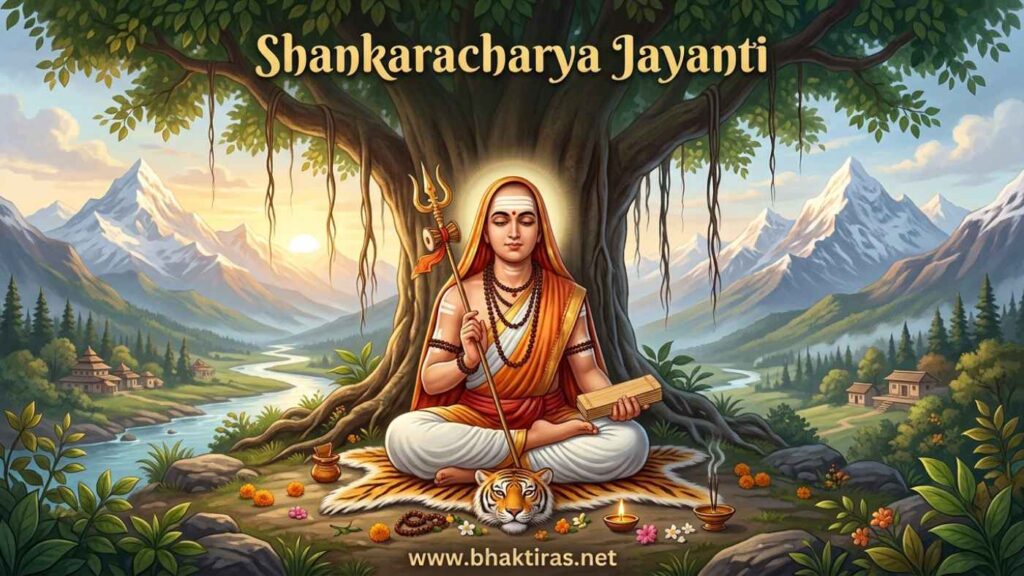
Shankaracharya Jayanti honours the birth of Adi Shankaracharya, the 8th-century saint-philosopher who reorganised Hindu thought around Advaita Vedanta, the teaching that the individual self and the absolute reality are one. Falling on the fifth lunar day of the bright half of Vaishakha – around 11 May in 2027 – the day is observed with discourses, recitation of his hymns and commentaries, and special worship at Kaladi in Kerala, his birthplace, and at the four mathas he established. It is a day for study and remembrance rather than fireworks or feasting.
Shankaracharya Jayanti 2026-2028: Dates & Calendar
The next Shankaracharya Jayanti is around 11 May 2027. Because it is fixed to Vaishakha Shukla Panchami in the lunar calendar, the Gregorian date shifts each year, usually falling between late April and mid May.
| Year | Date (approx) | Day | Tithi |
|---|---|---|---|
| 2026 | 22 April | Wednesday | Vaishakha Shukla Panchami |
| 2027 | 11 May | Tuesday | Vaishakha Shukla Panchami |
| 2028 | 29 April | Saturday | Vaishakha Shukla Panchami |
The Panchami tithi does not always align neatly with a single sunrise, so a few almanacs may list the observance a day earlier or later. Always confirm with a trusted regional Panchang close to the date.
Why Shankaracharya Jayanti Is Celebrated
Shankaracharya Jayanti celebrates Adi Shankara’s revival of Vedanta and Sanatana Dharma, and his central teaching that Atman (the self) and Brahman (the absolute) are one.
Shankara lived only around 32 years, yet in that short life he travelled the length of India, debated rival schools, and gave Advaita Vedanta the philosophical shape it still carries. The day sets aside time to return to those ideas and the texts that carry them.
Reviver of Advaita
Shankara argued that the perceived separation between the individual soul and the ultimate reality is born of ignorance, and that liberation comes from directly recognising their oneness. This non-dual view became the backbone of much later Hindu philosophy.
Commentator and poet
He wrote lucid commentaries (bhashyas) on the Brahma Sutra, the principal Upanishads and the Bhagavad Gita, and composed devotional hymns such as Bhaja Govindam and Soundarya Lahari that are still sung today.
Founder of the four mathas
Shankara set up four cardinal monastic centres – Sringeri, Dwarka, Puri and Jyotirmath – to anchor teaching across the subcontinent. Their heads still carry the title Shankaracharya, and the Jayanti is marked with particular care at each.
Seen as an aspect of Shiva
Many traditions revere Shankara as an incarnation of Shiva, born to restore the study of the Vedas. On his Jayanti this belief is expressed through worship of his sandals and readings from his works.
The Figure Honoured
Shankaracharya Jayanti centres on Adi Shankaracharya himself, a saint-philosopher rather than a temple deity. He is remembered as a teacher (acharya) and, in many traditions, as an aspect of Shiva.
Adi Shankaracharya
The 8th-century master whose birth the day marks. He is worshipped through paduka puja (honouring his sandals), recitation of his hymns, and study of his commentaries rather than through image worship.
Shiva
Several accounts hold that Shankara was Shiva born in human form to re-establish the path of knowledge. This link is why some mathas open the day’s observance with Shiva stotras.
Key Rituals, Step by Step
Observances are scholarly and devotional, held mainly at the four mathas, at Kaladi, and in Vedanta study circles.
- Morning worship. Devotees and monks bathe early and begin with prayers to Shankara and, in many places, to Shiva, invoking the teacher before the day’s readings.
- Paduka puja. The sandals (padukas) of Shankara, symbolising the guru’s presence, are bathed, dressed and worshipped with flowers, sandal paste and lamps.
- Recitation of his works. His hymns and stotras – Bhaja Govindam, Soundarya Lahari, Nirvana Shatkam and others – are chanted, often collectively.
- Discourses on Advaita. Scholars and matha heads deliver talks explaining his commentaries and the meaning of non-dual Vedanta for the day’s gathering.
- Special puja at the mathas and Kaladi. Sringeri, Dwarka, Puri and Jyotirmath, along with the birthplace shrine at Kaladi in Kerala, hold elaborate worship and processions.
- Scholarly seminars. Vedanta institutions and universities host seminars and debates on Advaita philosophy in his honour.
- Charity and bhiksha. Ascetics and scholars are offered food (bhiksha), and charity is distributed, reflecting the monastic tradition Shankara founded.
- Quiet study. Many devotees simply read or reflect on one of his texts, treating the day as a personal return to his teaching.
Food and Offerings on Shankaracharya Jayanti
The day leans towards simple, sattvic food rather than rich festival fare, in keeping with its ascetic and scholarly character.
Sattvic meals
Light vegetarian food without onion or garlic is preferred, matching the restraint associated with a life of study and renunciation.
Bhiksha for monks
Offering food to sannyasis and scholars is a central act of the day, echoing the monastic order Shankara established.
Fruits and prasada
Fruits and simple prasada are offered during puja and shared among devotees after the worship of the padukas.
Where It Is Observed
Shankaracharya Jayanti is marked across India, with special intensity at his birthplace and the centres he founded.
Kaladi, Kerala
Shankara’s birthplace on the banks of the Periyar draws devotees for elaborate worship, processions and readings on the Jayanti.
Sringeri (Karnataka)
The southern matha holds detailed puja, discourses and honouring of the reigning Shankaracharya on this day.
Dwarka & Jyotirmath
The western matha in Gujarat and the northern matha near Badrinath observe the day with worship and Vedanta talks.
Puri, Odisha
The eastern Govardhana matha marks the Jayanti alongside recitation of Shankara’s hymns and commentaries.
Shankaracharya Jayanti Do's and Don'ts
A few simple pointers keep the day in tune with its reflective spirit.
Do
- Read or listen to one of Shankara’s works, such as Bhaja Govindam.
- Attend a discourse or seminar on Advaita Vedanta if one is held nearby.
- Keep the day’s food simple and sattvic.
- Offer bhiksha or charity to scholars, monks or those in need.
- Confirm the exact date against a trusted regional Panchang.
Avoid
- Do not treat it as a loud festival with fireworks or feasting; it is a study-focused day.
- Do not fabricate or fix muhurat times; follow your almanac or temple.
- Do not confuse Adi Shankara with the living heads of the mathas who share the title.
- Do not skip the guru’s teaching for only the ritual – reflection is the point.
- Do not assume the same Gregorian date each year; the lunar tithi moves it.
Frequently Asked Questions
When is Shankaracharya Jayanti in 2027?
Shankaracharya Jayanti in 2027 falls on about 11 May, on Vaishakha Shukla Panchami. It marks the birth anniversary of Adi Shankaracharya. Because it follows the lunar Panchang, the exact date may vary by a day across regional almanacs.
When is Shankaracharya Jayanti in 2026 and 2028?
Shankaracharya Jayanti is around 22 April in 2026 and around 29 April in 2028. Both fall on Vaishakha Shukla Panchami, the fifth day of the bright half of Vaishakha. The precise date should be confirmed against a regional Panchang as it can shift by a day.
Why is Shankaracharya Jayanti celebrated?
Shankaracharya Jayanti is celebrated to honour Adi Shankara’s revival of Vedanta and Sanatana Dharma. He taught that the individual self (Atman) and the absolute (Brahman) are one, and reorganised Hindu thought around this non-dual view. The day is given to study, discourse and worship of his teaching.
Who was Adi Shankaracharya?
Adi Shankaracharya was an 8th-century saint-philosopher who consolidated Advaita Vedanta, the philosophy of non-dualism. He wrote commentaries on the Brahma Sutra, the Upanishads and the Bhagavad Gita, composed hymns such as Bhaja Govindam, and founded the four cardinal mathas. Many traditions revere him as an incarnation of Shiva.
What are the four mathas founded by Shankara?
Adi Shankara founded four cardinal monastic centres to guide the study of Vedanta across India: Sringeri in the south, Dwarka in the west, Puri in the east and Jyotirmath in the north. Their heads still carry the title Shankaracharya, and Shankaracharya Jayanti is observed with special care at each.
How is Shankaracharya Jayanti observed?
Shankaracharya Jayanti is observed with discourses on Advaita, recitation of Shankara’s hymns and commentaries, and paduka puja, the worship of his sandals. Special worship is held at the four mathas and at Kaladi in Kerala, his birthplace, along with scholarly seminars and the offering of bhiksha to monks and scholars.
Which god is worshipped on Shankaracharya Jayanti?
Shankaracharya Jayanti centres on Adi Shankara himself, a saint-philosopher rather than a temple deity. He is honoured as a guru through worship of his sandals and recitation of his works. As many traditions regard him as an incarnation of Shiva, some observances also include Shiva stotras.
What is the significance of Advaita Vedanta?
Advaita Vedanta is the non-dual philosophy Shankara systematised, holding that the individual self and the absolute reality are ultimately one. It teaches that liberation comes from recognising this oneness rather than through ritual alone. This idea shaped much of later Hindu thought and is the core of what Shankaracharya Jayanti remembers.
May the clarity of Adi Shankara’s teaching light your own path this Shankaracharya Jayanti.