
Sairi Festival 2026 – Himachal's Harvest Thanksgiving
सैर
When is Sairi (Sair) festival in 2026?
Sairi, also called Sair or Saja, falls on 16 September 2026 in the hill villages of Himachal Pradesh. It is a one-day harvest thanksgiving held on the Sankranti (Sagrand) that begins the month of Ashwin, marking the close of the monsoon and the start of autumn.
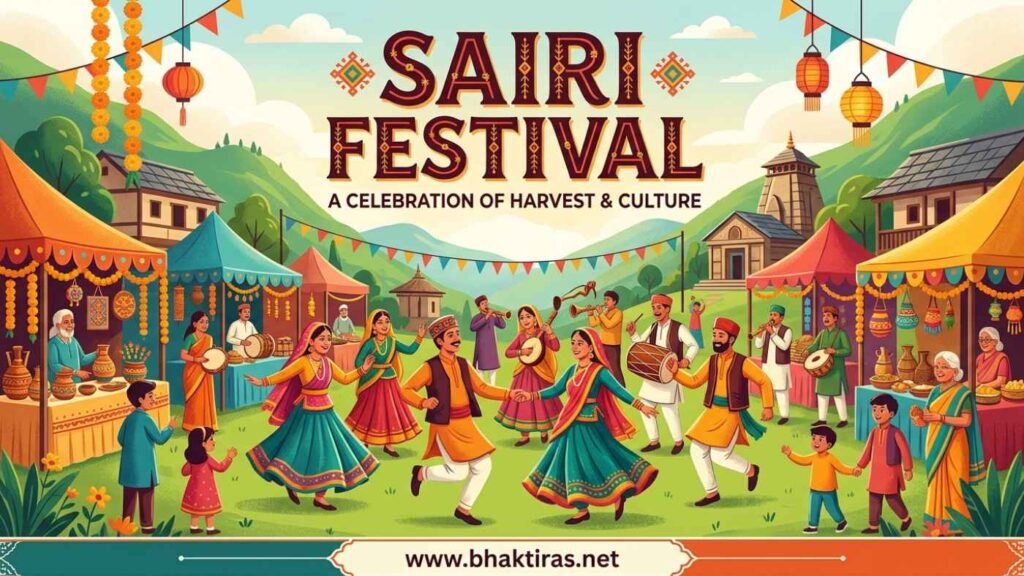
Sairi, known across the Himachal hills as Sair or Saja, is the day the mountain villages pause to thank the earth for the year’s harvest. It lands on the Sankranti that opens the month of Ashwin, around 16 September, when the last rains of Bhadon give way to clear autumn skies and the kharif crops turn gold. Families set out the season’s first grain, greens, walnuts and fruit before the local devtas, elders bless the young, and the day fills with folk songs, small fairs and shared meals.
Sairi Festival 2026-2028: Dates & Calendar
Sairi is tied to a solar reckoning – the Sagrand that begins Ashwin – so it stays close to 16 September every year rather than drifting the way lunar festivals do.
| Year | Date | Day | Notes |
|---|---|---|---|
| 2025 | 16 September | Tuesday | Celebrated as usual across HP |
| 2026 | 16 September | Wednesday | Next occurrence (approx.) |
| 2027 | 16 September | Thursday | Ashwin Sagrand (approx.) |
| 2028 | 16 September | Saturday | Ashwin Sagrand (approx.) |
Because the day is fixed to the sun’s entry into the Ashwin month, Sairi tends to fall on the same September date year after year, unlike Diwali or Holi which move with the moon.
Why Sairi Is Celebrated
Sairi is celebrated as a harvest thanksgiving – the hill villages of Himachal thank the earth and their local deities for the season’s crops as the monsoon ends and winter approaches.
The timing carries real weight in the mountains. Bhadon is the wettest month, and its close means the danger of landslides and washed-out fields is passing. Sairi marks that turn: the sun strengthens, the paddy and maize ripen, and the year’s hardest farm work is done for now.
Gratitude for the harvest
At its core Sairi is a thank-you. The first of the season’s grain, greens and fruit is offered before the household is fed, a way of acknowledging that the year’s food came from the soil, the rain and the labour of the family together.
Return of the devtas
In local belief the village gods are said to return from their summer sojourn around this time. Sairi welcomes them back and seeks their blessing for a mild winter and a safe, well-fed household in the cold months ahead.
Blessing the next generation
Elders press a blade of grass and a coin into the hands of the young, wishing them growth and prosperity. It is a quiet, tender custom that ties the family’s future to the greenery and abundance the festival honours.
Deities & Figures Worshipped
Sairi has no single presiding god. Villages honour their own gram devtas (local deities) alongside the earth itself, often personified as Sairi Mata or represented by the heap of first grain called the Sair.
Sairi Mata / the Sair
The Sair is a symbolic figure or a plate heaped with the season’s first wheat, maize cobs, cucumber, walnuts and fruit. Treated as Sairi Mata, it stands for the earth’s giving nature and receives the household’s first offering of the day.
Local gram devtas
Each village has its own devta or devi, carried in a palanquin at some fairs. On Sairi these local deities are thanked for guarding the crops through the monsoon and are asked to bless the coming winter.
The earth and cattle
The soil that bore the harvest and the bullocks that ploughed it are both honoured. Cattle are bathed, fed well and sometimes marked, a reminder that the harvest is a partnership between family, animals and land.
Key Rituals, Step by Step
The day moves from a quiet home offering in the morning to walnuts, blessings and folk songs by evening. Customs vary from valley to valley, but the shape is broadly the same.
- Prepare the Sair. A plate or fresh leaf is spread with the season’s first wheat, and seasonal produce – maize cobs, paddy ears, cucumber, guava, galgal and walnuts – is arranged on it as an offering.
- Offer to Sairi Mata. The household gathers before the Sair to thank the earth and the local devtas for the harvest, lighting a lamp and sometimes placing flowers before anyone eats.
- Honour the cattle. Bullocks and cows are washed, given a good feed and rested from work for the day, in recognition of their share in bringing the crops in.
- Elders bless the young. The eldest members press a blade of grass and a coin into the palms of children and younger relatives, wishing them health and prosperity.
- Exchange walnuts. Walnuts are given between families and friends, and children play games with them – rolling and knocking them together in a much-loved part of the day.
- Share a festive meal. Households cook special dishes and eat together, often sending plates to neighbours so the whole village shares in the season’s plenty.
- Gather for the fair. Many villages hold a small Sair fair or mela with folk songs, dancing and local trade, and in places the village devta is brought out in procession.
Special Foods of Sairi
Sairi food leans on the fresh harvest and simple hill cooking – grain, walnuts, seasonal vegetables and a few festive sweets.
Walnuts (akhrot)
Walnuts are the signature of Sair. In Mandi the streets fill with sacks of them; they are exchanged as gifts, cracked open at home and used by children in traditional games through the day.
Fresh harvest produce
The offering plate itself becomes food – new-season maize, cucumber, guava, galgal (hill lemon) and paddy. Roasted corn cobs and fresh fruit are enjoyed straight from the harvest.
Babru and hill breads
Babru, a stuffed fried bread made with black gram, is a Himachali festive favourite and often appears on the Sairi table alongside plain and thick local rotis.
Sweet dishes
Households prepare sweets such as sooji or besan halwa and jaggery-based treats to round off the celebratory meal and to send across to neighbours.
Regional Names & Variations
The festival goes by several names across Himachal and its shape shifts a little from one valley to the next.
Mandi
Mandi is closely linked with the walnut custom – buying, gifting and playing with akhrot is central here, and the bazaars stock up with sacks of walnuts in the days before Sair.
Shimla hills & Solan
In the Shimla hills and Solan the day is often called Saja or Sajo. The Sair heap is set up at home, elders bless the young with grass and coins, and small fairs bring neighbouring hamlets together.
Sirmaur
In Sirmaur the harvest thanksgiving keeps its strong farming character, with offerings of the first grain and honouring of cattle marking the end of the monsoon’s field work.
Kangra, Hamirpur & Bilaspur
Across the lower hills the festival is widely observed as Sair or Sayar on the Ashwin Sagrand, with family offerings, shared meals and local melas in many villages.
Sairi Do's and Don'ts
A few simple courtesies keep the spirit of this village thanksgiving intact.
Do
- Offer the season’s first grain and fruit before the family eats.
- Give and receive walnuts warmly – it is the heart of the day.
- Let elders bless the children with grass and a coin.
- Feed and rest the cattle well as part of the thanks.
- Share your festive dishes with neighbours.
Avoid
- Do not put the bullocks to heavy field work on Sairi.
- Do not skip the offering and start eating first.
- Do not waste the harvest produce set out for the day.
- Do not turn away someone who comes to exchange walnuts or greetings.
- Do not treat it as only a fair – the thanksgiving comes first.
Frequently Asked Questions
When is Sairi (Sair) festival in 2026?
Sairi festival falls on 16 September 2026. It is held on the Sankranti (Sagrand) that begins the month of Ashwin, a date fixed to the sun rather than the moon, so it stays near 16 September each year.
When is Sairi in 2027 and 2028?
Sairi is expected on 16 September in both 2027 and 2028. Because it is tied to the solar Ashwin Sagrand it barely moves; in some years local panchangs mark it on 17 September, so it is worth checking your village calendar.
Why is Sairi celebrated?
Sairi is celebrated as a harvest thanksgiving in the Himachal hills. It thanks the earth and the local devtas for the year’s crops, marks the end of the rainy Bhadon month and the arrival of autumn, and welcomes the village gods said to return around this time.
What is the Sair or Sairi Mata?
The Sair is a symbolic figure or a plate heaped with the season’s first wheat, maize, walnuts, cucumber and fruit, honoured as Sairi Mata. It represents the giving earth and receives the household’s first offering of the day before anyone eats.
Why are walnuts important on Sair?
Walnuts are the signature custom of Sair, especially in Mandi. Families exchange them as gifts of goodwill, and children play traditional games by rolling and knocking them together, making walnuts one of the most-loved parts of the celebration.
Where is Sairi festival celebrated?
Sairi is celebrated across the hill districts of Himachal Pradesh, including the Shimla hills, Mandi, Sirmaur, Kangra, Solan, Hamirpur and Bilaspur. It is a folk harvest festival of the mountain villages, also known as Sair, Sayar or Saja.
Is Sairi the same as Saja or Sair?
Yes. Saja, Sajo, Sair and Sayar are all regional names for the same festival. The shape stays the same – a harvest thanksgiving on the Ashwin Sagrand – while the exact name and small customs vary from one Himachali valley to another.
What do people eat on Sairi?
People eat fresh-harvest produce like maize, cucumber and guava, along with walnuts, Himachali breads such as babru, and festive sweets like halwa. The offering plate of first grain and fruit becomes part of the shared meal.
However your valley marks it – as Sair, Saja or Sayar – may this harvest bring your home a warm and well-fed autumn. Sair diyan lakh-lakh badhaiyan.