
Nuakhai 2026 – Western Odisha's New Rice Festival
ନୂଆଖାଇ
When is Nuakhai in 2026?
Nuakhai falls on Tuesday, 15 September 2026. It is the agrarian new-rice festival of western Odisha, observed on Bhadrapada Shukla Panchami, the day after Ganesh Chaturthi. Families offer the season’s first harvested rice to the presiding goddess Samaleswari, then share it together as nabanna.
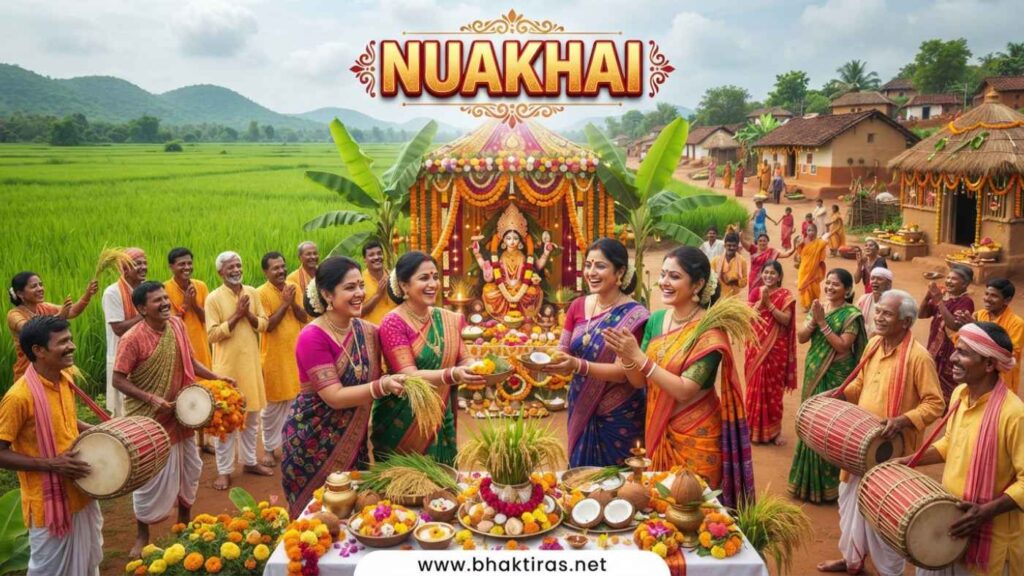
Nuakhai is the harvest thanksgiving of western Odisha, celebrated when the paddy fields turn heavy and the first grain of the season is ready. The name joins two Sambalpuri words – nua (new) and khai (to eat) – and marks the moment a family tastes the year’s first rice only after offering it to the presiding goddess. It falls on Bhadrapada Shukla Panchami, the day after Ganesh Chaturthi, and centres on the shrine of Samaleswari at Sambalpur. Beyond the ritual, it is a homecoming: relatives gather, elders bless the young, and evenings fill with folk song and dance.
Nuakhai 2026-2028: Dates & Calendar
The next Nuakhai is on 15 September 2026. Because it follows the Hindu lunar calendar – Bhadrapada Shukla Panchami, the day after Ganesh Chaturthi – the Gregorian date shifts by a few weeks each year.
| Year | Date | Day | Notes |
|---|---|---|---|
| 2026 | 15 September | Tuesday | Next occurrence |
| 2027 | 5 September | Sunday | Day after Ganesh Chaturthi |
| 2028 | 24 August | Thursday | Falls in late Bhadraba |
Since 1991 the festival has been fixed on the Bhadraba Shukla Panchami tithi so that all of western Odisha celebrates on the same day. The auspicious hour for offering the new rice is announced separately by the Samaleswari temple before each Nuakhai.
Why Nuakhai Is Celebrated
Nuakhai is celebrated to thank the earth and the presiding goddess for the paddy harvest, and to bind the farming community and its scattered families back together.
A thanksgiving for the harvest
The festival grew from the agrarian rhythm of western Odisha, where rice is the staple crop and the monsoon paddy is the year’s main harvest. Nuakhai is the day the community formally acknowledges the land’s bounty before anyone eats from the new crop.
Offering before eating
The heart of Nuakhai is a simple rule: the first new grain belongs to the deity. Only after the fresh rice is placed before Samaleswari and the family shrine is it cooked and shared. This ties everyday food to gratitude and restraint.
Family and community bonds
Nuakhai doubles as a reunion. Grown children return to their villages, quarrels are set aside, and the exchange of juhar greetings – the Nuakhai Bhetghat – renews ties across households and generations.
Rooted in Sambalpur
Though celebrated across Sambalpur, Bolangir, Bargarh and neighbouring districts, the festival’s spiritual centre is the Samaleswari temple at Sambalpur, where the first public offering signals that the season’s new rice may be eaten.
Deities & Figures Worshipped
Nuakhai centres on Samaleswari, the presiding goddess of Sambalpur, along with each household’s own family and village deities who receive the first offering of new rice.
Samaleswari
Maa Samaleswari is the guardian deity of Sambalpur and the region’s most revered mother goddess. The season’s first rice is offered at her temple, and her blessing formally opens the eating of the new harvest across western Odisha.
Ishta and gram devata
Alongside Samaleswari, families honour their own chosen deity (ishta devata) and the village deity (gram devata). The nabanna is placed before these local shrines so the blessing reaches every home, not only the main temple.
Key Rituals, Step by Step
The rituals move from the temple to the home in a single day, from the formal offering to the shared meal and the exchange of greetings.
- Setting the lagna. Before Nuakhai, the Samaleswari temple committee at Sambalpur announces the auspicious hour at which the new rice is to be offered.
- Harvesting the new rice. A portion of freshly cut paddy is brought in, cleaned and prepared so the very first grain of the season is ready for the deity.
- Nabanna offering. At the fixed hour, the new rice (nabanna) is offered first to Samaleswari at her temple, and then to each family’s own deity at home.
- Sharing the prasad. Once offered, the rice is cooked and the family eats it together – this shared first bite of the new crop is the core of the festival.
- Elders’ blessings. The young touch the feet of elders and receive their blessings, reaffirming the family hierarchy and goodwill.
- Nuakhai Bhetghat. Relatives, friends and neighbours visit one another to exchange the greeting Nuakhai Juhar, mending any lingering disputes.
- Folk song and dance. The evening turns festive with community dances such as Rasarkeli, Dalkhai and Sajani, performed to Sambalpuri folk music.
Special Foods of Nuakhai
The table is built around the new rice, joined by traditional Sambalpuri sweets and dishes prepared for the family gathering.
Nabanna (new rice)
The freshly harvested rice, offered first to the deity and then cooked, is the festival’s centrepiece. Eating it together marks the true start of Nuakhai.
Arisa pitha
A deep-fried rice-flour and jaggery cake with a soft centre and crisp edge, arisa pitha is a staple sweet prepared for offerings and guests.
Manda and kakara pitha
Steamed and fried stuffed rice cakes filled with grated coconut and jaggery, made in most homes for the day’s feasting.
Kheer
A rice-and-milk pudding sweetened with jaggery or sugar, often cooked with the new rice as part of the celebratory meal.
Where Nuakhai Is Celebrated
Nuakhai is strongest across western Odisha and spills into the neighbouring parts of Chhattisgarh and Jharkhand where the same Sambalpuri farming culture is shared.
Sambalpur and Bargarh
The festival’s heartland, with the Samaleswari temple at Sambalpur setting the tone. Public celebrations and cultural nights (Nuakhai Bhetghat) are largest here.
Bolangir, Sundargarh, Kalahandi
The wider western Odisha belt keeps the same rituals, with each district’s temples and village deities receiving the local nabanna.
Adjoining Chhattisgarh and Jharkhand
Sambalpuri-speaking communities in the bordering districts of Chhattisgarh and Jharkhand observe Nuakhai in the same spirit as a harvest thanksgiving.
Nuakhai Do's and Don'ts
A few simple customs keep the day meaningful.
Do
- Offer the new rice to your deity before anyone eats it.
- Return home and gather the family, if you can.
- Touch the feet of elders and accept their blessings.
- Greet others warmly with Nuakhai Juhar.
- Use the day to settle disputes and renew goodwill.
Avoid
- Do not eat the new-season rice before it has been offered.
- Do not skip the Bhetghat visits to relatives and neighbours.
- Do not carry old quarrels into the reunion.
- Do not treat it as only a food festival – the gratitude is the point.
- Do not fix your own offering hour if the temple has announced one.
Frequently Asked Questions
When is Nuakhai in 2026?
Nuakhai falls on Tuesday, 15 September 2026. It is observed on Bhadrapada Shukla Panchami, the day after Ganesh Chaturthi, as the new-rice harvest festival of western Odisha.
When is Nuakhai in 2027 and 2028?
Nuakhai is on Sunday, 5 September 2027 and on Thursday, 24 August 2028. The date follows the Hindu lunar calendar – always Bhadrapada Shukla Panchami, the day after Ganesh Chaturthi – so it shifts each year.
Why is Nuakhai celebrated?
Nuakhai is celebrated to give thanks for the paddy harvest and to offer the season’s first new rice to the presiding goddess before it is eaten. It is also a family reunion, when relatives gather, elders bless the young and the community renews its bonds.
What does the word Nuakhai mean?
Nuakhai comes from two Sambalpuri words: nua, meaning new, and khai, meaning to eat. Together they mean ‘eating the new rice’, which is exactly what the festival marks.
Which deity is worshipped on Nuakhai?
The chief deity of Nuakhai is Samaleswari, the presiding goddess of Sambalpur, who receives the first offering of new rice. Families also offer the nabanna to their own household and village deities at home.
What is Nuakhai Bhetghat?
Nuakhai Bhetghat is the social side of the festival, when people visit relatives, friends and neighbours to exchange the greeting Nuakhai Juhar. It is a time to mend disputes and strengthen family and community ties.
Where is Nuakhai celebrated?
Nuakhai is celebrated mainly across western Odisha – Sambalpur, Bargarh, Bolangir and nearby districts – with the Samaleswari temple at Sambalpur at its centre. Sambalpuri communities in adjoining parts of Chhattisgarh and Jharkhand observe it too.
What is the nabanna offering?
Nabanna is the offering of freshly harvested new rice made at the auspicious hour on Nuakhai. It is placed first before goddess Samaleswari and the family deity, and only afterwards is the new rice cooked and eaten by the family.
Nuakhai Juhar – may the new harvest bring your home health, plenty and warm reunions.