
Nongkrem Festival 2026 – Meghalaya's Five-Day Khasi Thanksgiving
When is the Nongkrem Festival in 2026?
The Nongkrem Festival is expected around mid-November 2026, likely 11 to 15 November, held over five days at Smit near Shillong in Meghalaya. It is the great post-harvest thanksgiving of the Khasi people of the Khyrim state, centred on the Pomblang goat offering and the sacred dance in the courtyard of the Iing Sad. The exact start is fixed each year by the Khyrim durbar and confirmed only a few weeks ahead.
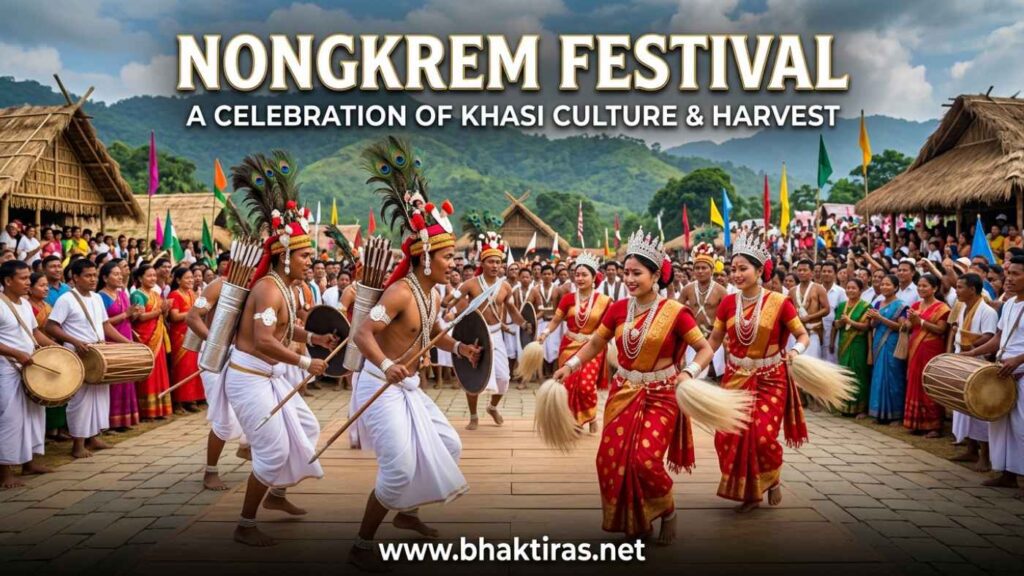
The Nongkrem Festival, or Ka Pomblang Nongkrem, is the most important religious gathering of the Khasi people, held each November at Smit, the old capital of the Khyrim state about 11 km from Shillong. Over five days the Syiem, the traditional chief of Khyrim, and the Lyngdoh, the high priest, offer goats and prayers to the goddess Ka Blei Synshar and to the ancestral spirits, thanking God for the harvest just gathered and asking for peace, health and a good season ahead. Unmarried maidens and young men dance in the courtyard of the royal thatched hall while drums and the tangmuri pipe keep time.
Nongkrem Festival 2026 to 2028: Dates & Calendar
The Nongkrem Festival is expected around mid-November 2026, with a likely window of 11 to 15 November. Because the Khyrim durbar sets the dates each year by tradition rather than a fixed formula, the figures below for 2027 and 2028 are typical estimates and should be confirmed nearer the time.
| Year | Expected dates | Start day | Notes |
|---|---|---|---|
| 2025 | 12 to 16 November | Wednesday | Held at Smit (past occurrence) |
| 2026 | 11 to 15 November | Wednesday | Next occurrence (expected) |
| 2027 | 17 to 21 November | Wednesday | Typical mid to late November estimate |
| 2028 | 15 to 19 November | Wednesday | Typical mid November estimate |
The five days build up to the main Pomblang day, when the chief offering is made and the public dancing reaches its height. Visitors planning a trip to Smit should check with Meghalaya Tourism or the Khyrim durbar once the dates are officially announced.
Why the Nongkrem Festival Is Celebrated
The Nongkrem Festival is a thanksgiving for the harvest and a prayer for prosperity, offered by the Khyrim state to the goddess Ka Blei Synshar and the ancestral spirits. It renews the bond between the living community, its ancestors and the divine.
For the Khasi, the year turns on the crop. Once the fields around the Khasi Hills have been reaped, the Khyrim state gathers at Smit to give thanks to God, whom the Niam Khasi tradition holds to be the one creator, and to the spirits who watch over the land. The festival is less a spectacle than a public act of gratitude and re-dedication.
Thanksgiving for the harvest
The central purpose is to thank God for the grain safely brought in and to pray that the coming year brings health, good weather and a fuller store. The offerings and the dance together carry this collective wish for the whole state.
Honouring Ka Blei Synshar
Prayers and sacrifice are directed to the goddess Ka Blei Synshar, revered as a guardian of the state’s welfare. Appeasing her is understood to protect the people from famine, sickness and misfortune.
The chief and priest as intermediaries
The Syiem of Khyrim and the Lyngdoh high priest act on behalf of the whole community. Only through their ancient office can the state’s offering be properly made, which is why the festival is bound so closely to the ruling clan of Khyrim.
Living heritage of the Khasi
Nongkrem keeps alive the Niam Khasi faith, the matrilineal social order and the old crafts of dress, drum and dance. It anchors Khasi identity in a modern, largely Christianised state, which is why it is guarded with such care.
Deities & Figures Worshipped
Nongkrem centres on the goddess Ka Blei Synshar, the ancestral mother Ka Iawbei and the hill spirit U Lei Shyllong, with the whole rite offered under the one God of Khasi belief.
Ka Blei Synshar
Ka Blei Synshar is the powerful goddess to whom the Khyrim state offers its thanks and its prayers for a good harvest and prosperity. She is treated as a guardian of the state’s fortune, and the Pomblang offering is made chiefly to seek her favour.
Ka Iawbei
Ka Iawbei is the first ancestress of the ruling clan, honoured as the root of the family line in the Khasi matrilineal system. Offerings to her renew the tie between the living Syiem’s clan and the founding mother from whom their authority descends.
U Lei Shyllong
U Lei Shyllong is the deity of Shyllong (Shillong) Peak, the sacred hill that gives the city its name. He is propitiated as the protector of the land, and part of the offering is directed to him for the safety of the state.
The one Creator
Above the named spirits, the Niam Khasi faith holds one supreme God as creator and sustainer. The festival’s gratitude is ultimately directed there, with Ka Blei Synshar and the ancestors approached as guardians rather than rivals to that God.
Key Rituals, Step by Step
The five days move from private priestly rites to the great public offering and the courtyard dances at the Iing Sad, the royal thatched hall of Smit.
- Opening rites at the Iing Sad. The festival begins quietly inside the Iing Sad, the large thatched palace built without metal that serves as the ritual seat of the Syiem Sad, the high priestess of Khyrim. Priests make preliminary offerings and prayers to prepare the ground for the days ahead.
- Ka Pomblang, the goat offering. On the main day the Syiem of Khyrim and the Lyngdoh high priest perform the Pomblang, offering goats to the ancestors of the ruling clan and to U Lei Shyllong. This sacrifice is the ritual heart of the festival and is carried out with strict, unhurried ceremony.
- Offerings to the ancestors. Portions and prayers are directed to Ka Iawbei, the ancestral mother, and to the founders of the clan, binding the present state to its origins and asking their continued protection.
- The maidens’ dance. Unmarried Khasi girls, dressed in fine silk, heavy silver and gold ornaments and a crown, dance slowly and gracefully in the courtyard. Their movement is modest and controlled, symbolising the purity and dignity of the community they represent.
- The men’s sword-and-whisk dance. Young men dance around the maidens with far more vigour, holding a sword in the right hand and a white yak-hair whisk in the left. They keep time to the shifting drum beats and the call of the tangmuri, the Khasi pipe.
- Music of drum and tangmuri. Throughout the dancing, a band of drums and the tangmuri sets the rhythm and mood, guiding the dancers through the changing beats that mark different parts of the performance.
- Blessing by the Syiem and priest. After the dancing the Syiem, with the Lyngdoh and his ministers, performs the concluding blessing, sealing the state’s thanksgiving and its plea for a prosperous, peaceful year.
- Close of the five days. The festival winds down with final prayers, and the community disperses carrying the season’s blessing back to their villages across the Khasi Hills.
Special Foods of the Nongkrem Festival
Khasi festival fare is simple, meat-forward and built around rice, shared among families and guests who gather at Smit for the five days.
Jadoh
Jadoh is the signature Khasi rice dish, red rice cooked with meat, usually pork or chicken, and flavoured with local spices and sometimes offal. It is the dish most associated with Khasi feasting and is served generously during the festival.
Doh (meat dishes)
Various doh preparations, meaning meat, accompany the rice, most often pork and chicken cooked plainly or with black sesame. Meat has a natural place at a festival whose central rite is a sacrificial offering.
Tungrymbai and sides
Fermented soybean paste, tungrymbai, cooked with pork and spices is a strong-flavoured Khasi favourite, served alongside boiled greens and simple vegetable sides that balance the rich meat.
Kyat, the rice beer
Kyat, a home-brewed rice beer, has a customary role in Khasi social and ritual life and is shared among the community during gatherings. It is part of the traditional hospitality rather than a mere refreshment.
Pumpkin, tubers and season produce
As a harvest festival, Nongkrem naturally brings the season’s own produce to the table, from pumpkin and squash to local tubers and greens gathered from the surrounding fields.
Nongkrem in Context: Smit and the Khasi Hills
Nongkrem belongs specifically to the Khyrim state and its seat at Smit, but it sits within a wider Khasi festival and social world.
Smit, the ritual seat
Smit is the traditional capital of the Khyrim state and holds the Iing Sad, the royal thatched hall around which the whole festival turns. About 11 km from Shillong, it draws Khasi families and visitors from across Meghalaya for the five days.
The Khyrim state (Hima Khyrim)
Nongkrem is the state festival of Hima Khyrim, one of the old Khasi chiefdoms. Its ties to the Syiem’s ruling clan and the high priestess are what give the rite its authority, so it is not simply a general regional fair.
Khasi matriliny
Khasi society is matrilineal: lineage, clan name and much property pass through the mother’s line, and the youngest daughter often keeps the ancestral home. This is why the ancestral mother Ka Iawbei and the high priestess hold such weight in the festival.
Among Khasi festivals
Nongkrem stands alongside other Khasi celebrations such as Shad Suk Mynsiem, the spring dance of joy, and the neighbouring Jaintia festival Behdienkhlam, each expressing the same close bond between the community, its faith and its land.
Nongkrem Festival Do's and Don'ts
The festival is a living religious rite, not a staged show, so visitors are asked to behave as respectful guests.
Do
- Treat the Pomblang offering and all priestly rites as sacred and observe them quietly.
- Ask permission before photographing people, especially the dancers, priests and the Syiem.
- Dress modestly and keep to the areas open to the public at the Iing Sad courtyard.
- Learn a little about Khasi custom and the Niam Khasi faith before you go.
- Follow the directions of local organisers and elders on where to stand and move.
Avoid
- Do not interrupt, mimic or step into the dance or the ritual space.
- Do not photograph the sacrificial rite if photography is restricted or if it feels intrusive.
- Do not treat the ceremony as mere entertainment or talk loudly during the prayers.
- Do not touch ritual objects, ornaments or costumes without being invited to.
- Do not bring or press alcohol on participants outside the community’s own customs.
Frequently Asked Questions
When is the Nongkrem Festival in 2026?
The Nongkrem Festival is expected around mid-November 2026, most likely from 11 to 15 November, held over five days at Smit in Meghalaya. The exact start is set by the Khyrim durbar each year and is usually confirmed only a few weeks in advance, so travellers should verify the dates nearer the time.
When was Nongkrem in 2025 and when is it in 2027 and 2028?
The Nongkrem Festival was held from about 12 to 16 November 2025, beginning on a Wednesday at Smit. For 2027 and 2028 the festival is again expected in mid to late November, with typical estimates around 17 to 21 November 2027 and 15 to 19 November 2028, subject to the Khyrim durbar’s announcement.
Why is the Nongkrem Festival celebrated?
The Nongkrem Festival is celebrated as a thanksgiving for the harvest and a prayer for prosperity by the Khasi people of the Khyrim state. Through the Pomblang offering and the sacred dances, the community thanks God, honours the goddess Ka Blei Synshar and the ancestral spirits, and asks for peace, health and a good coming year.
Which goddess is worshipped in the Nongkrem Festival?
The Nongkrem Festival centres on the goddess Ka Blei Synshar, revered as a guardian of the Khyrim state’s welfare. Offerings are also made to the ancestral mother Ka Iawbei and to U Lei Shyllong, the deity of Shillong Peak, with the whole rite offered under the one God of Khasi belief.
What is the Pomblang ceremony?
The Pomblang is the central rite of the festival, in which the Syiem of Khyrim and the Lyngdoh high priest offer goats to the ancestors of the ruling clan and to U Lei Shyllong. It is the ritual heart of Nongkrem, performed with careful ceremony as the community’s formal thanksgiving offering.
Who performs the Nongkrem dance?
Unmarried Khasi maidens perform the slow, graceful central dance in fine silk and silver and gold ornaments, symbolising purity and dignity. Young men dance around them with far more energy, each holding a sword in the right hand and a white yak-hair whisk in the left, keeping time to drums and the tangmuri pipe.
Where is the Nongkrem Festival held?
The Nongkrem Festival is held at Smit, the traditional capital of the Khyrim state, about 11 km from Shillong in the East Khasi Hills of Meghalaya. The rituals and dances take place in and around the Iing Sad, the royal thatched hall built without metal that serves as the ritual seat of the state.
How long does the Nongkrem Festival last?
The Nongkrem Festival lasts five days, moving from the opening priestly rites to the main Pomblang offering day and the public dances, and closing with the Syiem’s blessing. It is one of the most important annual religious events of the Khasi people.
May the Nongkrem thanksgiving bring peace and plenty to every home in the Khasi Hills – Khublei.