
Behdienkhlam 2026 – Meghalaya's Festival to Drive Away Plague
When is Behdienkhlam in 2026?
Behdienkhlam is celebrated from 11 to 14 July 2026, with the main procession day falling on Saturday, 11 July. It is the most important festival of the Pnar (Jaintia) people of Meghalaya, held at Jowai and Tuber in the Jaintia Hills after the sowing season to drive away plague and evil and to pray for a good harvest.
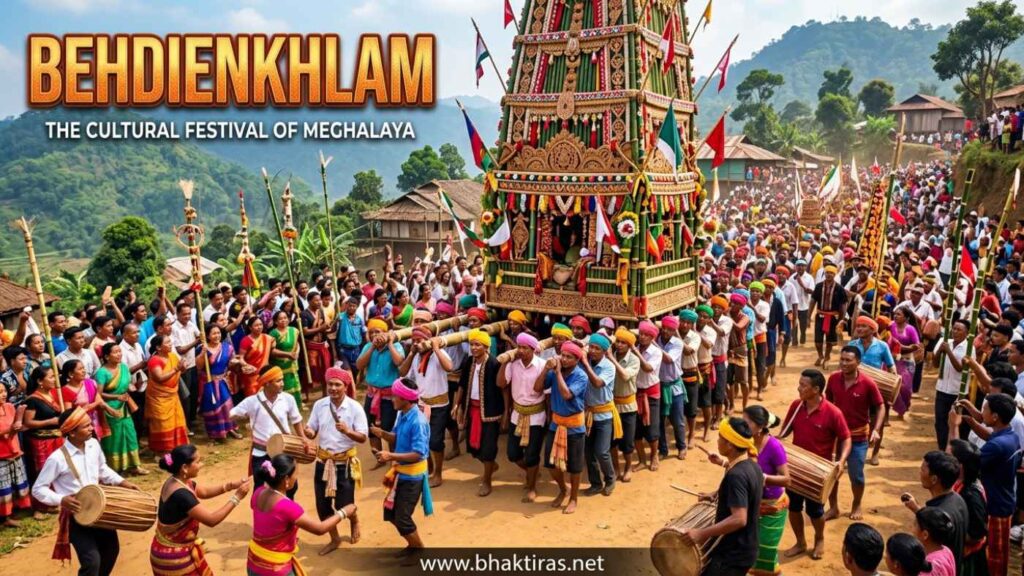
Behdienkhlam is the biggest festival of the Pnar, the Jaintia people of Meghalaya, and one of the oldest living rituals in the northeast. The name means to drive away the demon of plague, and it is kept every July at Jowai and Tuber once the fields have been sown. Followers of the indigenous Niamtre faith beat the roofs of their houses to chase off disease, raise tall decorated towers called rots, wrestle a great wooden beam through a pool of mud, and read the coming harvest from a rough football match. It is thanksgiving, protection and community identity rolled into four monsoon-soaked days.
Behdienkhlam 2026-2028: Dates & Calendar
Behdienkhlam 2026 falls on 11-14 July, with the climactic Aitnar procession on Saturday, 11 July. The exact days are fixed each year by the Niamtre religious calendar and announced locally, so they shift slightly within mid-July.
| Year | Dates | Main Day | Notes |
|---|---|---|---|
| 2025 | 12-15 July | Saturday | Held after the sowing season |
| 2026 | 11-14 July | Saturday | Next occurrence; procession at Aitnar on 11 July |
| 2027 | Mid-July (to be declared) | Saturday (expected) | Set nearer the date by the Niamtre calendar |
| 2028 | 14 July | Friday | Four-day festival at Jowai and Tuber |
Jowai, the West Jaintia Hills headquarters, hosts the largest gathering, while a smaller, more archaic form is kept at Tuber a week or so earlier. Because the observance is tied to the agricultural cycle, the community reads the readiness of the sown crop as much as any fixed calendar.
Why Behdienkhlam Is Celebrated
Behdienkhlam is celebrated to drive away plague and evil spirits and to ask U Blai, God in the Niamtre faith, for protection and a plentiful harvest. It doubles as thanksgiving once the year’s sowing is finished.
The festival grew out of a real fear that shaped hill life for centuries: epidemic disease, especially cholera, which the Pnar word khlam personifies as a demon. Behdienkhlam is the community’s yearly act of pushing that danger back out of the village and sealing the settlement in health for another season.
Driving out disease
The core meaning is protection. Young men move through the lanes striking rooftops with bamboo poles so that plague and misfortune have nowhere to hide. The act is old, deliberate and taken seriously rather than performed for show.
Thanksgiving after sowing
Behdienkhlam comes only after the paddy has been planted. With the hardest field labour done, families turn to prayer and feasting, thanking U Blai for the rains and asking that the young crop ripen safely into a full harvest.
The Niamtre faith
This is an indigenous religion, not a branch of any other. Its rites are led by the Daloi and other elders who carry ancestral duties, and Behdienkhlam is the largest public expression of Niamtre belief anywhere.
Jaintia identity
For the Pnar, the festival is also who they are. The rots each locality builds, the songs, the mud and the games bind neighbourhoods together and pass the culture, intact, to the next generation.
Whom the Pnar Pray To
Prayers at Behdienkhlam are addressed to U Blai, the supreme God of the Niamtre faith, along with the guardian spirits of the locality, seeking health and a good harvest.
U Blai
U Blai is the creator and protector in Niamtre belief. The whole festival is an appeal to U Blai to keep sickness away from the community and to bless the sown fields with a heavy crop.
Guardian spirits of the land
Local protective deities and ancestral spirits tied to Jowai and its clans are honoured through the Daloi’s offerings. They are asked to watch over the settlement in the coming months of monsoon and growth.
Key Rituals, Step by Step
Behdienkhlam unfolds over three to four days, building from private preparation to a huge public climax at the Aitnar pool.
- Building the rots and symlengs. In the days before, each locality crafts its rot, a tall tower of bamboo and wood dressed in coloured paper, tinsel and carved motifs, sometimes 20 to 30 feet high. Slimmer, rounded poles called symlengs are shaped alongside them. The work takes skilled hands and friendly rivalry between neighbourhoods.
- Rooftop beating. Groups of young men go house to house striking the thatch and roofs with bamboo poles, chanting as they go, symbolically forcing plague and evil out of every home and out of the village.
- Offerings by the Daloi. The Daloi and elders perform the religious rites, making ancestral offerings and prayers to U Blai for protection and harvest. These are the sober, sacred heart of the festival.
- Procession to Aitnar. On the main day the rots and symlengs are carried through the town in a loud, joyful procession of drums, pipes and dancing, converging on Aitnar, a large pool of mud on the edge of Jowai.
- The khnong tug in the mud. A massive wooden beam, the khnong, is brought to Aitnar and hundreds of men, chest-deep in mud, tussle to touch and heave it. The struggle is charged with emotion and is believed to carry blessing to those who take part.
- Dad-lawakor. A rough football-like game is played with a wooden ball between two sides. The result is read as an omen: which side wins is taken to forecast whether the harvest will be good, giving the match real weight beyond sport.
- Immersion and closing prayers. The rots are finally lowered into the pool, the community offers closing thanks, and the settlement is considered cleansed and protected for the year ahead.
Food During Behdienkhlam
Behdienkhlam is also a season of shared feasting, with Jaintia home cooking at its centre and pork on almost every table.
Jadoh
Jadoh is the signature Pnar dish, rice cooked with pork and its blood, seasoned with local spices and often turmeric. Rich and filling, it is the meal most associated with festive gatherings in the Jaintia Hills.
Pork dishes
Pork is the meat of the festival. Pigs are offered in the rites, and the meat returns to families as stews and dry preparations shared at the community feast that follows the sacrifices.
Rice and local greens
Plain rice anchors every plate, served with foraged greens, fermented sides and chillies. The cooking is simple and hearty, suited to the wet July weather and long days outdoors.
Rice beer (kiad)
Locally brewed rice beer is shared among adults during the celebrations. It is part of hospitality and ritual life in the hills, poured for guests and used in some traditional offerings.
Jowai and Tuber: Two Celebrations
Behdienkhlam is centred on the Jaintia Hills, but it is kept in two main places, each with its own character.
Jowai
The West Jaintia Hills headquarters holds the largest and best known Behdienkhlam. Thousands gather at the Aitnar pool for the rots, the khnong tug and Dad-lawakor, and the town’s localities compete to raise the finest towers.
Tuber
Tuber, deeper in the Jaintia Hills, keeps an older, quieter form of the festival, usually a little before Jowai. It is smaller and more austere, closer to the original agricultural rite than the grand public spectacle at Jowai.
Beyond the Jaintia Hills
Pnar families living in Shillong and elsewhere in Meghalaya, and in the wider diaspora, mark the season and often travel home to Jowai to take part, keeping the festival tied to its birthplace.
Behdienkhlam Do's and Don'ts
This is a living indigenous rite, not a tourist show, so visitors are welcome but expected to be respectful.
Do
- Ask before photographing people, the rots or the rituals
- Follow the directions of the Daloi, organisers and local hosts
- Learn the meaning of the rituals so you can watch with understanding
- Dress modestly and keep a respectful distance during prayers
- Support the community by buying local food and crafts
Avoid
- Don’t treat the ceremonies as mere entertainment or a photo backdrop
- Don’t touch the rots, symlengs or the khnong unless invited
- Don’t interrupt the rooftop-beating or the Daloi’s offerings
- Don’t enter the Aitnar mud tussle uninvited; it is a ritual, not a game for onlookers
- Don’t make light of the Niamtre faith or its beliefs
Frequently Asked Questions
When is Behdienkhlam in 2026?
Behdienkhlam is celebrated from 11 to 14 July 2026, with the main procession to the Aitnar pool on Saturday, 11 July. It is held at Jowai and Tuber in the Jaintia Hills of Meghalaya after the sowing season.
What does Behdienkhlam mean?
Behdienkhlam means to drive away the demon of plague. The Pnar word khlam refers to disease, especially cholera, and the festival is the community’s yearly ritual to push sickness and evil out of the village and pray for health and a good harvest.
Who celebrates Behdienkhlam?
Behdienkhlam is celebrated by the Pnar, or Jaintia, people of Meghalaya, chiefly the followers of the indigenous Niamtre faith. It is the largest and most important festival of the Niamtre religion, centred on the town of Jowai.
What are rots and symlengs?
Rots are tall towers of bamboo and wood, often 20 to 30 feet high and decorated with coloured paper, tinsel and carved motifs, built by each locality for Behdienkhlam. Symlengs are slimmer rounded poles shaped alongside them. Both are carried in procession and finally immersed in the Aitnar mud pool.
What is the Dad-lawakor game?
Dad-lawakor is a rough football-like game played with a wooden ball between two sides during Behdienkhlam. Its outcome is read as an omen for the farming year, with the winning side taken to forecast whether the coming harvest will be good.
What is the khnong and the Aitnar ritual?
The khnong is a huge wooden beam brought to the Aitnar pool, a large pit of mud at Jowai, on the main day of Behdienkhlam. Hundreds of men wrestle and heave it while standing chest-deep in the mud, an act believed to carry blessing to those who take part.
Why do people beat the roofs during Behdienkhlam?
Beating the rooftops with bamboo poles is how the Pnar symbolically drive plague and evil spirits out of their homes. Groups of young men move house to house striking the roofs and chanting, cleansing each dwelling and the whole village of sickness.
When is Behdienkhlam in 2027 and 2028?
Behdienkhlam is expected in mid-July 2027, with the exact days declared nearer the time by the Niamtre religious calendar, and in 2028 it falls around 14 July. The dates shift slightly each year because the festival follows the traditional Pnar reckoning and the farming cycle.
May the roofs be swept clean, the fields ripen and the year ahead stay free of harm. Khublei to the people of Jowai.