
Narasimha Jayanti 2027 – The Man-Lion Avatar's Appearance Day
नृसिंह जयंती
When is Narasimha Jayanti in 2027?
Narasimha Jayanti falls on Tuesday, 18 May 2027. It marks the dusk-hour appearance of Narasimha, the fourth avatar of Vishnu, who took the form of a man-lion to rescue his young devotee Prahlada and slay the demon Hiranyakashipu. Devotees fast through the day and break it after sunset, the very hour the avatar is said to have burst forth.
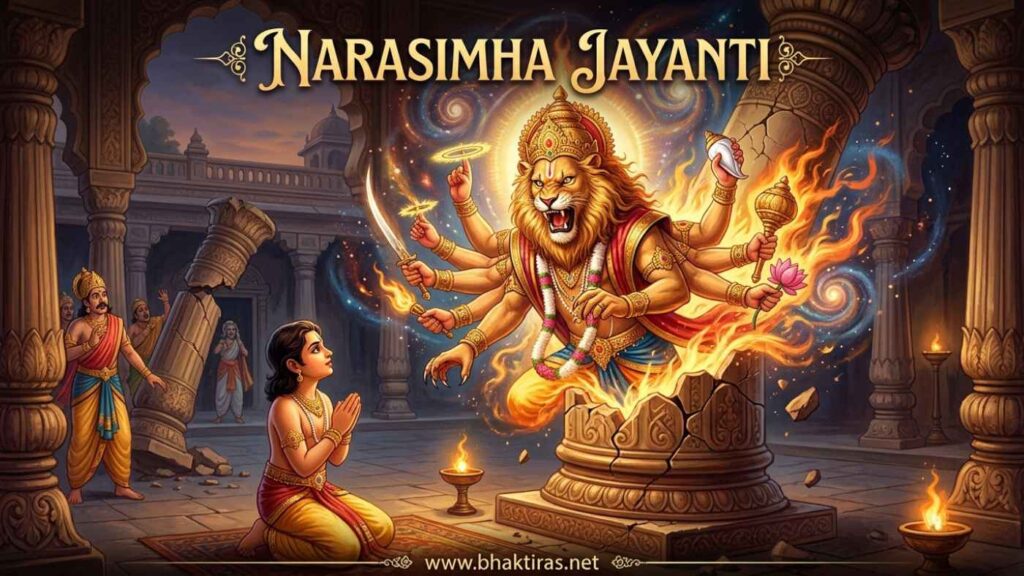
Narasimha Jayanti honours the day Vishnu took his fiercest form – Narasimha, half man and half lion – to protect a child who would not stop loving God. Falling on Vaishakha Shukla Chaturdashi (April-May), it recalls how the Lord stepped out of a temple pillar at twilight to end the reign of the demon-king Hiranyakashipu and shield the boy-saint Prahlada. For Vaishavas it is a day about surrender and divine protection: the promise that no threat, however clever, can reach a devotee who has truly taken refuge. Fasting runs from dawn to the dusk hour of the avatar’s appearance.
Narasimha Jayanti 2026-2028: Dates & Calendar
The next Narasimha Jayanti falls on Tuesday, 18 May 2027. Because it follows the lunar tithi Vaishakha Shukla Chaturdashi rather than a fixed solar date, it shifts each year across late April and May.
| Year | Date | Day | Tithi |
|---|---|---|---|
| 2026 | 30 April | Thursday | Vaishakha Shukla Chaturdashi |
| 2027 | 18 May | Tuesday | Vaishakha Shukla Chaturdashi |
| 2028 | 16 May | Tuesday | Vaishakha Shukla Chaturdashi |
The puja is unusual in being an evening rite. Because the avatar appeared at the junction of day and night – neither one nor the other, to honour the terms of the demon’s boon – worship is offered during the Sayankala (twilight) Muhurat rather than at midday, and the fast is broken only after this window.
Why Narasimha Jayanti Is Celebrated
Narasimha Jayanti celebrates the moment God intervened to protect a devoted child and to prove that no loophole can shield cruelty forever. It is a festival about faith outlasting power.
The demon who thought he was safe
Hiranyakashipu won a boon that he could not be killed by man or beast, indoors or outdoors, by day or night, on the ground or in the sky, by any weapon. Believing himself deathless, he demanded to be worshipped as god and turned savage against anyone who refused – including his own son.
Prahlada's unshakable devotion
The king’s young son Prahlada loved Vishnu with his whole heart and would not stop, no matter the threats. Poison, fire and a fall from a cliff all failed to harm him. His steady faith, tested again and again, is the emotional centre of the festival.
Every loophole answered
When Hiranyakashipu mockingly asked whether Vishnu was in a pillar, the Lord burst out as Narasimha – neither man nor beast. He seized the king at the threshold of the hall (neither in nor out), at dusk (neither day nor night), laid him across his lap (neither ground nor sky) and used his claws (no weapon). The boon held; the tyrant fell.
Protection of the devotee
For Vaishnavas the deeper meaning is refuge. Narasimha is invoked as a fierce guardian who removes fear and destroys inner and outer evil. The day reassures the faithful that surrender to God is never left unanswered.
Deities & Figures Worshipped
The day centres on Vishnu in his Narasimha form, remembered alongside the child-devotee Prahlada whose faith brought the avatar forth. In many shrines the fierce form is paired with a calming consort.
Narasimha
The fourth of Vishnu’s ten avatars, shown with a lion’s head and a human body, often mid-roar. He is worshipped as Ugra Narasimha (the fierce protector) and, when seated peacefully with Lakshmi, as Lakshmi Narasimha. Ahobilam in Andhra Pradesh honours nine distinct forms of him.
Prahlada
The boy-saint whose devotion never wavered under his father’s cruelty. He is remembered as the model bhakta, and his calm presence is what softens Narasimha’s rage in the story’s closing scenes.
Lakshmi
As Lakshmi Narasimha, the Goddess is depicted seated with the Lord, cooling his fury after the battle. Temples such as Simhachalam and Yadadri worship this gentler, blessing-bestowing form.
Key Rituals, Step by Step
Narasimha Jayanti is a day-long fast that culminates in an evening puja timed to the avatar’s dusk appearance. Observances are simple and heartfelt.
- Sankalpa and morning bath. Devotees rise early, bathe, and take a vow (sankalpa) to observe the fast and worship Narasimha through the day.
- Fast through the day. A strict fast is kept from sunrise; many take only water, while others allow fruit and milk. The intention is to hold hunger until the hour the Lord appeared.
- Set up the puja. An image or idol of Lakshmi Narasimha is placed on a clean altar and offered flowers, tulsi leaves, sandal paste, kumkum and a lamp.
- Evening worship at Sayankala. The main puja is performed at dusk. The Narasimha mantras and the Narasimha Kavacham are chanted, and the story of Prahlada is often read aloud.
- Recite the protective stotras. Devotees seeking safety and courage recite verses invoking Narasimha as the remover of fear and destroyer of evil.
- Offer bhoga and aarti. Cooling foods, panakam and fruit are offered, followed by the waving of lamps in aarti.
- Break the fast (parana). After the evening puja concludes, the fast is broken with the offered prasad. Charity – giving food, water pots or cloth – is considered especially meritorious on this day.
Special Foods of Narasimha Jayanti
Because the festival falls in the summer heat, the offerings lean toward cooling, thirst-quenching preparations – the same drinks associated with soothing the Lord’s fury.
Panakam
A cooling jaggery drink flavoured with dry ginger, cardamom and a little black pepper. It is the signature offering of the season, given both to the deity and to visitors.
Neer mor
Spiced buttermilk thinned with water and seasoned with ginger, curry leaves and green chilli – a light, digestive drink offered to beat the summer heat.
Kosambari
A fresh salad of soaked moong dal, grated cucumber or carrot and coconut, tempered lightly. It is a common Vaishnava offering during these warm-weather festivals.
Fruit and milk
Those who fast on fruit break the day with seasonal fruit, milk and dry fruits, keeping the meal simple and sattvic in keeping with the vrat.
Where It Is Celebrated
The festival is strongest across the Vaishnava temple belt of South India, though it is observed by devotees of Vishnu everywhere.
Ahobilam, Andhra Pradesh
The most important centre, where nine forms of Narasimha are enshrined across the hills. It is regarded as the very place associated with the avatar’s appearance, drawing large crowds on the day.
Simhachalam, Andhra Pradesh
The hilltop shrine of Varaha Lakshmi Narasimha near Visakhapatnam holds elaborate worship, its deity kept coated in sandal paste to cool the Lord’s fierce form.
Melkote & Karnataka
Sri Vaishnava centres in Karnataka, including Melkote and the Yadadri (Yadagirigutta) temple, mark the day with special abhisheka, recitation and evening puja.
Homes and Vaishnava mandirs
Beyond the great temples, devotee families keep the fast at home, worship a Narasimha image at dusk and read the Prahlada story to children, passing on its lesson of fearless faith.
Narasimha Jayanti Do's and Don'ts
A few simple observances help keep the day focused on devotion and the discipline of the fast.
Do
- Take the sankalpa in the morning and keep the fast sincerely until dusk.
- Time the main puja to the Sayankala (twilight) period, honouring the hour of the avatar.
- Chant the Narasimha mantras and recite the Prahlada story.
- Offer cooling items such as panakam, buttermilk and fruit.
- Give in charity – food, water or cloth – after the puja, as the day favours generosity.
Avoid
- Do not break the fast before completing the evening worship.
- Do not offer tamasic foods such as onion, garlic, meat or alcohol.
- Do not treat the fierce form casually; approach the puja with humility and calm.
- Do not skip the parana – end the fast mindfully with the offered prasad.
- Do not let anger or harsh words spoil a day that is, at heart, about protecting the innocent.
Frequently Asked Questions
When is Narasimha Jayanti in 2027?
Narasimha Jayanti in 2027 falls on Tuesday, 18 May. It is observed on Vaishakha Shukla Chaturdashi, the fourteenth day of the bright fortnight of the month of Vaishakha, with the main puja performed at dusk.
When is Narasimha Jayanti in 2026 and 2028?
Narasimha Jayanti is on Thursday, 30 April 2026 and on Tuesday, 16 May 2028. The date moves each year because it follows the lunar tithi Vaishakha Shukla Chaturdashi rather than a fixed Gregorian date, usually landing between late April and mid-May.
Why is Narasimha Jayanti celebrated?
Narasimha Jayanti celebrates the appearance of Narasimha, the man-lion avatar of Vishnu, who came to protect his devotee Prahlada and destroy the tyrant Hiranyakashipu. It marks the triumph of devotion over ego and the assurance that God protects those who take refuge in him.
Which god is worshipped on Narasimha Jayanti?
Vishnu is worshipped in his Narasimha form on Narasimha Jayanti, often as Lakshmi Narasimha where the Goddess sits with him to calm his fury. The devotee-child Prahlada is remembered alongside the Lord as the model of unwavering faith.
How did Narasimha kill Hiranyakashipu despite his boon?
Narasimha killed Hiranyakashipu by answering every clause of his boon. The demon could not be slain by man or beast, indoors or out, by day or night, on ground or in sky, or by any weapon – so Narasimha, neither man nor beast, took him at the threshold at dusk, on his lap, and used his claws rather than a weapon.
How do devotees observe Narasimha Jayanti?
Devotees observe Narasimha Jayanti by fasting from sunrise and performing the main puja at dusk, the hour the avatar appeared. They chant Narasimha mantras, read the story of Prahlada, offer cooling foods such as panakam, and break the fast only after the evening worship.
Why is the Narasimha Jayanti puja done in the evening?
The Narasimha Jayanti puja is done in the evening because the avatar appeared at twilight – neither day nor night – to satisfy the terms of Hiranyakashipu’s boon. The fast is therefore held through the day and broken after this dusk-hour worship.
Where is Narasimha Jayanti celebrated most grandly?
Narasimha Jayanti is celebrated most grandly at the Vaishnava temples of South India, above all Ahobilam in Andhra Pradesh, which enshrines nine forms of the deity. Simhachalam, Melkote and Yadadri also hold large observances on the day.
May the fierce and protecting form of Narasimha guard your home and steady your faith. Narasimha Jayanti ki hardik shubhkamnayein.