
Matsya Jayanti 2027 – The Day Vishnu Became a Fish
मत्स्य जयंती
When is Matsya Jayanti in 2027?
Matsya Jayanti 2027 falls on Friday, 9 April. It marks the appearance of Matsya, the fish avatar and the first of Vishnu’s ten incarnations, observed on Chaitra Shukla Tritiya. Devotees fast, read the Matsya story from the Matsya Purana, and worship Vishnu.
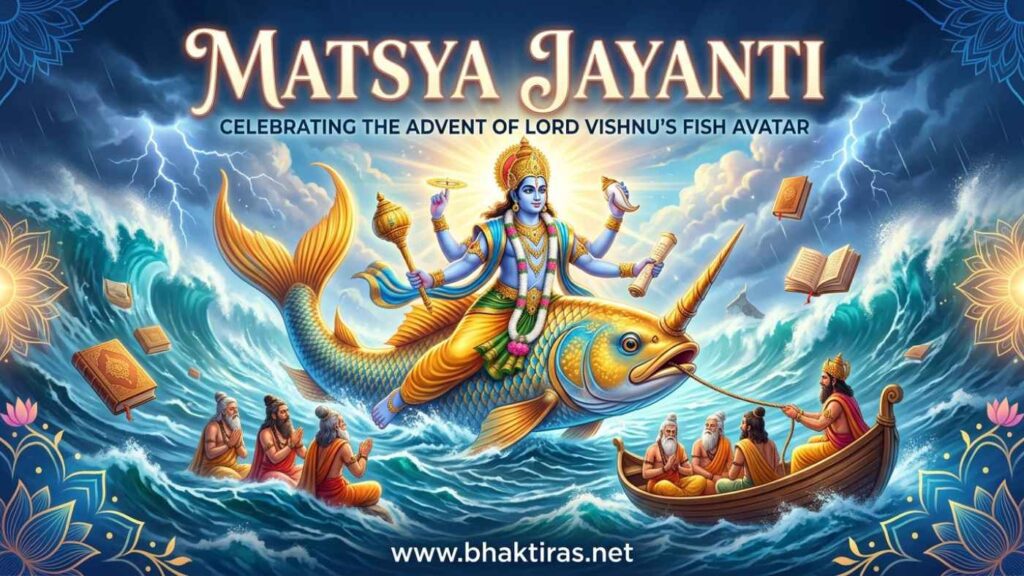
Matsya Jayanti honours the day Vishnu first stepped into the world as a fish. Falling on Chaitra Shukla Tritiya – Friday, 9 April in 2027 – it remembers the story from the Matsya Purana in which a small fish grew into a cosmic being, warned King Manu of a flood that would drown the world, and towed his boat to safety. It is the first of the ten avatars, and for many Vaishnavas it opens the story of how Vishnu keeps returning to protect creation.
Matsya Jayanti 2026-2028: Dates & Calendar
The next Matsya Jayanti is on Friday, 9 April 2027. The date shifts each year because it follows the lunar month of Chaitra rather than the fixed solar calendar.
| Year | Date | Day | Notes |
|---|---|---|---|
| 2026 | 21 March | Saturday | Fell during Chaitra Navratri |
| 2027 | 9 April | Friday | Next occurrence |
| 2028 | 29 March | Wednesday | Coincides with spring Gangaur season |
The festival lands on the third lunar day (Tritiya) of the bright half of Chaitra, so it usually arrives within the nine days of Chaitra Navratri. The Vishnu puja is typically done in the afternoon, around midday, when the Tritiya tithi is in force – check a local panchang for the exact window in your city.
Why Matsya Jayanti Is Celebrated
Matsya Jayanti celebrates the first of Vishnu’s ten avatars, the fish who rescued life and sacred knowledge before a world-ending flood. It is a day about protection, renewal, and the survival of dharma across ages.
The flood and King Manu
A tiny fish asks the righteous king Manu for shelter, then keeps outgrowing every pot, pond and river until Manu realises this is no ordinary creature. The fish warns him that a great deluge is coming and tells him to build a boat. When the waters rise, Manu loads it with the seven sages, seeds of every plant, and pairs of living things – the seed-stock of the next age.
Towed to safety on a horn
As the flood covers the earth, the fish returns, now vast, with a single horn on its head. Manu ties his boat to the horn with the serpent Vasuki, and Matsya tows the vessel through the storm to the safety of the northern mountains, holding it steady until the waters recede.
The Vedas recovered
In a linked strand of the story, a demon named Hayagriva steals the Vedas and hides them in the depths of the cosmic ocean. Matsya dives after him, defeats him, and brings the sacred texts back – so that sacred knowledge, not just living creatures, survives into the new world.
First of the ten avatars
Matsya is the opening avatar of the Dashavatara, the ten descents of Vishnu that run from the fish through the tortoise, boar and man-lion up to Krishna and beyond. Some readers see the sequence as a march from water to land to human form, and Matsya Jayanti is where that long story begins.
Deities & Figures Worshipped
The day centres on Vishnu in his Matsya form. King Manu, the seven sages and the serpent Vasuki appear in the story as the ones saved and the ones who help.
Vishnu as Matsya
Vishnu is worshipped in his fish incarnation, usually pictured as a golden fish or as a four-armed figure rising from a fish’s body, holding the conch, discus, mace and lotus. Prayers thank him for preserving life and knowledge when the old world was swept away.
King Manu
Manu is the righteous ancestor of humankind who shelters the fish and heeds its warning. In many tellings he is the Manu of the current age, which makes the flood story a bridge between the old creation and our own.
The seven sages (Saptarishi)
The seven great sages ride Manu’s boat through the flood, carrying the wisdom of the earlier age. Their survival is part of why the festival is read as the rescue of both life and learning.
Key Rituals, Step by Step
Observance is quiet and devotional rather than showy – a day of fasting, reading and Vishnu worship, kept mostly by Vaishnava households and temples.
- Wake and bathe early. Devotees rise before sunrise and bathe, ideally in a river or by adding a little holy water to the bath, since water is central to this avatar’s story.
- Take a vow to fast. Many keep a full or fruit-and-milk fast for the day, resolving to worship Vishnu before eating; some observe it like an Ekadashi-style fast.
- Set up the puja. A clean altar is prepared with an image or idol of Vishnu or Matsya, a lit lamp, incense, flowers and tulsi leaves, which are especially dear to Vishnu.
- Offer the puja. Vishnu is invoked with the Matsya form in mind, bathed (in image), dressed, and offered sandalwood, flowers, fruit and sweets, usually in the afternoon while the Tritiya tithi holds.
- Read the Matsya story. Families read or listen to the Matsya avatar narrative from the Matsya Purana – the flood, Manu’s boat, the horn, and the recovery of the Vedas.
- Chant Vishnu’s names. The Vishnu Sahasranama or simple japa of “Om Namo Bhagavate Vasudevaya” is recited, and aarti is performed at the close.
- Give and share. Some feed fish, give grain or water to those in need, and share prasad, breaking the fast after the evening worship.
How It Is Observed
Matsya Jayanti is a pan-India Vaishnava observance rather than a big public festival, so it looks a little different from place to place.
Vishnu and Vaishnava temples
Temples dedicated to Vishnu hold special abhishekam and aarti, and some display the Matsya form or the full Dashavatara panel for the day. The mood is devotional, with kirtan and readings rather than processions.
Rajasthan and the north
Because the day falls in bright Chaitra, in parts of Rajasthan it overlaps with the Gangaur and Chaitra Navratri season, so household worship of Vishnu sits alongside the spring festivities already under way.
Coastal and riverside communities
In places tied to rivers and the sea, the fish avatar carries an extra resonance, and the day’s link to water – bathing, offering water, sometimes feeding fish – is felt more strongly.
Home observance
For most families the day is kept at home: an early bath, a fast, a Vishnu puja and the retelling of the flood story to children, who often meet the Dashavatara for the first time through the fish.
Matsya Jayanti Do's and Don'ts
A few simple customs keep the day’s spirit of purity and devotion.
Do
- Bathe early and keep the puja space clean.
- Offer tulsi leaves, which Vishnu is said to love.
- Read or listen to the Matsya avatar story.
- Keep the fast sincerely if you take the vow.
- Share prasad, food or water with others.
Avoid
- Do not eat non-vegetarian food, especially fish, on this day.
- Avoid onion and garlic if you are keeping the fast.
- Do not break the fast before completing the evening worship.
- Avoid harsh speech, anger and quarrels during the vrat.
- Do not offer stale flowers or leave the lamp unattended.
Frequently Asked Questions
When is Matsya Jayanti in 2027?
Matsya Jayanti 2027 falls on Friday, 9 April. It is observed on Chaitra Shukla Tritiya, the third lunar day of the bright half of the month of Chaitra, and honours Vishnu’s fish avatar.
When is Matsya Jayanti in 2026 and 2028?
Matsya Jayanti was on Saturday, 21 March 2026, and will next be on Wednesday, 29 March 2028. The date moves each year because it follows the Hindu lunar month of Chaitra rather than the fixed solar calendar.
Why is Matsya Jayanti celebrated?
Matsya Jayanti is celebrated because it marks the appearance of Matsya, the first of Vishnu’s ten avatars. In the fish form, Vishnu warned King Manu of a world-ending flood, towed his boat to safety, and recovered the stolen Vedas – preserving both life and sacred knowledge for the new age.
Which god is worshipped on Matsya Jayanti?
Vishnu is worshipped on Matsya Jayanti, specifically in his Matsya (fish) incarnation. Devotees offer flowers, tulsi and fruit, read the Matsya story, and chant Vishnu’s names such as “Om Namo Bhagavate Vasudevaya”.
What is the story of the Matsya avatar?
The Matsya avatar is the story of a small fish who asks King Manu for shelter and keeps growing until he reveals himself as Vishnu. He warns Manu of a coming flood, tells him to build a boat carrying the seven sages, seeds and creatures, and tows it to safety on his horn, later recovering the Vedas from the demon Hayagriva.
Is Matsya the first avatar of Vishnu?
Yes, Matsya is the first of Vishnu’s ten avatars, the Dashavatara. He is followed by Kurma the tortoise, Varaha the boar, Narasimha the man-lion, and on through the sequence to Krishna and beyond.
How is Matsya Jayanti observed?
Matsya Jayanti is observed with an early bath, a day-long fast, and a Vishnu puja usually performed in the afternoon. Devotees read the Matsya story from the Matsya Purana, chant Vishnu’s names, perform aarti, and share prasad before breaking the fast.
Can you eat fish on Matsya Jayanti?
No, eating fish or other non-vegetarian food is avoided on Matsya Jayanti, since the day honours Vishnu in the form of a fish. Most observers keep a vegetarian or fasting diet and avoid onion and garlic during the vrat.
May the first avatar who carried the world through the flood keep your path steady – a joyful Matsya Jayanti to you and yours.