
Parashurama Jayanti 2026 – The Axe-Wielding Sage's Birthday
परशुराम जयंती
When is Parashurama Jayanti in 2027?
Parashurama Jayanti falls on Saturday, 8 May 2027. It marks the appearance day of Parashurama, the sixth avatar of Vishnu, born on Vaishakha Shukla Tritiya. The tithi usually coincides with Akshaya Tritiya, though in 2027 it lands a day earlier.
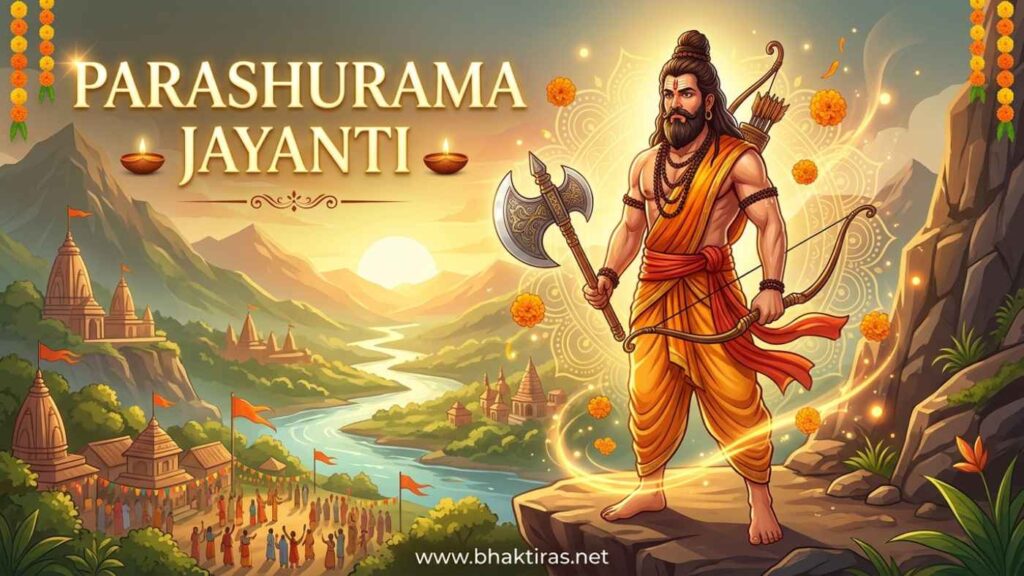
Parashurama Jayanti is the day Hindus remember the birth of Parashurama, the sixth of Vishnu’s ten avatars and one of the most unusual – a brahmin sage who carried an axe. Born to sage Jamadagni and Renuka, he is the warrior-priest who, tradition says, humbled the arrogant kshatriya kings of his age. The observance falls on Vaishakha Shukla Tritiya, the same bright-fortnight day as Akshaya Tritiya, so it usually rides along with that famously auspicious date. He is counted among the chiranjivi, the deathless ones, and is believed to still walk the earth.
Parashurama Jayanti 2026-2028: Dates & Calendar
The next Parashurama Jayanti is Saturday, 8 May 2027. The date shifts each year because it is fixed to the lunar tithi Vaishakha Shukla Tritiya, not to a Gregorian day.
| Year | Date | Day | Notes |
|---|---|---|---|
| 2026 | 19 April | Sunday | Same day as Akshaya Tritiya |
| 2027 | 8 May | Saturday | Next occurrence – one day before Akshaya Tritiya (9 May) |
| 2028 | 27 April | Thursday | Same day as Akshaya Tritiya |
In most years Parashurama Jayanti and Akshaya Tritiya share the same date. When the Tritiya tithi begins late in the day, as in 2027, the Parashurama observance (tied to a Pradosh-time appearance) can fall a day earlier than Akshaya Tritiya.
Why Parashurama Jayanti Is Celebrated
Parashurama Jayanti is celebrated because it marks the birth of Vishnu’s sixth avatar, the sage-warrior who restored balance when kingly power turned cruel. It honours a figure who embodies both scholarship and force.
The sixth avatar
Parashurama is the sixth of Vishnu’s dashavatara, appearing after the animal-and-hybrid forms and before Rama. He is the first fully human avatar, and unusually he does not die at the end of his story – he steps aside, remaining among the living.
The axe from Shiva
His name means Rama-with-the-axe. The parashu was given to him by Shiva after long penance, along with martial knowledge. That axe became the symbol of a brahmin who was also a warrior, a rare and deliberate combination.
Curbing tyranny
The tradition holds that Parashurama acted against a warrior class that had grown arrogant and oppressive, most famously against King Kartavirya Arjuna, who wronged his father Jamadagni. His story is read less as conquest and more as a correction of abused power.
An immortal presence
Parashurama is one of the eight chiranjivi, the immortals believed to live through the ages. He appears in both the Ramayana, where he meets the young Rama, and the Mahabharata, where he teaches Bhishma, Drona and Karna – linking two epics across time.
Deities & Figures Worshipped
Parashurama Jayanti centres on Parashurama himself as an avatar of Vishnu, with his parents remembered alongside him.
Parashurama
The day’s central figure – the axe-bearing sage. Devotees invoke him for courage, discipline and the strength to stand against injustice, and he is a kuladevata (family deity) for several Brahmin communities along the west coast.
Vishnu
Because Parashurama is Vishnu’s sixth descent, the festival is ultimately a Vaishnava observance. Worship of the avatar is worship of Vishnu in that specific form.
Jamadagni and Renuka
His father, the sage Jamadagni, and mother Renuka are recalled in the tellings of his life. Renuka is herself worshipped as a goddess in parts of Maharashtra and Karnataka.
Key Rituals, Step by Step
Observance is simple and devotional rather than elaborate, often folded into the wider Akshaya Tritiya morning.
- Early bath and vrat. Devotees rise before sunrise, bathe, and many keep a fast for the day in Parashurama’s honour.
- Set up worship. An image or picture of Parashurama, usually shown holding his axe, is placed and cleaned; a lamp and incense are lit.
- Offerings. Flowers, fruit, tulsi leaves and sandalwood paste are offered, following the pattern of Vishnu puja.
- Recitation. The Vishnu Sahasranama, Parashurama stotras, or readings from the epics recounting his deeds are read aloud.
- Temple visit. Where Parashurama temples exist – notably along the Konkan and in Kerala – devotees visit for darshan on this day.
- Charity. As with Akshaya Tritiya, giving daan (food, grain, clothing) is considered especially fruitful and is a common closing act.
Regional Names & Variations
Parashurama is honoured most strongly along India’s western seaboard, the land tradition credits him with reclaiming from the sea.
Konkan (Maharashtra & Goa)
The Konkan coast is called Parashurama Kshetra in tradition, said to be raised from the sea when he flung his axe. Chiplun in Ratnagiri district has a well-known Parashurama temple, and Chitpavan Brahmins revere him as their progenitor.
Kerala
Malayali tradition credits Parashurama with creating Kerala itself, throwing his axe from Gokarna to Kanyakumari so the sea drew back. He is tied to the founding of several temples and to the settling of the region’s Brahmin families.
North & Central India
In states such as Haryana, Rajasthan and Madhya Pradesh, Maharshi Parashuram Jayanti is a recognised holiday, marked with processions and community programmes by Brahmin associations.
Coastal Karnataka
Around Udupi and Gokarna, sites linked to Parashurama draw pilgrims, and the avatar is woven into local temple-origin legends of the Tulu and Konkani coast.
Parashurama Jayanti Do's and Don'ts
A few simple observances keep the day sincere and calm.
Do
- Bathe early and begin the day with a clean space for worship
- Offer daan – food or grain to those in need, as the tithi rewards giving
- Read or listen to Parashurama’s story from the Ramayana or Mahabharata
- Light a lamp before Vishnu or Parashurama and keep the mind peaceful
- Visit a Parashurama or Vishnu temple if one is nearby
Avoid
- Do not treat the axe symbolism as violence – it stands for cutting away injustice
- Avoid anger and harsh speech on a day about restoring balance
- Do not skip charity if you are able; giving is central to this tithi
- Avoid non-vegetarian food and alcohol if you are keeping the vrat
- Do not confuse Parashurama (sixth avatar) with Rama of Ayodhya (seventh) – they are distinct
Frequently Asked Questions
When is Parashurama Jayanti in 2027?
Parashurama Jayanti is on Saturday, 8 May 2027. It falls on Vaishakha Shukla Tritiya, the third day of the bright fortnight in the Hindu month of Vaishakha. In 2027 it lands one day before Akshaya Tritiya.
When is Parashurama Jayanti in 2026 and 2028?
Parashurama Jayanti is on Sunday, 19 April 2026 and on Thursday, 27 April 2028. In both those years it coincides with Akshaya Tritiya, unlike in 2027 when it falls a day earlier. The date moves because it follows the lunar tithi rather than a fixed calendar day.
Why is Parashurama Jayanti celebrated?
Parashurama Jayanti is celebrated to mark the birth of Parashurama, the sixth avatar of Vishnu. He is remembered as the sage-warrior who checked the arrogance of tyrannical kings and, by tradition, reclaimed the western coastal land from the sea. Devotees honour his union of scholarship and courage.
Which god is worshipped on Parashurama Jayanti?
Parashurama, the sixth avatar of Vishnu, is worshipped on this day, and through him Vishnu himself. He is depicted as a brahmin sage carrying an axe (parashu) given to him by Shiva. His parents, the sage Jamadagni and Renuka, are also remembered.
Why does Parashurama Jayanti fall on Akshaya Tritiya?
Parashurama Jayanti falls on Akshaya Tritiya because both observe Vaishakha Shukla Tritiya, the same lunar day. Tradition places Parashurama’s appearance on this tithi. In some years the exact tithi timing shifts the Parashurama observance one day earlier, as happens in 2027.
Is Parashurama immortal?
Yes, Parashurama is regarded as one of the chiranjivi, the eight immortals of Hindu tradition believed to live through all the ages. This is why he appears in both the Ramayana and the Mahabharata, two epics set generations apart. He is not shown dying at the end of his story.
What is the significance of Parashurama's axe?
The axe, or parashu, was given to Parashurama by Shiva and is the source of his name, meaning Rama-with-the-axe. It symbolises the cutting away of injustice and arrogance rather than mere violence. It marks him as a rare figure who was both a brahmin scholar and a warrior.
How is Parashurama Jayanti observed?
Parashurama Jayanti is observed with an early bath, a day-long fast by many devotees, and puja before an image of the axe-bearing sage. People recite Vishnu prayers and stories of his deeds, visit Parashurama or Vishnu temples, and give charity, which is considered especially rewarding on this tithi.
May Parashurama’s steady resolve inspire courage and fairness in your home this year. Parashuram Jayanti ki shubhkamnayein.