
Naraka Chaturdashi 2026 – Choti Diwali, the Dawn Bath Day
नरक चतुर्दशी
When is Naraka Chaturdashi in 2026?
Naraka Chaturdashi (Choti Diwali) falls on Saturday, 7 November 2026, the second day of the five-day Diwali festival and the day before Lakshmi Puja. It marks Krishna’s slaying of the demon Narakasura, and families rise before sunrise for the ceremonial oil bath known as abhyanga snan.
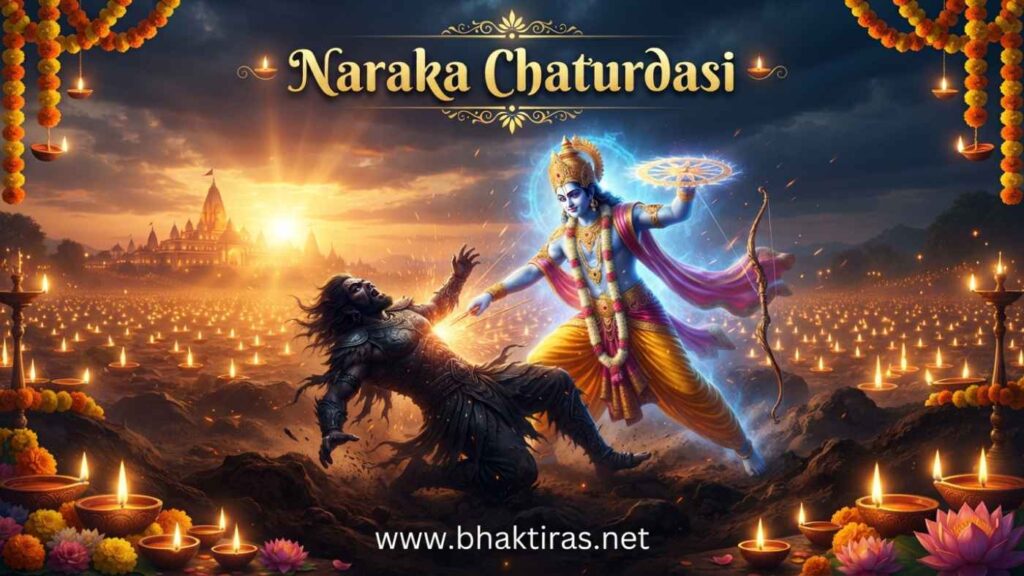
Naraka Chaturdashi, better known across much of India as Choti Diwali, is the second day of the five-day Diwali cycle, observed on the fourteenth lunar day (Chaturdashi) of Kartik’s dark fortnight. In 2026 it is on 7 November. The day recalls how Krishna, aided by his wife Satyabhama, killed the demon king Narakasura and released the sixteen thousand captives he had imprisoned. In southern India and Goa this is the principal Deepavali day, celebrated with a pre-dawn oil bath and firecrackers at first light.
Naraka Chaturdashi 2026-2028: Dates & Calendar
The next Naraka Chaturdashi is on 7 November 2026. Because it follows the Hindu lunisolar calendar, the Gregorian date shifts each year, always landing the day before Lakshmi Puja (the main Diwali night).
| Year | Date | Day | Notes |
|---|---|---|---|
| 2026 | 7 November | Saturday | Next occurrence – day before Lakshmi Puja (8 Nov) |
| 2027 | 28 October | Thursday | Day before Lakshmi Puja (29 Oct) |
| 2028 | 16 October | Monday | Day before Lakshmi Puja (17 Oct) |
The abhyanga snan is timed to the early hours, usually between roughly 5 and 6 am, when the moon is still up during Chaturdashi tithi. Because the ritual bath belongs to the pre-dawn window, some households observe it on the morning that shares the tithi even when the calendar prints the previous evening.
Why Naraka Chaturdashi Is Celebrated
Naraka Chaturdashi celebrates the defeat of the demon Narakasura by Krishna and Satyabhama, and the freeing of the sixteen thousand women he had held captive. It is a day of cleansing, light and release from fear.
The fall of Narakasura
Narakasura, son of the earth goddess Bhudevi, had grown into a tyrant who terrorised gods and mortals alike. Krishna, with Satyabhama at his side, fought and killed him. A boon meant Narakasura could only be slain by his own mother, so Satyabhama striking the final blow carries real weight in the story.
The dying wish
As he lay dying, Narakasura asked that his death be remembered not with mourning but with lamps and colour. That request is why the day is bright rather than sombre, and why lamps are lit the evening before the main Diwali.
Freedom of the captives
After the demon’s death Krishna freed sixteen thousand women held in Narakasura’s palace and, to restore their honour in society, is said to have accepted them into his household. The theme of rescue and dignity runs through the festival.
Washing away impurity
The pre-dawn oil bath symbolises washing off the residue of the old year and of Naraka, the hellish realm the demon is named after. Applying oil and ubtan before sunrise is believed to remove sin and grant beauty, which is why the day is also called Roop Chaudas.
Deities & Figures Worshipped
Krishna is the central figure of Naraka Chaturdashi, honoured for slaying Narakasura. Regional traditions add Kali, Hanuman and Yama to the day’s worship.
Krishna
Krishna, aided by Satyabhama, is the hero of the day. In southern India his victory over Narakasura is the reason Naraka Chaturdashi, not the following night, is treated as the main Deepavali.
Kali
In Bengal and parts of Gujarat the day is Kali Chaudas, dedicated to the goddess Kali. Devotees offer worship for protection and the removal of negativity, often after dark.
Hanuman
In several Gujarati and western communities Hanuman is worshipped on Kali Chaudas for strength and protection against evil forces.
Yama
A lamp called the Yama deepa is lit facing south in the evening to honour Yama, the lord of death, and to seek freedom from untimely death for the household.
Key Rituals, Step by Step
The heart of Naraka Chaturdashi is the abhyanga snan, the ritual oil bath taken before sunrise, followed by prayers, lamps and, in many regions, early-morning firecrackers.
- Wake before dawn. The family rises well before sunrise, during the Chaturdashi tithi, for the auspicious bath window.
- Apply oil and ubtan. Warm sesame or coconut oil is massaged into the body and a fragrant ubtan (a paste of gram flour, turmeric and herbs) is applied to cleanse the skin.
- Take the abhyanga snan. The oil bath is taken, symbolically washing away impurity and the taint of Naraka. Some households place a bitter apamarga or takla leaf on the head during the bath.
- Light the lamps. Diyas are lit around the home, and a south-facing Yama deepa is placed to honour Yama and pray against untimely death.
- Offer prayers to Krishna. The family worships Krishna, recalling his victory over Narakasura, and in Bengal and Gujarat offers worship to Kali or Hanuman.
- Burst crackers at daybreak. In south India and Goa, children and adults light firecrackers at first light to mark the demon’s defeat.
- Burn the Narakasura effigy. In Goa, large effigies of Narakasura built by neighbourhood groups are burned before dawn, followed by the oil bath and a festive breakfast.
Special Foods of Naraka Chaturdashi
The morning after the oil bath is marked with festive breakfasts and Diwali sweets, with dishes that differ sharply between the south and the north.
Deepavali lehiyam
A dark, medicinal digestive paste of jaggery, dry ginger, pepper and spices, eaten in a small spoonful after the oil bath to settle the stomach before the rich festive food that follows.
Fov and sweets
In Goa, poha (fov) prepared several ways, along with sweets, is shared at the pre-dawn breakfast after the Narakasura effigy is burned.
Chakli and murukku
Crisp savoury spirals of rice and gram flour are prepared in large batches for the Diwali faral platter, alongside chivda and shankarpali.
Diwali mithai
Ladoo, barfi, karanji and other sweets are made and exchanged, as the day flows into the Lakshmi Puja celebrations that follow.
Regional Names & Variations
Naraka Chaturdashi is known by many names, and its importance ranges from a curtain-raiser in the north to the main Deepavali in the south.
South India
In Tamil Nadu, Karnataka, Andhra Pradesh and Telangana this is Naraka Chaturdashi, the principal Deepavali. The pre-dawn oil bath and new clothes come first, and firecrackers greet the sunrise.
Goa
Goa is famous for building and burning towering effigies of Narakasura before dawn, a community competition, after which families take the oil bath and share breakfast.
North India
Across the Hindi belt the day is Choti Diwali, a smaller lead-in to the main Diwali night, with lamps lit around the home and preparations completed for Lakshmi Puja.
Bengal
In Bengal the day is Bhoot Chaturdashi and Kali Chaudas, when fourteen lamps are lit for ancestors and Kali is worshipped, often at night.
Gujarat
Gujaratis observe Kali Chaudas with worship of Kali and Hanuman, seen as a night for warding off evil and negative forces before the Diwali new year.
Naraka Chaturdashi Do's and Don'ts
A few simple customs help you observe the day in keeping with tradition.
Do
- Rise before sunrise for the abhyanga snan during Chaturdashi tithi.
- Apply oil and ubtan before bathing, as the ritual intends.
- Light a south-facing Yama deepa in the evening.
- Wear fresh or new clothes after the bath.
- Share sweets and greet family and neighbours.
Avoid
- Do not skip the pre-dawn timing and bathe casually late in the morning.
- Avoid quarrels and harsh words on a day meant for release from negativity.
- Do not burst firecrackers unsafely or near people and animals.
- Avoid non-vegetarian food and alcohol if your family keeps the day sattvic.
- Do not leave the home dark – keep lamps lit through the evening.
Frequently Asked Questions
When is Naraka Chaturdashi in 2026?
Naraka Chaturdashi (Choti Diwali) is on Saturday, 7 November 2026. It is the second day of the five-day Diwali festival and falls the day before Lakshmi Puja on 8 November. The pre-dawn oil bath, or abhyanga snan, is its defining ritual.
When is Naraka Chaturdashi in 2027 and 2028?
Naraka Chaturdashi falls on Thursday, 28 October 2027 and on Monday, 16 October 2028. In each year it lands on the fourteenth day of Kartik’s dark fortnight, immediately before Lakshmi Puja. The Gregorian date shifts because it follows the Hindu lunisolar calendar.
Why is Naraka Chaturdashi celebrated?
Naraka Chaturdashi celebrates Krishna’s slaying of the demon king Narakasura, with the help of his wife Satyabhama, and the freeing of the sixteen thousand women the demon had imprisoned. Narakasura’s dying wish was that his death be marked with lights and colour rather than grief, which is why the day is joyful.
Which god is worshipped on Naraka Chaturdashi?
Krishna is the central deity of Naraka Chaturdashi, honoured for defeating Narakasura. In Bengal and Gujarat the goddess Kali is worshipped on the same day, called Kali Chaudas, and many Gujarati households also worship Hanuman. A Yama deepa is lit in the evening for Yama.
What is abhyanga snan on Choti Diwali?
Abhyanga snan is the ceremonial oil bath taken before sunrise on Naraka Chaturdashi. Warm oil and a herbal ubtan are applied to the body before bathing, symbolically washing away impurity and the taint of Naraka. It is why the day is also called Roop Chaudas, the day of beauty.
Why is Naraka Chaturdashi the main Diwali in south India?
In Tamil Nadu, Karnataka, Andhra Pradesh, Telangana and Goa, Naraka Chaturdashi is the principal Deepavali because it directly marks Krishna’s victory over Narakasura. Families take the pre-dawn oil bath, wear new clothes and burst firecrackers at daybreak, treating this day rather than the following night as the festival’s peak.
What is the difference between Naraka Chaturdashi and Kali Chaudas?
They are the same lunar day observed differently by region. Most of India calls it Naraka Chaturdashi or Choti Diwali and centres it on Krishna, while Bengal and Gujarat call it Kali Chaudas and worship the goddess Kali. In Bengal it is also Bhoot Chaturdashi, when lamps are lit for ancestors.
What are the other names for Naraka Chaturdashi?
Naraka Chaturdashi is also called Choti Diwali, Kali Chaudas, Roop Chaudas or Roop Chaturdashi, and in Bengal Bhoot Chaturdashi. In south India it is often simply Deepavali. The many names reflect the different customs attached to the same fourteenth lunar day of Kartik.
However you keep the day, may the pre-dawn light wash away the old year’s shadows. Shubh Choti Diwali.