
Makhan Chor Festival 2026 – Braj's Butter-Thief Krishna Celebration
माखन चोर
When is the Makhan Chor celebration in Braj in 2026?
The Makhan Chor celebration falls in the Krishna Janmashtami season, on 4 September 2026 in Braj. It honours the child Krishna as the loveable butter thief (Makhan Chor), and spills into the next morning with Nandotsav and the Dahi Handi pot-breaking on 5 September. Mathura, Vrindavan and Gokul are the heart of it.
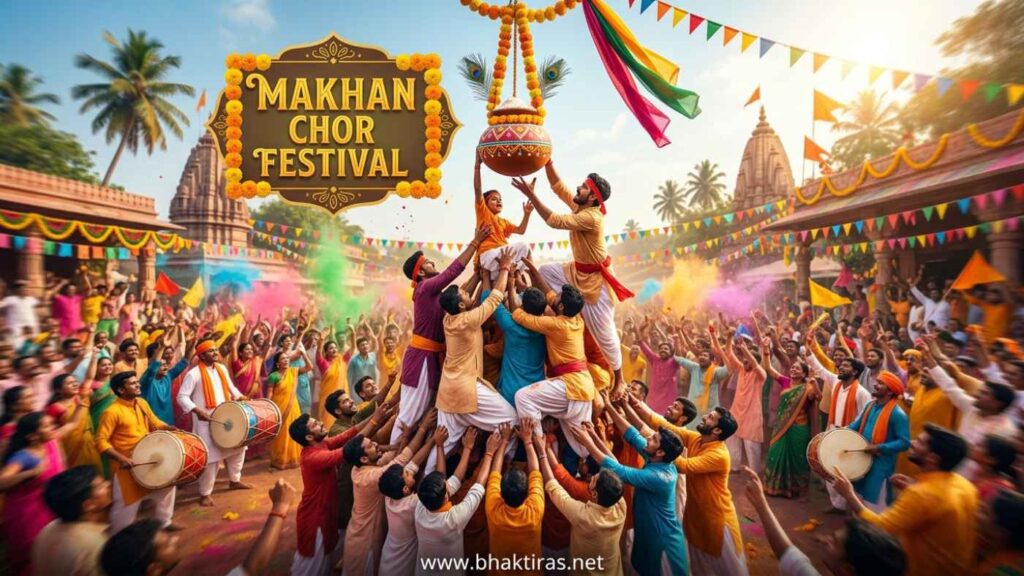
Makhan Chor, literally the butter thief, is one of the most affectionate names Braj gives its child-god Krishna. This celebration is not a separate calendar day so much as a mood that sweeps Mathura, Vrindavan and Gokul during the Krishna Janmashtami season – in 2026 around 4 September. Homes and temples retell how little Kanha and his friends raided the gopis’ butter pots, formed human ladders to reach the ones hung high, and were caught butter-cheeked by mother Yashoda. It is the madhurya, the sweetness of God as a mischievous toddler.
Makhan Chor / Janmashtami Season 2026-2028: Dates
The Makhan Chor mood peaks on Krishna Janmashtami and the Nandotsav-Dahi Handi that follows the next morning. In 2026 that anchor date is 4 September; the date shifts each year because it tracks the Hindu lunar calendar.
| Year | Janmashtami | Day | Braj note |
|---|---|---|---|
| 2026 | 4 September | Friday | Next occurrence; Nandotsav & Dahi Handi on 5 Sep |
| 2027 | 25 August | Wednesday | Butter-thief jhankis through the week |
| 2028 | 13 August | Sunday | Earlier in Bhadrapada |
In Braj the butter-thief celebrations are rarely confined to a single midnight. Temples in Gokul and Vrindavan often stretch the theme across two days, with the newborn worship at midnight of Janmashtami and the joyous Nandotsav, dahi-handi and butter-throwing the following morning.
Why Braj Celebrates Krishna as Makhan Chor
Braj celebrates the butter-thief because it remembers God not as a distant king but as a naughty, lovable child – the form easiest to love without fear.
The stolen butter
The stories tell of Kanha and his gwala friends slipping into the gopis’ homes to eat freshly churned white makhan. When the pots were hung high on ropes to keep them safe, the boys stood on each other’s shoulders to reach – the human pyramid that survives today as dahi handi.
Yashoda's love, not punishment
Every version ends the same tender way: mother Yashoda catches Krishna butter-smeared and mock-scolds him, only to melt at his face. The tale is really about vatsalya, a parent’s helpless love, and about a devotee’s heart being the true butter Krishna comes to steal.
The sweet form of God
Braj bhakti prizes madhurya, the sweet and playful aspect of the divine. Worshipping Krishna as a hungry toddler, rather than as the philosopher of the Gita, lets devotees relate to God with pure, uncomplicated affection.
Deities & Figures Worshipped
The celebration centres on the child Krishna, with Yashoda, Nanda and the gopis of Braj as beloved supporting figures in every retelling.
Bal Krishna (Makhan Chor)
The infant and toddler Krishna is the star – shown crawling, dancing, and clutching a lump of butter. Temple idols are dressed as a tiny cowherd and offered makhan-mishri (butter and sugar crystals).
Yashoda & Nanda
Krishna’s foster mother and the chief of Gokul. Nandotsav, the morning after Janmashtami, is literally Nanda’s celebration of his son’s birth, with butter and curd thrown in joy.
The Gopis of Braj
The cowherd women whose butter Krishna stole and whose devotion he won. Their loving complaints to Yashoda are re-enacted in raas-leela and folk plays across Braj.
Key Rituals, Step by Step
In Braj the butter-thief celebration blends midnight birth worship with the playful morning games that recall Krishna’s childhood.
- Jhanki setup. Temples and homes arrange tableaux of baby Krishna – the prison birth, the crossing of the Yamuna, Yashoda’s courtyard, and of course the hanging butter pot.
- Dressing little Krishnas. Children are dressed as Kanha and the gopis, complete with peacock feather and flute, and pose for the butter-stealing scenes.
- Midnight birth worship. On Janmashtami night the infant idol is bathed (abhishek) with milk, curd, honey and ghee, then laid in a decorated cradle and rocked by devotees.
- Makhan-mishri bhog. Fresh white butter with sugar crystals is offered to Krishna as his favourite food, then shared as prasad.
- Raas-leela and Krishna-lila plays. Braj’s traditional dance-dramas re-enact the butter theft, Yashoda’s scolding and Krishna’s mischief for gathered crowds.
- Nandotsav. The next morning Gokul celebrates Nanda’s joy, with turmeric, butter and curd thrown in playful abandon.
- Dahi handi. A pot of curd and butter is hung high in the streets, and human pyramids of young men climb to break it – a direct re-enactment of how Krishna reached the pots the gopis kept out of his reach.
Special Foods of the Makhan Chor Celebration
Dairy rules the table, because butter and curd are what the little thief loved best.
Makhan-mishri
Fresh hand-churned white butter mixed with rock-sugar crystals – Krishna’s signature offering and the simplest, most beloved bhog of the day.
Dhaniya panjiri
A dry sweet of roasted coriander-seed powder, ghee, sugar and nuts, traditionally distributed as Janmashtami prasad across Mathura and Vrindavan.
Charnamrit
The sweetened milk-curd-honey-tulsi mixture used to bathe the infant idol, then given to devotees as a blessed drink.
Curd & buttermilk
Bowls of dahi and chaas echo the dahi-handi theme and cool the late-summer Braj heat.
Pedas of Mathura
The famous milk-based Mathura peda, thick and grainy, is bought and shared through the festival crowds.
Where the Butter-Thief Is Loved Most
Though Krishna is worshipped everywhere, the Makhan Chor stories belong most intimately to the Braj region where he grew up.
Gokul
The village of Krishna’s early childhood keeps Nandotsav with special warmth, throwing butter and curd the morning after Janmashtami.
Vrindavan
Its many temples stage elaborate jhankis and raas-leela, dressing Krishna as the tiny butter thief through the season.
Mathura
Krishna’s birthplace draws the largest crowds; the Janmabhoomi and city temples fill with butter-thief tableaux and midnight worship.
Beyond Braj
Maharashtra turns the same butter-stealing memory into public dahi-handi contests, while ISKCON and Krishna temples worldwide dress deities as Makhan Chor for Janmashtami.
Makhan Chor Celebration Do's and Don'ts
A few simple ways to keep the spirit sweet and the crowds safe.
Do
- Offer fresh butter and mishri to Krishna as bhog.
- Dress children as Kanha or gopis and let them enjoy the games.
- Share charnamrit and panjiri prasad with neighbours.
- Visit a jhanki or raas-leela to hear the stories retold.
- Keep dahi-handi pyramids safe, with padding and careful spotters.
Avoid
- Do not push or crowd the smallest children in dahi-handi teams.
- Do not treat the butter-throwing as mere fun without the devotion behind it.
- Do not waste large quantities of food in the play; use it mindfully.
- Do not scale unsafe heights for a pot without proper support.
- Do not forget the midnight birth worship in the rush of the games.
Frequently Asked Questions
When is the Makhan Chor celebration in Braj in 2026?
The Makhan Chor celebration falls in the Krishna Janmashtami season, anchored on 4 September 2026 in Braj. It is not a separate fixed date but part of the Janmashtami and Nandotsav-Dahi Handi period, with the pot-breaking on 5 September. Mathura, Vrindavan and Gokul are its centre.
What are the dates for 2027 and 2028?
The Janmashtami anchor for the Makhan Chor season is 25 August 2027 (Wednesday) and 13 August 2028 (Sunday). The date moves each year because it follows the Hindu lunar calendar, on Ashtami of Bhadrapada Krishna Paksha. Braj observance clusters around these days rather than one civil date.
Who is Makhan Chor?
Makhan Chor, the butter thief, is an affectionate name for the child Krishna. Braj folklore tells how little Krishna and his cowherd friends stole freshly churned white butter (makhan) from the gopis’ homes. It celebrates the sweet, playful child-form of the divine.
Why is Krishna called the butter thief?
Krishna is called the butter thief because, as a toddler in Gokul, he raided the gopis’ butter pots and shared the makhan with his friends. When the pots were hung high, the boys formed human pyramids to reach them. Devotees read it as God stealing not butter but the hearts of his loving devotees.
Which god is worshipped in the Makhan Chor festival?
The child Krishna (Bal Krishna), worshipped as Makhan Chor, is the deity of this celebration. His foster parents Yashoda and Nanda and the gopis of Braj feature as beloved figures in the stories and re-enactments. Idols are offered butter and sugar as Krishna’s favourite food.
What is the connection with Dahi Handi?
Dahi Handi directly re-enacts Krishna’s butter theft. A pot of curd and butter is hung high in the streets, and young men build human pyramids to climb and break it – just as Krishna and his friends reached the pots the gopis kept out of reach. In Braj it usually follows Janmashtami during Nandotsav.
How is it celebrated in Mathura and Vrindavan?
In Mathura and Vrindavan the celebration blends midnight birth worship with butter-thief jhankis, raas-leela plays and makhan offerings. Children are dressed as little Krishnas, idols are bathed and cradled at midnight, and the next morning Gokul keeps Nandotsav with butter and curd thrown in joy.
What food is offered to Makhan Chor?
Fresh white butter with sugar crystals, called makhan-mishri, is the signature offering to Makhan Chor. Devotees also prepare dhaniya panjiri, charnamrit and Mathura pedas, sharing them as prasad. Dairy dominates because butter and curd were the child Krishna’s favourite foods.
May the little butter thief steal your worries and leave sweetness in their place. Jai Shri Krishna.