
Mahamastakabhisheka – The 12-Year Head Anointing of Bahubali
महामस्तकाभिषेक
When is the next Mahamastakabhisheka?
The next Mahamastakabhisheka is expected around 2030. It is not an annual festival – the grand head-anointing of the 57-foot Bahubali (Gommateshwara) statue at Shravanabelagola in Karnataka takes place roughly once every 12 years. The most recent ceremony was held from 17 to 25 February 2018.
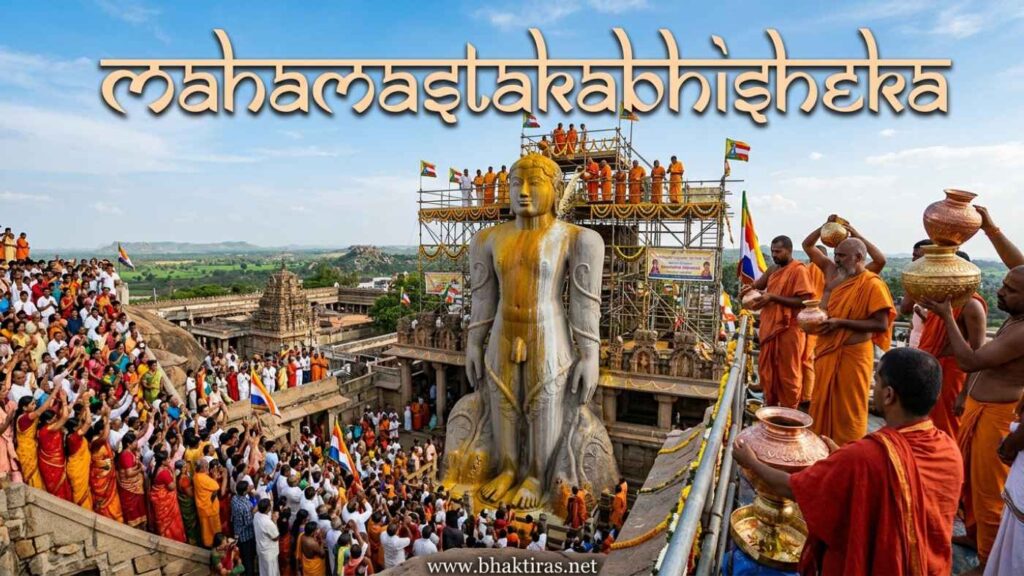
Mahamastakabhisheka is one of Jainism’s most striking public ceremonies – the ritual bathing of the 57-foot monolithic statue of Bahubali, also called Gommateshwara, that has stood atop Vindhyagiri hill at Shravanabelagola in Karnataka since around 981 CE. It is not a yearly festival. The full anointing is performed only about once every twelve years, when a temporary scaffold is raised beside the colossus and the head is showered with a sequence of sacred liquids and powders before enormous crowds. The rite honours Bahubali’s renunciation of his kingdom and his attainment of kevala jnana, or omniscience.
Mahamastakabhisheka: The 12-Year Cycle
Mahamastakabhisheka does not follow an annual calendar. The grand anointing at Shravanabelagola recurs roughly once every twelve years, so the meaningful dates are the most recent ceremony and the next expected one.
| Occurrence | Year | Status | Notes |
|---|---|---|---|
| Recent | 2018 | Held | Conducted 17-25 February 2018 at Shravanabelagola |
| Next | around 2030 | Expected | Approximate; exact dates announced nearer the time |
| Earlier | 2006 | Held | The preceding twelve-year anointing |
Because the ceremony is spaced about a dozen years apart, a countdown in days is not meaningful. Pilgrims usually plan travel once the matha publishes the official schedule, typically a year or more in advance.
Why Mahamastakabhisheka Is Held
Mahamastakabhisheka commemorates Bahubali’s renunciation of worldly power and his attainment of kevala jnana (omniscience), and it renews the sanctity of the great Gommateshwara statue for a new generation.
Bahubali's renunciation
Bahubali, son of the first Jain Tirthankara Rishabhanatha, is said to have given up his kingdom and stood in meditation so long that vines grew around his limbs. The anointing celebrates that inner victory over pride and desire rather than any military conquest.
Attainment of omniscience
In Jain tradition Bahubali became the first person in this age to attain kevala jnana, perfect knowledge. Bathing the statue is a gesture of reverence towards that ideal of complete detachment and self-realisation.
Renewing a millennium-old icon
The statue was consecrated by the minister Chavundaraya around 981 CE. Repeating the anointing every twelve years keeps a living ritual tradition attached to one of the oldest and largest free-standing images in India.
A gathering of the community
The event draws hundreds of thousands of Jains and other visitors from across India and abroad, making it a rare moment of large-scale religious assembly and shared devotion at a single sacred site.
The Figure Honoured
The ceremony centres on Bahubali, also known as Gommateshwara, a revered figure in Jainism rather than a god in the theistic sense.
Bahubali (Gommateshwara)
Bahubali was the second son of Rishabhanatha, the first Tirthankara. After renouncing his throne he undertook severe meditation and, in Jain belief, became the first soul of this cosmic age to reach omniscience. The Shravanabelagola statue depicts him standing in the kayotsarga posture of complete stillness.
How the Anointing Is Performed
On the main day a scaffold is erected around the statue and priests pour a fixed sequence of sacred substances over the head, letting each stream flow down the full height of the figure.
- Raising the scaffold. A tall temporary platform is built beside and above the 57-foot statue so that officiants can reach the crown of the head safely.
- Water. The anointing opens with a bathing of pure water, symbolically cleansing the image before the offerings that follow.
- Milk. Thousands of pots of milk are poured over the head, cascading down the shoulders and body in a white sheet.
- Sugarcane juice. Sweet sugarcane juice follows, one of the traditional liquids used in the abhisheka sequence.
- Saffron, sandalwood and turmeric. Fragrant saffron paste, sandalwood and turmeric are applied, giving the statue warm golden and ochre tones.
- Vermilion. Bright red vermilion (kumkum) powder is added to the flowing offerings, marking the auspicious character of the rite.
- Flowers and precious powders. The ceremony closes with a shower of flowers, along with gold and silver coins and coloured powders, cast over the statue before the assembled devotees.
Other Bahubali Anointings
Although Shravanabelagola hosts the most famous Mahamastakabhisheka, similar anointings are performed at other large Bahubali statues in Karnataka.
Shravanabelagola, Hassan district
The principal site, home to the 57-foot statue on Vindhyagiri hill. Its twelve-year anointing is the largest and best known, drawing pilgrims from across the world.
Karkala
A 42-foot Bahubali statue near Karkala in coastal Karnataka, consecrated in the fifteenth century, also receives its own Mahamastakabhisheka ceremonies.
Dharmasthala and Venur
Other monolithic Bahubali images in Karnataka, including at Dharmasthala and Venur, hold their own periodic anointings on separate schedules from Shravanabelagola.
Mahamastakabhisheka Do's and Don'ts
A few simple courtesies help visitors take part respectfully at a very crowded pilgrimage site.
Do
- Check the officially announced dates before planning travel, as they are confirmed only near the event.
- Book accommodation and transport early, since Shravanabelagola fills far beyond its normal capacity.
- Dress modestly and be prepared to climb the hill on foot to reach the statue.
- Carry water and sun protection, as queues and waits can be long.
- Follow the instructions of the matha and volunteers managing the enormous crowds.
Avoid
- Do not expect an annual event; the full anointing happens only about once in twelve years.
- Do not assume a fixed future date – the ~2030 timing is approximate until officially set.
- Do not push or rush in the crowds around the scaffold and steps.
- Do not litter or leave offerings where they obstruct the pilgrim paths.
- Do not photograph in restricted areas or ignore posted guidance during the ritual.
Frequently Asked Questions
When is the next Mahamastakabhisheka?
The next Mahamastakabhisheka is expected around 2030. The anointing recurs roughly once every twelve years, and the last one was held in February 2018, so the following ceremony is anticipated near 2030. Exact dates are confirmed by the Shravanabelagola matha closer to the event.
When was the last Mahamastakabhisheka held?
The last Mahamastakabhisheka was held from 17 to 25 February 2018 at Shravanabelagola in Karnataka. The ceremony before that took place in 2006, reflecting the roughly twelve-year cycle of the anointing of the Bahubali statue.
Is Mahamastakabhisheka an annual festival?
No, Mahamastakabhisheka is not an annual festival. The grand head-anointing of the 57-foot Bahubali statue at Shravanabelagola takes place only about once every twelve years, which is what makes each occasion such a major gathering for the Jain community.
What is Mahamastakabhisheka?
Mahamastakabhisheka is the ceremonial bathing of the head of the 57-foot monolithic Bahubali (Gommateshwara) statue at Shravanabelagola. From a scaffold, priests pour water, milk, sugarcane juice, saffron, sandalwood, turmeric and vermilion over the statue, finishing with flowers, coins and coloured powders before huge crowds.
Who is worshipped at Mahamastakabhisheka?
The ceremony honours Bahubali, also called Gommateshwara, a revered Jain figure and the son of the first Tirthankara Rishabhanatha. It celebrates his renunciation of his kingdom and his attainment of kevala jnana, or omniscience, rather than worship of a deity in the usual sense.
Where does Mahamastakabhisheka take place?
The most famous Mahamastakabhisheka takes place at Shravanabelagola in the Hassan district of Karnataka, India, where the statue stands atop Vindhyagiri hill. Similar anointings are also performed at other large Bahubali statues in Karnataka, such as those at Karkala and Venur.
How tall is the Bahubali statue at Shravanabelagola?
The Bahubali statue at Shravanabelagola is about 57 feet tall and carved from a single block of granite. Consecrated around 981 CE, it is one of the largest free-standing monolithic statues in the world and the focus of the Mahamastakabhisheka.
Why is the ceremony held only every twelve years?
Mahamastakabhisheka follows a traditional twelve-year cycle set by the Shravanabelagola matha, a rhythm maintained for centuries. The long gap is part of what gives each anointing its scale and significance, allowing a fresh generation of devotees to witness and take part in the rite.
May the serene example of Bahubali – victory won not over others but over the self – inspire all who make the climb to Shravanabelagola.