
Mahamaham 2028 – The Kumbh Mela of the South
மகாமகம்
When is Mahamaham in 2028?
Mahamaham 2028 falls on Thursday, 9 March 2028, at the Mahamaham tank in Kumbakonam, Tamil Nadu. It is a holy-bathing festival held only once every 12 years, on the Masi Magam full moon when Jupiter transits Leo, and the last one was in 2016. Pilgrims in their millions take a sacred dip on this single main day.
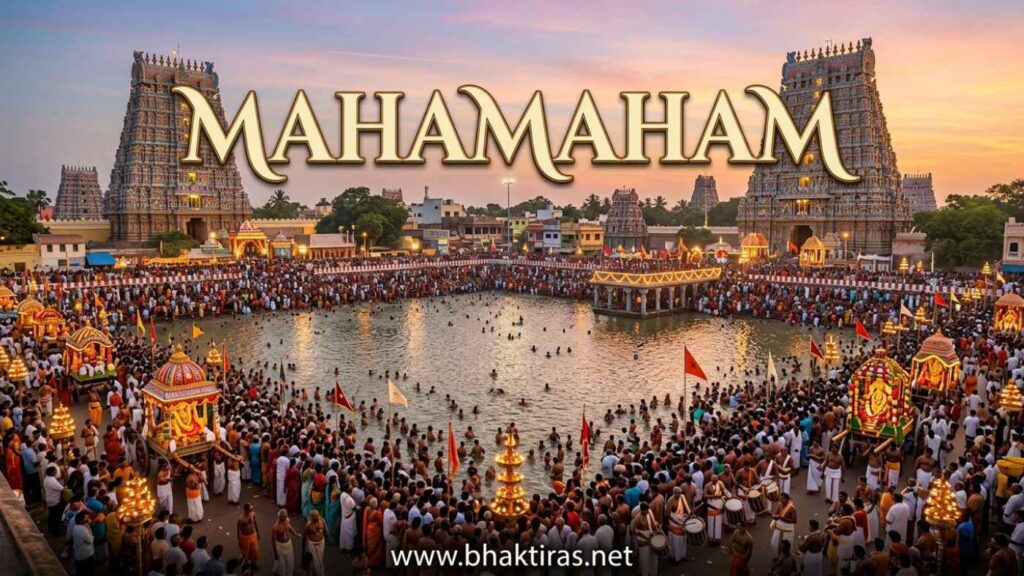
Mahamaham, also spelt Mamangam or Mahamagam, is a grand holy-bathing festival held once every 12 years at Kumbakonam in Tamil Nadu. On the Masi Magam full moon, when Jupiter (Guru) moves into Leo, devotees believe that nine of India’s most sacred rivers, from the Ganga to the Kaveri, gather in the Mahamaham tank. A single dip on this day is held to carry the merit of bathing in all of them at once, which is why the festival is often called the Kumbh Mela of the South. The next Mahamaham is on 9 March 2028; the previous one was in 2016.
Mahamaham 2016-2040: Dates & 12-Year Cycle
The next Mahamaham is on Thursday, 9 March 2028. Because it depends on Jupiter completing a full circuit of the zodiac and returning to Leo, it recurs only once every 12 years, not annually.
| Year | Main Bath Date | Day | Notes |
|---|---|---|---|
| 2016 | 22 February | Monday | Previous Mahamaham (held) |
| 2028 | 9 March | Thursday | Next Mahamaham |
| 2040 | March (to be fixed) | – | Following cycle, exact date set nearer the time |
There is no Mahamaham in the years between these dates. A smaller annual Masi Magam bath is observed at Kumbakonam every year on the same star, but the great Mahamaham, with the belief that all nine rivers converge, comes only in the 12-year Jupiter-in-Leo year.
Why Mahamaham Is Celebrated
Mahamaham is celebrated because a dip in the Kumbakonam tank on this day is believed to equal bathing in nine sacred rivers at once, washing away accumulated sins. It marks a rare 12-year alignment of Jupiter, the sun and the Magam star.
The festival ties together astronomy, geography and legend. Its timing is astronomical: Jupiter takes about 12 years to travel through the zodiac, and Mahamaham is fixed for the year Jupiter enters Leo, coinciding with the Masi full moon on the Magam star. Its geography is the Mahamaham tank itself, a vast temple pond ringed by 16 mandapams and holding 21 sacred wells, each named for a river or a form of Shiva.
The pot of amrita and the name Kumbakonam
A well-known legend says that during a great deluge Shiva preserved the seed of creation, together with the nectar of immortality, inside a pot (kumbha). The pot drifted and came to rest here; Shiva, in the guise of a hunter, pierced it with an arrow. Where the nectar spilled, the Mahamaham tank formed, and the town took the name Kumbakonam, the ‘corner of the pot’.
Nine rivers in one tank
Tradition holds that on the Mahamaham day the nine river goddesses, Ganga, Yamuna, Sarasvati, Narmada, Godavari, Krishna, Tungabhadra, Kaveri and Sarayu, come to the tank to cleanse themselves of the sins that pilgrims have washed into them through the year. Bathing here on that morning is therefore said to carry the combined merit of all nine.
The Kumbh Mela of the South
Like the northern Kumbh Mela, Mahamaham is a mass river-bathing event governed by a Jupiter cycle and drawing pilgrims in the millions to a single sacred spot. The scale, the astrology and the promise of spiritual cleansing have earned it the popular name Kumbh Mela of the South.
Deities & Sacred Sites Worshipped
The presiding deity is Shiva as Adi Kumbeswarar, whose temple stands close to the tank, along with the tank itself as a living tirtha where the river goddesses are honoured.
Adi Kumbeswarar
Shiva is worshipped here as Adi Kumbeswarar, the lord of the pot, linked directly to the amrita-kumbha legend. On Mahamaham day the temple utsava deities are carried in procession to the tank so that the god also ‘bathes’ with the pilgrims.
The Mahamaham tank
The tank is treated as a deity in its own right, a confluence of nine rivers. Its 16 mandapams and 21 wells are each dedicated to a river or a form of Shiva, and pilgrims offer worship at the water’s edge before and after the dip.
Kasi Viswanathar and the nine goddesses
Belief holds that Ganga herself visits Kumbakonam from Kashi (Varanasi) on this day, and the nearby Kasi Viswanathar temple honours that link. The nine river goddesses are worshipped through the tank and its mandapam shrines rather than as separate temple idols.
Key Rituals, Step by Step
The heart of Mahamaham is a single holy dip taken during the auspicious window, framed by temple worship and offerings to ancestors.
- Arrive and purify. Pilgrims reach the Mahamaham tank early, often the night before, and prepare with a simple bath and clean clothes before the main sacred hour.
- Take the holy dip. During the auspicious muhurta on the Magam full-moon morning, devotees immerse themselves in the tank, ideally as the temple deities are brought to the water, believing all nine rivers are present.
- Offer tarpanam to ancestors. Many perform tarpanam, a water offering to departed forebears, at the tank or the Kaveri ghats, as the day is considered highly auspicious for honouring ancestors.
- Worship at Adi Kumbeswarar. After bathing, pilgrims visit the Adi Kumbeswarar temple for darshan and abhishekam of Shiva.
- Circuit the twelve Shiva temples. Devout visitors move on to the ring of twelve Shiva temples associated with the festival across Kumbakonam, taking darshan at as many as time allows.
- Bathe in the Kaveri. Some complete the day with a further dip in the Kaveri river nearby, seen as part of the wider Mahamaham pilgrimage.
- Give annadhanam. Pilgrims and temples distribute free food (annadhanam) and make charitable offerings, a central act of merit during the festival.
Special Foods of Mahamaham
Food at Mahamaham centres on temple prasadam and the free community meals served to the vast crowds of pilgrims.
Annadhanam meals
Free vegetarian meals are the signature offering of Mahamaham. Temples, mutts and volunteer groups serve rice, sambar, rasam and vegetables to lakhs of pilgrims, and feeding others is treated as a core act of merit for the day.
Sakkarai and ven pongal
Pongal in both forms appears widely: sweet sakkarai pongal made with rice, jaggery and ghee, and savoury ven pongal with pepper and cumin. Both are cooked as temple prasadam and shared with devotees.
Temple prasadam
Sweet pongal, coconut, puffed rice and tamarind rice are distributed as prasadam from the Adi Kumbeswarar and other temples, small blessed portions carried home by pilgrims.
Filter coffee and tiffin
Around the tank, Kumbakonam’s famed filter coffee and quick tiffin such as idli, dosa and pongal keep pilgrims going through long hours of waiting and walking between temples.
Mahamaham Do's and Don'ts
With millions gathered at one tank on a single day, safety and respect matter as much as the ritual itself.
Do
- Plan travel and stay well ahead; book accommodation in or near Kumbakonam months in advance.
- Reach the tank early and follow police and volunteer crowd-control instructions at all times.
- Keep children, elderly relatives and valuables close, and agree on a meeting point in case you are separated.
- Carry water, a hat and any personal medicines for the long wait in the sun.
- Change into dry clothes soon after the dip and keep the ghats and tank clean.
Avoid
- Do not rush or push at the water’s edge; a tragic stampede at the 1992 festival is a solemn reminder to move calmly and never crowd the steps.
- Do not enter deep or unfamiliar parts of the tank, especially if you cannot swim.
- Do not carry large amounts of cash or jewellery into the crush.
- Do not litter, use soap or pollute the sacred water.
- Do not ignore official routing; follow the designated entry and exit lanes rather than taking shortcuts.
Frequently Asked Questions
When is Mahamaham in 2028?
Mahamaham 2028 falls on Thursday, 9 March 2028, at Kumbakonam in Tamil Nadu. It is the main holy-bath day, timed to the Masi Magam full moon in the year Jupiter transits Leo.
When was the last Mahamaham and when is the next one?
The last Mahamaham was held on 22 February 2016. The next Mahamaham is on 9 March 2028, and the one after that will follow around 2040. The festival recurs only once every 12 years.
Why is Mahamaham celebrated only once in 12 years?
Mahamaham is celebrated once every 12 years because it is fixed to the year Jupiter (Guru) completes its roughly 12-year orbit and enters Leo, coinciding with the full moon on the Magam star in the Tamil month of Masi. Only then are the nine sacred rivers believed to gather in the Kumbakonam tank.
Why is Mahamaham called the Kumbh Mela of the South?
Mahamaham is called the Kumbh Mela of the South because, like the northern Kumbh Mela, it is a mass river-bathing festival governed by a 12-year Jupiter cycle and draws millions of pilgrims to a single sacred site. Both promise spiritual cleansing through a holy dip at an astrologically appointed hour.
Which god is worshipped at Mahamaham?
The presiding deity of Mahamaham is Shiva, worshipped as Adi Kumbeswarar at the temple beside the tank. The Mahamaham tank itself is honoured as a confluence of nine river goddesses, and Ganga is believed to visit from Kashi on the festival day.
What is the significance of the Mahamaham tank?
The Mahamaham tank is a large temple pond in Kumbakonam believed to hold the combined waters of nine sacred rivers. Ringed by 16 mandapams and containing 21 wells, it is where legend says the pot of nectar spilled, giving Kumbakonam its name, and a dip here on Mahamaham day is said to cleanse a lifetime of sins.
What rituals do pilgrims perform at Mahamaham?
Pilgrims take a holy dip in the Mahamaham tank during the auspicious hour, offer tarpanam to their ancestors, and worship at the Adi Kumbeswarar temple. Many also complete a circuit of the twelve associated Shiva temples and take part in annadhanam, the free feeding of fellow devotees.
Is Mahamaham crowded, and is it safe?
Mahamaham draws millions of pilgrims to one tank on a single day, so crowds are extreme. A stampede in 1992 caused loss of life, so authorities now manage crowd flow closely; visitors should arrive early, follow official routing and move calmly at the water’s edge.
May a dip at the Mahamaham tank bring you peace and blessings in 2028. Om Namah Shivaya.