
Lai Haraoba 2027 – The Merrymaking of the Gods
লাই হরাওবা
When is Lai Haraoba in 2027?
Lai Haraoba is expected around April to June 2027, though there is no single fixed date. Each Umang Lai shrine in Manipur sets its own days, so the festival unfolds across different localities at different times, usually between spring and early summer. It is the Meitei people’s ancient ritual festival honouring the sylvan deities known as the Umang Lai.
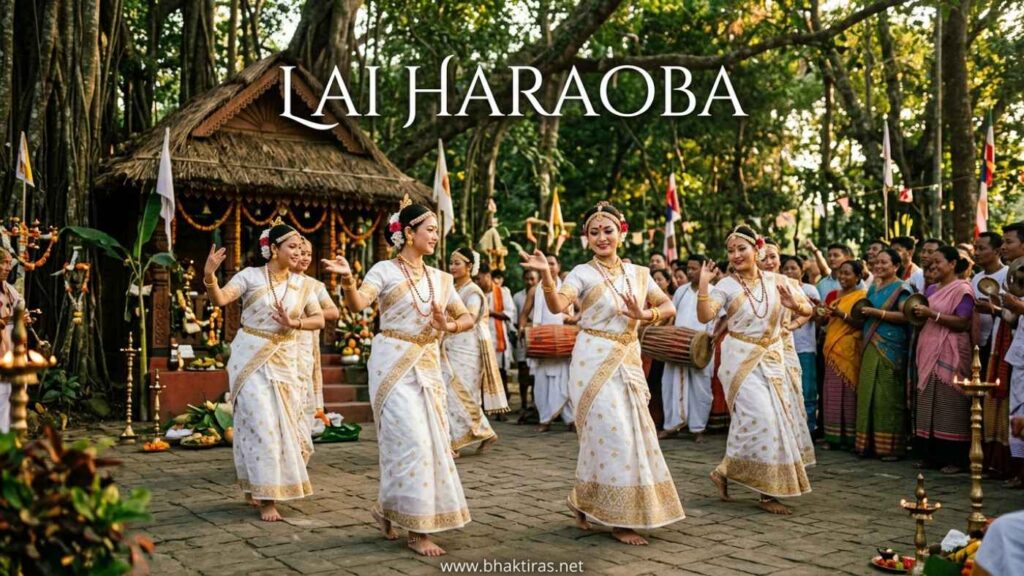
Lai Haraoba, meaning the merrymaking of the gods, is one of the oldest surviving festivals of the Meitei people of Manipur. Rooted in the pre-Vaishnavite Sanamahi tradition, it honours the Umang Lai, the sylvan deities said to guard forests, villages and clans. Over several days, priests and priestesses called maibas and maibis perform ritual dances that re-enact the creation of the world and the human body, carried along by the reedy voice of the pena fiddle.
Lai Haraoba 2026-2028: When It Is Held
Lai Haraoba has no single national date. Every Umang Lai shrine fixes its own schedule, so celebrations are spread across Manipur, mostly between April and June, with some shrines beginning as early as February.
| Year | Season | Duration | Notes |
|---|---|---|---|
| 2026 | Approx. Apr-Jun (past) | 3 days to a month | Held across shrines earlier in 2026 |
| 2027 | Approx. Apr-Jun | 3 days to a month | Next season; dates vary by locality |
| 2028 | Approx. Apr-Jun | 3 days to a month | Timing again set shrine by shrine |
Because the festival is tied to individual shrines rather than one fixed tithi, the same season can see many separate Lai Haraoba celebrations in different villages and temples across Manipur and neighbouring Meitei areas.
Why Lai Haraoba Is Celebrated
Lai Haraoba is celebrated to please and re-awaken the Umang Lai, the ancestral and nature deities of the Meitei, and to renew the bond between a community and its guardian god.
The festival preserves the religious world of the Meitei as it existed before Vaishnavism reached Manipur. Its songs, dances and gestures carry an older cosmology, passed down orally through generations of maibas and maibis.
Merrymaking of the gods
The name itself describes the purpose: to entertain and delight the deities. Villagers believe a well-performed Lai Haraoba keeps the Umang Lai content and, in turn, protects the community, its harvests and its health through the year.
Re-enacting creation
Central dances mirror the making of the world and the forming of the human body, from the head down to the limbs. The choreography is treated as sacred knowledge rather than performance, teaching cosmology through movement.
A living pre-Hindu tradition
Lai Haraoba is one of the clearest windows into the Sanamahi religion of the Meitei. It safeguards deities, chants and ritual dances that predate later Hindu influence in Manipur, keeping an indigenous identity alive.
Deities & Figures Worshipped
The festival is dedicated to the Umang Lai, the traditional sylvan or forest deities of the Meitei, who number in the hundreds across different clans and localities.
Umang Lai
The Umang Lai are the guardian deities of forests, villages and lineages in Meitei belief. Each shrine honours its own Umang Lai, and the whole festival is built around inviting, seating and pleasing this deity.
Lainingthou & Lairembi
Many rites centre on a divine pair, the male Lainingthou and the female Lairembi, represented by woven forms and brass masks. Their union reflects the creative principle at the heart of the re-enacted cosmogony.
Ancestral and clan spirits
Alongside the main deity, ancestors and legendary forefathers are remembered. This links the living community to its origins and to the founders of its clans and settlements.
Key Rituals, Step by Step
The exact order varies by shrine and by the type of Lai Haraoba, but most follow a recognisable ritual sequence led by the maibas and maibis.
- Lai Ikouba. The deity is ceremonially invoked and called up from water, with the maibi summoning the divine presence to attend the festival.
- Seating the Lai. The Umang Lai is installed in the shrine, often as woven forms dressed and fitted with brass masks representing Lainingthou and Lairembi.
- Pena music. The pena, a traditional one-stringed fiddle, accompanies the chants and songs; the pena player is essential to setting the ritual mood.
- Laibou dance. Maibis perform the core dances that re-enact creation and the shaping of the human body, gesture by gesture, from head to feet.
- Community participation. Villagers join in group dances and offerings, dressed in traditional attire, turning the shrine grounds into a shared celebration.
- Folk games and sports. Several Lai Haraoba include traditional games and mock contests that add to the merrymaking dedicated to the deity.
- Lai Nongshaba and farewell. Closing rites give thanks and send the deity back, sealing the community’s renewed bond with its Umang Lai for the year ahead.
Where It Is Celebrated & Variations
Lai Haraoba is strongest in Manipur but is observed wherever Meitei communities have settled, and it takes a few distinct ritual forms.
Manipur valley
The heartland of the festival, where hundreds of Umang Lai shrines each hold their own Lai Haraoba through the spring and early summer season.
Assam, Tripura & Bangladesh
Meitei communities settled in parts of Assam, Tripura and Bangladesh keep the tradition alive, adapting it to local shrines while preserving the core rites.
Ritual types
Recognised forms include Kanglei, Moirang and Chakpa Lai Haraoba, among others. They share the same spirit but differ in songs, sequence and detail from place to place.
Lai Haraoba Do's and Don'ts
A few simple courtesies help visitors respect what is, above all, a sacred community ritual.
Do
- Follow the guidance of the maibas and maibis at the shrine
- Dress modestly and in a way that respects the ritual setting
- Watch the Laibou dances quietly and attentively
- Ask before photographing rites, performers or the shrine
- Join community dances only when invited to do so
Avoid
- Do not treat the dances as mere entertainment or a photo backdrop
- Do not enter restricted shrine areas without permission
- Do not interrupt or talk over the chants and pena music
- Do not assume every shrine follows the same dates or rites
- Do not touch the deity forms, masks or ritual objects
Frequently Asked Questions
When is Lai Haraoba in 2027?
Lai Haraoba is expected roughly between April and June 2027, but it has no single fixed date. Each Umang Lai shrine in Manipur sets its own schedule, so the festival takes place across many localities at different times during the spring and early-summer season.
When is Lai Haraoba in 2026 and 2028?
In both 2026 and 2028 Lai Haraoba falls in the approximate April-to-June window, with some shrines starting as early as February. Because dates are decided locally rather than by one calendar, the exact days differ from village to village and temple to temple each year.
Why is Lai Haraoba celebrated?
Lai Haraoba is celebrated to please and re-awaken the Umang Lai, the ancestral forest deities of the Meitei people. Its name means the merrymaking of the gods, and the rituals renew the bond between a community and its guardian deity while preserving pre-Hindu Meitei tradition.
Who are the Umang Lai?
The Umang Lai are the traditional sylvan or forest deities of the Meitei, guardians of forests, villages and clans in the Sanamahi tradition. There are hundreds of them, and each shrine honours its own Umang Lai during Lai Haraoba.
What do maibas and maibis do during Lai Haraoba?
Maibas (priests) and maibis (priestesses) lead the entire festival. They invoke the deity, install it in the shrine, chant the sacred songs and perform the ritual dances that re-enact the creation of the world and the human body, accompanied by the pena fiddle.
What is the pena in Lai Haraoba?
The pena is a traditional one-stringed Meitei fiddle played throughout Lai Haraoba. Its distinctive sound accompanies the chants and dances, and the pena player is considered essential to carrying the ritual songs of the festival.
How long does Lai Haraoba last?
Lai Haraoba can last anywhere from three days to over a month, depending on the shrine. Larger, well-endowed shrines may hold extended celebrations, while smaller village shrines keep to a shorter cycle of rites.
Where is Lai Haraoba celebrated?
Lai Haraoba is celebrated mainly in Manipur, at hundreds of Umang Lai shrines across the valley. Meitei communities in parts of Assam, Tripura and Bangladesh also observe it, keeping the tradition alive wherever they have settled.
May the Umang Lai bless every home with peace and plenty. Lai Haraoba Haraojari!