
Labh Pancham 2026 – Gujarat's Auspicious New Year Workday
લાભ પંચમ
When is Labh Pancham in 2026?
Labh Pancham falls on Saturday, 14 November 2026. It is the fifth day of the bright fortnight of Kartik and the closing day of Gujarat’s Diwali and New Year season. Traders reopen their shops, open fresh account books, and pray to Ganesha and Goddess Sharda for a profitable year ahead.
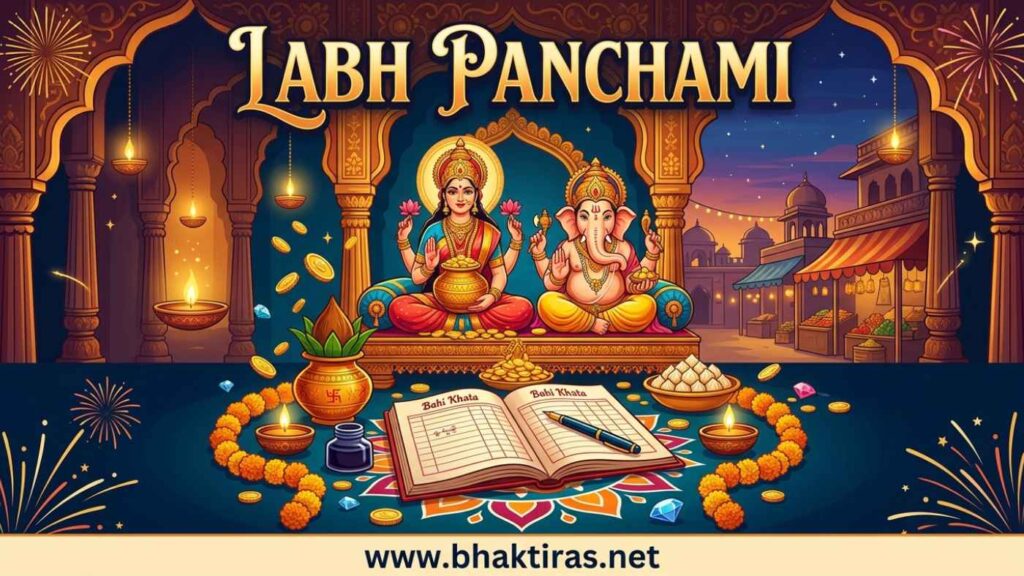
Labh Pancham, also called Saubhagya Panchami, is the fifth day of the bright half of Kartik and the day Gujarat quietly returns to work after Diwali. The word labh means profit or benefit, and that hope shapes everything about it. Shopkeepers unlock their shutters, open crisp new account books marked with a swastika and the words Shubh-Labh, and offer the first prayers of the financial year to Ganesha and Goddess Sharda. In 2026 it lands on 14 November, closing the festive season on a note of enterprise.
Labh Pancham 2026-2028: Dates & Calendar
Labh Pancham next falls on Saturday, 14 November 2026. The date shifts each year because it follows the Hindu lunar calendar – the Panchami (fifth) tithi of Shukla Paksha in the month of Kartik, roughly five days after Diwali.
| Year | Date | Day | Notes |
|---|---|---|---|
| 2025 | 26 October | Sunday | Previous year |
| 2026 | 14 November | Saturday | Next occurrence |
| 2027 | 3 November | Wednesday | Kartik Shukla Panchami |
| 2028 | 22 October | Sunday | Kartik Shukla Panchami |
In 2026 the commonly cited morning muhurat for opening account books and starting work runs roughly from 6:46 AM to 10:19 AM, though families follow their own priest or panchang. The forenoon is generally treated as the most favourable window for chopda pujan.
Why Labh Pancham Is Celebrated
Labh Pancham is celebrated as the most auspicious day to begin work, trade and study in the new Gujarati year. It marks the formal end of the Diwali holidays and a fresh, hopeful start to earning and enterprise.
For a merchant community, the calendar does not simply turn – it is opened. Diwali honours wealth already earned; Bestu Varas greets the new year; and Labh Pancham is the day that wealth is invited to grow. Businesses that stayed shut through the celebrations reopen now, treating the very first transaction of the year as a good omen.
The day of profit
Labh means gain or benefit, and the festival asks for exactly that – honest profit in the year to come. Reopening the shop on this tithi is believed to set a prosperous tone for every deal that follows.
Saubhagya – good fortune
The alternate name Saubhagya Panchami frames the day around good fortune and wellbeing, not money alone. Families pray for health, harmony and steady luck as much as for a strong balance sheet.
Closing the Diwali season
Labh Pancham is the fifth and final day of Gujarat’s Diwali cycle, following Dhanteras, Diwali, Govardhan Puja and Bhai Dooj. It sends everyone back to daily life with the festival’s optimism still fresh.
Knowledge and the ledger
In some traditions the day is also linked to Gyan Panchami, honouring learning and the tools of one’s trade. Worshipping the account books ties earning to knowledge, discipline and clean record-keeping.
Deities & Figures Worshipped
Labh Pancham centres on Ganesha, the remover of obstacles, and Goddess Sharda (a form of Lakshmi and Saraswati together), who is invoked over the account books for prosperity and wisdom.
Ganesha
Every new venture begins with Ganesha, and the new ledger is no exception. Traders write Shri Ganeshaya Namah on the opening page so the year’s work starts free of obstacles.
Goddess Sharda / Lakshmi
Sharda is worshipped for both wealth and clear thinking – the two qualities a good business needs. The symbols Shubh and Labh, written on either side of a swastika, carry her blessing for auspicious gain.
The account book (chopda)
The traditional red bound ledger, or chopda, is itself treated as sacred on this day. It is cleaned, decorated with kumkum and rice, and worshipped before the first entry is made.
Key Rituals, Step by Step
The heart of Labh Pancham is chopda pujan – the worship of new account books – performed at home or at the shop before business resumes.
- Clean and prepare the space. The shop or workspace is swept and washed, and a clean cloth or low table is set out for the puja and the new books.
- Set up the new ledgers. Fresh account books, often bound in red, are placed before the deities alongside a coin, kumkum, rice, and a small oil lamp.
- Invoke Ganesha. The first page is opened and Shri Ganeshaya Namah is written at the top so the year begins under his protection.
- Write Shubh-Labh and the swastika. A swastika is drawn, with the word શુભ (Shubh, auspicious) on one side and લાભ (Labh, profit) on the other, sometimes with the mantra Sava or the figure 1.25 for prosperity.
- Offer prayers to Sharda and Lakshmi. The family lights the lamp, offers flowers, sweets and incense, and prays for a profitable and honest year.
- Make the first symbolic entry. A token first transaction or a small note is written in the new book to formally open the year’s accounts.
- Reopen the business. Shops raise their shutters and welcome the first customers of the year, whose purchase is received as a good sign.
- Visit the temple and greet others. Many families visit a Ganesha or Lakshmi temple and exchange New Year greetings with relatives, staff and neighbours.
Special Foods of Labh Pancham
There is no single fixed dish for Labh Pancham; it borrows the sweet, festive spread of the Gujarati Diwali table, shared with visitors and staff as the season winds down.
Ghughra
Crescent pastries stuffed with sweetened semolina, coconut and dry fruit, fried till golden. A Diwali staple that lingers on the table through Labh Pancham.
Mohanthal
A dense, fudge-like gram flour sweet flavoured with cardamom and topped with nuts. Often distributed to well-wishers and shop customers on the day.
Sev and chevdo
Crisp savoury mixtures of gram-flour sev, spiced flakes and nuts. The salty counterpoint to all the sweets, offered to anyone who drops by to greet the family.
Sukhadi / gol-papdi
A simple jaggery, ghee and wheat-flour sweet considered auspicious for new beginnings. A small piece is sometimes offered to the ledger before the first entry.
Labh Pancham Do's and Don'ts
A few gentle customs shape how the day is observed by trading families.
Do
- Clean your shop or workspace before the puja
- Write Shri Ganeshaya Namah on the first page of the new ledger
- Draw the swastika with Shubh on the left and Labh on the right
- Welcome the first customer of the year warmly, as a good omen
- Share sweets and greetings with staff, family and neighbours
Avoid
- Do not begin the year’s work in an untidy or unwashed space
- Do not treat the account book carelessly on this day
- Do not turn away or argue with the first customer
- Do not fabricate an auspicious muhurat – follow your local panchang or priest
- Do not let the day pass without a simple prayer, even if you cannot do the full puja
Frequently Asked Questions
When is Labh Pancham in 2026?
Labh Pancham falls on Saturday, 14 November 2026. It is observed on the Panchami tithi of Shukla Paksha in the month of Kartik, about five days after Diwali. This is the day most Gujarati traders reopen their shops and begin the new financial year.
When is Labh Pancham in 2027 and 2028?
Labh Pancham falls on Wednesday, 3 November 2027 and Sunday, 22 October 2028. The date moves each year because it follows the Hindu lunar calendar rather than a fixed solar date. It always lands on Kartik Shukla Panchami, five days after Diwali.
Why is Labh Pancham celebrated?
Labh Pancham is celebrated as the most auspicious day to begin work and business in the new Gujarati year. Labh means profit, so traders reopen their shops, open new account books, and pray for a prosperous year. It also marks the final day of Gujarat’s Diwali celebrations.
Which god is worshipped on Labh Pancham?
Ganesha and Goddess Sharda (a form of Lakshmi and Saraswati) are worshipped on Labh Pancham. Ganesha is invoked to remove obstacles from the year’s work, while Sharda is honoured over the new account books for wealth and wisdom. The words Shubh and Labh written with a swastika carry their blessing.
What is chopda pujan on Labh Pancham?
Chopda pujan is the worship of new account books, the central ritual of Labh Pancham. The fresh ledgers are cleaned and decorated, Shri Ganeshaya Namah is written on the first page, and a swastika with Shubh and Labh is drawn before the year’s first entry. It formally opens the trading year.
What does Shubh-Labh mean?
Shubh-Labh means auspiciousness and profit. On Labh Pancham the two words are written on either side of a swastika in the new account books – Shubh (auspicious) on one side and Labh (gain) on the other. Together they invite a year that is both fortunate and profitable.
Is Labh Pancham only celebrated in Gujarat?
Labh Pancham is most closely associated with Gujarat, where it is the first working day of the new Gujarati year. It is also observed by Gujarati trading communities elsewhere in India and in the diaspora. The same tithi is known as Saubhagya Panchami and, in some traditions, Gyan Panchami.
What is the difference between Labh Pancham and Diwali?
Diwali is the main festival of lights honouring wealth and Goddess Lakshmi, while Labh Pancham is the fifth and final day of that season, five days later. Diwali celebrates prosperity, whereas Labh Pancham invites new prosperity by reopening businesses and starting fresh account books.
May your new ledgers fill with honest gain and your year begin in good fortune. શુભ લાભ – Shubh Labh.