
Kalidasa Day 2026 – Honouring India's Greatest Sanskrit Poet
कालिदास दिवस
When is Kalidasa Day / Kalidas Samaroh in 2026?
The Kalidas Samaroh at Ujjain usually falls in November, and the exact dates are fixed and announced each year by the Madhya Pradesh government. In recent years the seven-day festival has opened around the second week of November. It is a cultural and literary observance honouring Kalidasa, the classical Sanskrit poet and dramatist.
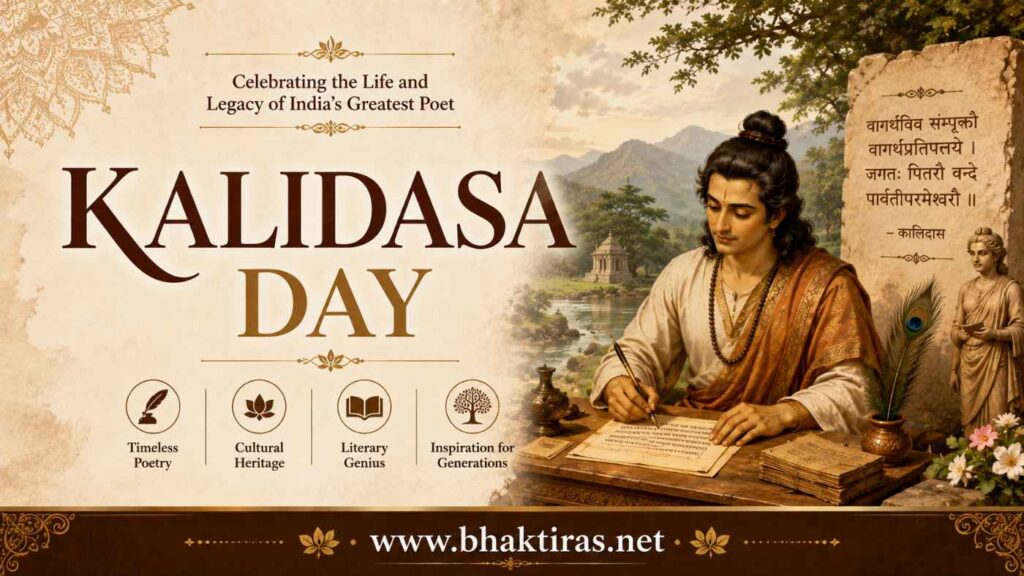
Kalidasa Day is a cultural and literary observance that honours Kalidasa, the poet and playwright widely held to be the finest voice of classical Sanskrit. His surviving works – the play Abhijnanashakuntalam, the lyric Meghaduta, and the epics Raghuvamsha and Kumarasambhava – shaped India’s literary imagination. The best-known celebration is the Kalidas Samaroh, a multi-day national gathering of classical arts held at Ujjain, the city Kalidasa loved, usually in November each year.
Kalidas Samaroh 2026: Dates & Schedule
The Kalidas Samaroh at Ujjain is an organiser-set festival: the Madhya Pradesh government and the Kalidas Sanskrit Academy fix and announce the dates fresh each year, so they are not tied to a lunar tithi. The dates below are approximate and should be confirmed against the official announcement.
| Year | Likely window | Venue | Notes |
|---|---|---|---|
| 2024 | November | Ujjain | Seven-day Akhil Bharatiya Samaroh |
| 2025 | November | Ujjain | Held on organiser-set dates |
| 2026 | November (approx.) | Ujjain | Next occurrence – dates to be announced |
In recent years the seven-day programme has opened in the second week of November, but you should check the Kalidas Sanskrit Academy or Madhya Pradesh Tourism for the confirmed 2026 schedule before planning a visit.
Why Kalidasa Day Is Observed
Kalidasa Day marks the achievement of Kalidasa and, through him, the living value of Sanskrit letters. It is a literary and cultural tribute rather than a religious festival.
A poet without a rival
Kalidasa is remembered as the master of the classical Sanskrit tradition. His imagery, his ear for metre and his tenderness in describing love and longing set a standard that later poets measured themselves against. Honouring him is a way of keeping that literary inheritance in public view.
Ujjain, the poet's city
Kalidasa is closely tied to Ujjain (ancient Ujjayini), the old capital he praised warmly in the Meghaduta, where the cloud-messenger pauses over the city and the shrine of Mahakala. Holding the Samaroh here roots the celebration in a place the poet himself wrote about with real affection.
Keeping Sanskrit alive
The festival is deliberately performative: staging Kalidasa’s plays in Sanskrit, running seminars and drawing scholars from across the country. The aim is to treat Sanskrit as a language still worth speaking, staging and studying, not only as a subject for the archive.
The Figure Honoured
Kalidasa Day centres on a person rather than a deity: the poet Kalidasa himself. His works, however, draw deeply on Hindu myth and on the goddess of learning.
Kalidasa
Kalidasa was a classical Sanskrit poet and dramatist, traditionally connected with the court of Ujjain. His dating is debated by scholars, but his authorship of the great plays and poems is not. Kalidasa Day exists to honour his life and work.
Saraswati
By tradition Kalidasa’s gift is credited to the grace of Saraswati, goddess of speech, learning and the arts. Popular legend paints him as a simple man transformed into a poet by her blessing, which is why literary festivals in his name carry a devotional undertone.
What Happens at the Samaroh
The Kalidas Samaroh is a programme of the arts rather than a set of household rites. A typical seven-day edition moves through these elements.
- Formal opening. The festival is inaugurated with an assembly of writers, artists and state dignitaries, and a garlanding or lamp-lighting in Kalidasa’s honour.
- Sanskrit theatre. Kalidasa’s own plays, above all Abhijnanashakuntalam, are staged in the original Sanskrit, alongside Hindi and other-language adaptations.
- Classical music. Evening concerts bring Hindustani and Carnatic vocalists and instrumentalists to the stage.
- Classical dance. Recitals in forms such as Kathak, Bharatanatyam and Odissi interpret episodes from Kalidasa’s poems.
- Poetry and recitation. Sessions of poetry and Sanskrit recitation give a platform to both established and younger voices.
- Scholarly seminars. An all-India gathering of scholars presents papers on Kalidasa, Sanskrit poetics and classical drama.
- Art and sculpture exhibition. A national exhibition of painting and sculpture runs alongside the performances.
- Awards and closing. Literary honours, including the Kalidas Samman connected with the state’s cultural calendar, and a closing session round off the week.
Where It Is Celebrated
The observance is strongest in Madhya Pradesh, at two places with a direct link to Kalidasa’s writing.
Ujjain, Madhya Pradesh
Ujjain hosts the flagship Akhil Bharatiya (all-India) Kalidas Samaroh, organised in association with the Kalidas Sanskrit Academy. As the city of Mahakaleshwar and the setting Kalidasa praised in the Meghaduta, it is the natural home of the celebration.
Ramtek, near Nagpur
Ramtek in Maharashtra is traditionally linked with the Meghaduta as the hill where the exiled yaksha is said to have watched the passing cloud. It holds its own Kalidas festival, tying the poet to the Vidarbha landscape.
Universities and Sanskrit institutes
Sanskrit departments, academies and cultural bodies across India mark Kalidasa’s memory with lectures, recitations and student productions, so the observance reaches well beyond the two main venues.
Kalidas Samaroh: Do's and Don'ts
A short guide if you plan to attend the festival at Ujjain.
Do
- Check the official Kalidas Sanskrit Academy or Madhya Pradesh Tourism site for confirmed dates before you travel.
- Book Ujjain accommodation early, as the festival week overlaps with steady pilgrim traffic to Mahakaleshwar.
- Read a translation of Abhijnanashakuntalam or the Meghaduta beforehand to follow the performances.
- Arrive early for the evening music and dance recitals, which draw large audiences.
- Combine the visit with the Mahakaleshwar temple and the old ghats of the Shipra.
Avoid
- Do not assume a fixed calendar date – the schedule changes every year.
- Do not treat it as a religious fair; it is a cultural and literary programme.
- Do not disturb the Sanskrit theatre and seminar sessions with photography flash or noise.
- Do not expect every event in one venue; performances are spread across halls in the city.
- Do not skip the art and sculpture exhibition, which is easy to miss beside the stage events.
Frequently Asked Questions
When is Kalidasa Day / Kalidas Samaroh in 2026?
The Kalidas Samaroh at Ujjain is expected around November 2026, but the exact dates are set and announced each year by the Madhya Pradesh government. Because it is an organiser-fixed festival rather than a lunar-calendar one, you should confirm the 2026 dates with the Kalidas Sanskrit Academy or Madhya Pradesh Tourism before planning.
Who was Kalidasa?
Kalidasa was a classical Sanskrit poet and dramatist, regarded by many as the greatest in the language. He wrote the play Abhijnanashakuntalam, the lyric poem Meghaduta, and the epics Raghuvamsha and Kumarasambhava. He is traditionally associated with Ujjain, though his exact dates are debated by scholars.
Why is the Kalidas Samaroh held in Ujjain?
The Kalidas Samaroh is held in Ujjain because the city, ancient Ujjayini, is closely tied to Kalidasa’s life and writing. He praised it warmly in the Meghaduta, where the cloud-messenger lingers over the city and the shrine of Mahakala. Ujjain is therefore treated as the poet’s own city.
What happens during the festival?
The festival is a week-long programme of classical arts. It features Kalidasa’s plays staged in Sanskrit, classical music and dance recitals, poetry sessions, an all-India scholars’ seminar and an exhibition of art and sculpture. Literary honours are also presented during the celebration.
Is Kalidasa Day a religious festival?
No, Kalidasa Day is a cultural and literary observance, not a religious festival. It honours a poet and his contribution to Sanskrit letters. That said, it carries a devotional undertone, since tradition credits Kalidasa’s gift to the grace of the goddess Saraswati.
Which of Kalidasa's works are best known?
Kalidasa’s best-known works are the play Abhijnanashakuntalam (the story of Shakuntala and King Dushyanta), the lyric poem Meghaduta (the cloud-messenger), and the two epic poems Raghuvamsha and Kumarasambhava. These are widely read and translated and form the core of what is performed and discussed at the Samaroh.
Is there a Kalidas festival outside Ujjain?
Yes. Ramtek near Nagpur in Maharashtra holds its own Kalidas festival, drawing on the poem’s traditional link to the hill where the exiled yaksha watched the passing cloud. Sanskrit institutes and universities across India also mark Kalidasa’s memory with lectures, recitations and student productions.
How can I attend the Kalidas Samaroh?
To attend, first confirm the year’s dates through the Kalidas Sanskrit Academy or Madhya Pradesh Tourism, then plan your trip to Ujjain. Book accommodation early, as the festival overlaps with pilgrim traffic to Mahakaleshwar. Most performances are free and open to the public across venues in the city.
Kalidasa Day keeps a fifteen-hundred-year-old voice in the room, reminding us that a good line of poetry outlasts empires. If you can, spend the week at Ujjain and let the plays and the Shipra do the rest.