
Kajari Teej 2026 – The Monsoon Fast for Married Women
कजरी तीज
When is Kajari Teej in 2026?
Kajari Teej falls on Monday, 31 August 2026. It is observed on the third day of the dark fortnight (Krishna Tritiya) of the Bhadrapada month, about a fortnight after Hariyali Teej. Married women keep a day-long fast for their husband’s long life and the family’s wellbeing, worship Goddess Parvati, and break the fast after seeing the moon.
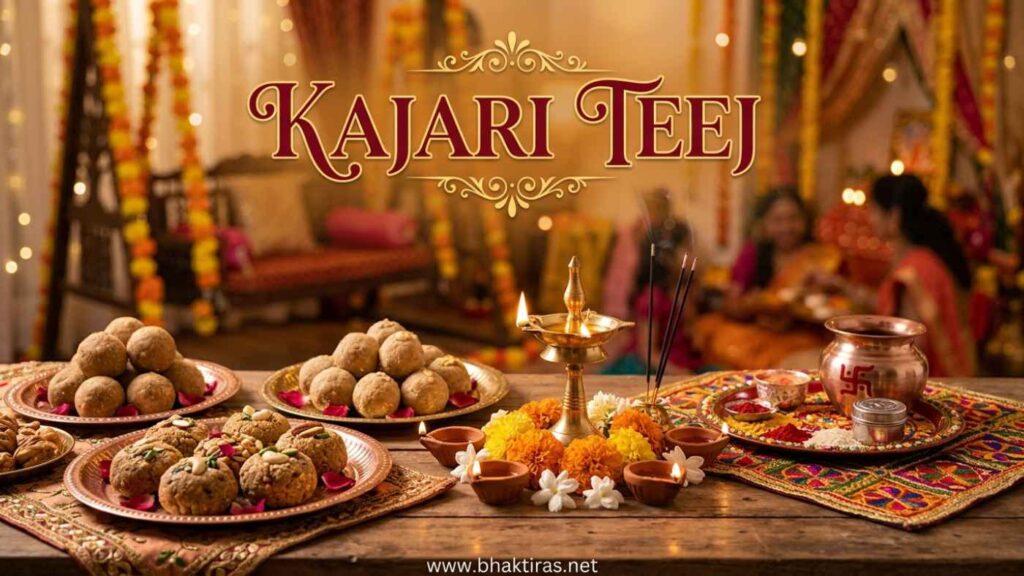
Kajari Teej, also called Kajali Teej or Badi Teej, is a monsoon festival kept mainly by married women across Uttar Pradesh, Bihar, Madhya Pradesh and Rajasthan. It falls on Bhadrapada Krishna Tritiya, roughly a fortnight after Hariyali Teej, and in 2026 lands on 31 August. Women fast through the day for their husband’s long life and the family’s welfare, worship Goddess Parvati in the form of Neemri Mata, and end the fast only after offering water to the risen moon. The name comes from the Kajari folk songs of the rains, sung together as the fields turn green.
Kajari Teej 2026-2028: Dates & Calendar
The next Kajari Teej is on Monday, 31 August 2026. The date shifts each year because it follows the Hindu lunar month of Bhadrapada rather than the fixed Gregorian calendar.
| Year | Date | Day | Notes |
|---|---|---|---|
| 2026 | 31 August | Monday | Next occurrence |
| 2027 | 20 August | Friday | About a fortnight after Hariyali Teej |
| 2028 | 8 August | Tuesday | Three days after Raksha Bandhan |
Kajari Teej comes about fifteen days after Hariyali Teej and usually falls a few days after Raksha Bandhan, placing it firmly in the centre of the monsoon season.
Why Kajari Teej Is Celebrated
Kajari Teej celebrates married life, the monsoon, and the devotion of Goddess Parvati to Lord Shiva. Women fast and pray for the long life of their husbands and the happiness of the home.
Parvati's devotion
Like the other Teej fasts, Kajari Teej honours Goddess Parvati, who is believed to have won Lord Shiva as her husband through years of penance. Married women fast in her memory, praying for a long and settled married life; unmarried girls sometimes keep it hoping for a good husband.
A festival of the rains
Kajari Teej falls when the monsoon has soaked the fields and greenery has returned. The festival marks this fertile season with folk songs called Kajari, sung by groups of women, which give the day its name.
The moonrise vow
The fast is a nirjala or waterless vrat for many women, held from dawn until the moon rises. Breaking the fast only after offering water to the moon ties the day to the lunar rhythm that also governs its date.
Deities & Figures Worshipped
The central deity of Kajari Teej is Goddess Parvati, worshipped alongside Lord Shiva. On this day she is honoured in a special local form known as Neemri Mata.
Goddess Parvati
Parvati, the consort of Shiva and the ideal of the devoted wife, is the heart of the festival. Women pray to her for marital harmony and for their husband’s long life, offering flowers, sindoor and sweets.
Lord Shiva
Shiva is worshipped together with Parvati as the divine couple whose union the fast celebrates. Many women recite Shiva-Parvati stories and offer bel leaves during the puja.
Neemri Mata
In much of North India, Parvati is worshipped on Kajari Teej as Neemri Mata, symbolised by a small branch of the neem tree planted in the worship area. Women circle it and offer water, roli and food before ending the fast.
Key Rituals, Step by Step
Kajari Teej is built around a day-long fast that opens with a pre-dawn meal and closes only after the moon appears.
- Sargi before dawn. Women eat a light pre-dawn meal, often including sattu, fruit and sweets, before the fast begins with the sunrise.
- Bathing and dressing. The day starts with a bath, after which women wear festive clothes, green or red bangles, and apply mehendi and sindoor as married women.
- Setting up Neemri Mata. A neem branch is planted in a clean spot along with a small pond or bowl of water, representing the goddess for the day’s worship.
- The Parvati puja. Women offer flowers, roli, rice, fruit and sweets to Parvati and Shiva, and light a lamp while reciting the Kajari Teej katha (story).
- Singing Kajari songs. Groups of women gather to sing traditional Kajari folk songs of the monsoon, often on swings tied to trees.
- Waiting for moonrise. The fast, kept without food and often without water, continues through the day until the moon is sighted in the evening.
- Arghya to the moon. When the moon rises, women offer it water (arghya) and complete a final round of prayers.
- Breaking the fast. After the moon puja the fast is broken, traditionally with water and food blessed during the day, often taking the elders’ blessings first.
Special Foods of Kajari Teej
Because the day is a fast, the food centres on the pre-dawn meal and the dishes eaten after moonrise. Sattu and seasonal sweets are the signatures of the festival.
Sattu dishes
Roasted gram flour (sattu) is closely linked to Kajari Teej, especially in Bihar and eastern UP. It is eaten as sweet or savoury balls and is a common part of the pre-dawn sargi.
Ghewar
The honeycomb-like disc-shaped sweet ghewar, soaked in sugar syrup, is a monsoon-season favourite that appears at Teej celebrations across Rajasthan and the north.
Malpua & kheer
Sweet fried malpua and rice kheer are prepared to break the fast and to share with family, marking the festive end of the day.
Seasonal fruit
Fresh monsoon fruit is offered during the puja and eaten after moonrise, keeping the post-fast meal light and in tune with the rainy season.
Regional Names & Variations
Kajari Teej is a North Indian festival with strong local colour, especially in the Bundelkhand belt and around Mirzapur, where the Kajari song tradition is famous.
Uttar Pradesh
In UP the festival is widely called Kajari or Kajali Teej. Mirzapur is celebrated for its Kajari singing, and the songs form a distinct genre of Hindustani folk music associated with the rains.
Bundelkhand & Madhya Pradesh
Across Bundelkhand and much of MP the day is known as Kajali Teej and is marked by community singing, swings and the neem-branch worship of Neemri Mata.
Rajasthan
In Rajasthan Kajari Teej is called Badi Teej, meaning the ‘bigger’ Teej, held about a fortnight after Hariyali Teej (the ‘small’ Teej). Bundi is known for a Kajari Teej procession.
Bihar
In Bihar the festival is observed with a strong emphasis on sattu-based food and the fast for the husband’s long life, sitting between Raksha Bandhan and Janmashtami in the calendar.
Kajari Teej Do's and Don'ts
A few simple practices help keep the fast meaningful and safe.
Do
- Eat a nourishing sargi before dawn to sustain the day-long fast.
- Set up the neem branch and water for Neemri Mata in a clean space.
- Recite or listen to the Kajari Teej katha during the puja.
- Break the fast only after offering arghya to the risen moon.
- Seek the blessings of elders after completing the vrat.
Avoid
- Do not start eating before moonrise if you have taken the moon-based vrat.
- Avoid anger and quarrels; the day is meant for calm and devotion.
- Do not skip water beyond what your health allows – break a strict fast if you feel unwell.
- Avoid non-vegetarian food and alcohol during the fast.
- Do not treat the neem branch or puja items carelessly after the worship.
Frequently Asked Questions
When is Kajari Teej in 2026?
Kajari Teej in 2026 is on Monday, 31 August. It falls on Bhadrapada Krishna Tritiya, the third day of the dark fortnight of the Bhadrapada month, about a fortnight after Hariyali Teej.
When is Kajari Teej in 2027 and 2028?
Kajari Teej is on Friday, 20 August 2027 and on Tuesday, 8 August 2028. The date changes every year because the festival follows the Hindu lunar calendar rather than the fixed Gregorian one.
Why is Kajari Teej celebrated?
Kajari Teej is celebrated to honour Goddess Parvati and her devotion to Lord Shiva. Married women fast on this day for the long life and wellbeing of their husbands, while the monsoon setting is marked with Kajari folk songs.
Which god is worshipped on Kajari Teej?
Goddess Parvati is the main deity worshipped on Kajari Teej, alongside Lord Shiva. She is honoured in a local form called Neemri Mata, represented by a neem branch during the puja.
What is the difference between Kajari Teej and Hariyali Teej?
Kajari Teej comes about a fortnight after Hariyali Teej and is often called Badi (bigger) Teej, while Hariyali Teej is the Chhoti (smaller) Teej. Both honour Parvati, but Kajari Teej is tied to the Kajari monsoon songs and includes worship of the moon at night.
What is Neemri Mata worship on Kajari Teej?
Neemri Mata worship is the practice of honouring Goddess Parvati through a small neem branch planted in the puja area on Kajari Teej. Women offer water, roli and food to it and circle it as part of the day’s rituals.
How is the Kajari Teej fast broken?
The Kajari Teej fast is broken after moonrise. Women offer water (arghya) to the moon, complete their prayers, and then eat, often after taking the blessings of elders in the family.
Why are Kajari songs sung on this festival?
Kajari songs are monsoon folk songs that give Kajari Teej its name. Women sing them together, often on swings, to celebrate the rains, the green fields and the theme of longing and love that runs through the season.
May Maa Parvati bless your home with love and long life this Kajari Teej. Teej ki hardik shubhkamnayein.