
Kaila Devi Fair 2027 – Karauli's Great Lakkhi Mela
कैला देवी मेला
When is the Kaila Devi Fair in 2027?
The Kaila Devi Fair runs for about a fortnight in Chaitra (March-April), and in 2027 the crowds peak on Chaitra Shukla Ashtami, Wednesday 14 April 2027. The mela begins around Chaitra Krishna Dwadashi (early April 2027) at the Kaila Devi temple in Karauli, Rajasthan. It is also called the Lakkhi Mela because lakhs of pilgrims from the Meena, Gurjar and other communities gather here.
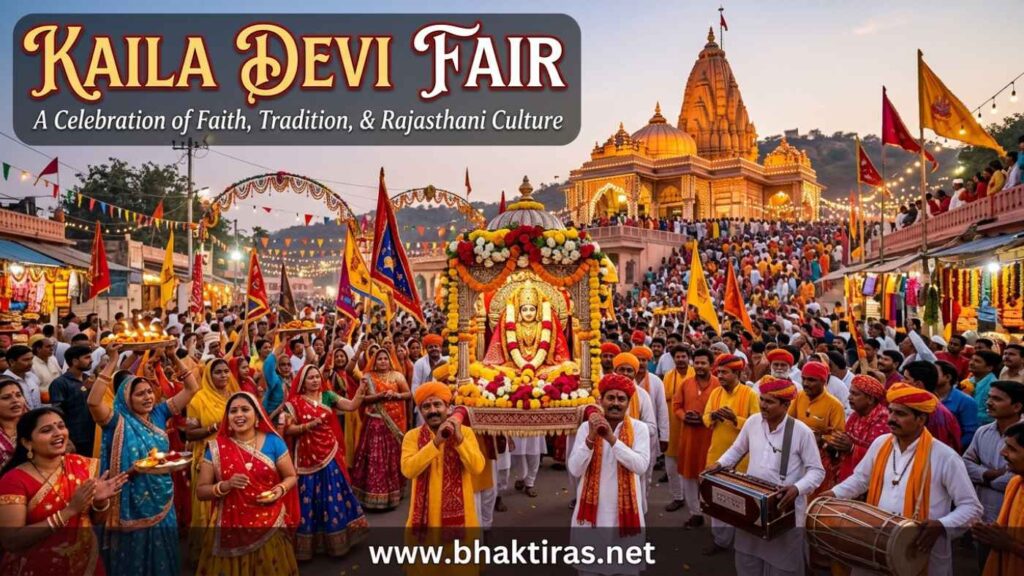
The Kaila Devi Fair, or Lakkhi Mela, is Rajasthan’s largest Shakta pilgrimage gathering, held each Chaitra (March-April) at the hilltop shrine of Kaila Devi near Karauli. Over roughly a fortnight, close to two million devotees, drawn heavily from the Meena and Gurjar communities, walk to the Trikut hills beside the Kalisil river carrying red-and-orange flags. They come to honour Kaila Devi, worshipped as a form of Yogmaya and Mahalakshmi, the divine girl who slipped from Kansa’s grasp and foretold his end.
Kaila Devi Fair 2026-2028: Dates & Calendar
The fair opens around Chaitra Krishna Dwadashi and runs for a fortnight, so its exact dates shift each year with the Hindu lunar calendar. The busiest day is Chaitra Shukla Ashtami, which in 2027 falls on 14 April.
| Year | Fair period (approx.) | Peak day (Chaitra Shukla Ashtami) | Notes |
|---|---|---|---|
| 2026 | 16-30 March | 26 March (Thursday) | Already concluded |
| 2027 | 3-17 April | 14 April (Wednesday) | Next occurrence |
| 2028 | 24 March – 7 April | 3 April (Monday) | Falls a little earlier |
The fortnight-long mela traditionally begins on Chaitra Krishna Dwadashi (the twelfth day of the waning moon) and builds through Chaitra Navratri to the Ashtami climax. Many pilgrims time their darshan for Ashtami and the following Ram Navami, when the temple town is at its fullest.
Why the Kaila Devi Fair Is Celebrated
The Kaila Devi Fair is celebrated to honour Kaila Devi as Yogmaya, the divine girl-child linked to Krishna’s birth story, and as the guardian goddess (kuldevi) of the Karauli royal house and of many Meena and Gurjar families.
The Yogmaya legend
In the Krishna birth story, Yogmaya is the daughter of Nanda and Yashoda who was exchanged with the infant Krishna to save him from King Kansa. When Kansa tried to dash her against a stone, she slipped from his hands, rose into the sky and warned that his destroyer already lived. Devotees identify Kaila Devi with this fierce, protective Yogmaya, also revered as a form of Mahalakshmi.
Kuldevi of Karauli
The Chandravanshi Jadaun rulers of Karauli have been patrons of the shrine for centuries, treating Kaila Devi as their kuldevi (family deity). This royal devotion helped the temple grow from a hill shrine into a major regional centre, and the ruling house long sponsored its worship and upkeep.
A Shakti shrine of the hills
Set in the Trikut hills above the Kalisil river, the shrine carries the aura of a living Shakti seat. Pilgrims speak of vows fulfilled and protection granted, and the goddess is invoked for the wellbeing of family, cattle and harvest, concerns close to the pastoral Gurjar and Meena communities who form the heart of the crowd.
Faith of Meena and Gurjar communities
For generations of Meena and Gurjar families, Kaila Devi is the goddess to whom the first thanksgiving is owed. Whole villages travel together, and the fair doubles as a social gathering where communities renew ties, arrange matches and settle vows made through the year.
Deities & Figures Worshipped
The fair centres on Kaila Devi, enshrined alongside Chamunda Devi in the sanctum, with the two idols worshipped together.
Kaila Devi
Kaila Devi is the presiding goddess, worshipped as a form of Yogmaya and Mahalakshmi. Hers is the larger of the two marble idols in the sanctum, its head slightly bent, and it draws the great flow of Ashtami pilgrims.
Chamunda Devi
Seated beside Kaila Devi is Chamunda, a fierce form of the Mother Goddess. The pairing of the two idols in one sanctum is a distinctive feature of the Karauli shrine, and devotees offer worship to both together.
Bhairav and hill guardians
As at many Shakta shrines, Bhairav and local guardian spirits of the Trikut hills are honoured on the way up, with pilgrims pausing at wayside shrines before the main darshan of the goddess.
Key Rituals, Step by Step
For most pilgrims the fair is a journey of effort and offering, from the walk with flags to the darshan and the songs at the shrine.
- The nishan padyatra. Groups set out on foot carrying tall red and orange flags known as dhwaja or nishan, walking many kilometres to the hills. Carrying the family nishan to the goddess is itself the core act of devotion.
- Kanak-dandoti. The most demanding vow-keepers advance by prostrating full length, marking the ground reached, then rising to that mark and prostrating again, covering the whole route to the temple in this way.
- Arrival at the Trikut hills. Pilgrims reach the shrine beside the Kalisil river, often bathing or sprinkling its water before the climb to the sanctum for darshan.
- Darshan of Kaila Devi and Chamunda. After queuing through the crowd, devotees take darshan of the twin idols, offering their nishan, coconuts, red chunri cloth and sweets to the goddess.
- The chhadi offering. Many present a chhadi, a decorated ceremonial stick or staff, at the shrine as a mark of surrender and thanksgiving, a custom strongly associated with this mela.
- Kanjar lango-riya folk songs. Through the day and night, groups sing the traditional kanjar and lango-riya folk songs and perform devotional dances in the goddess’s honour around the temple precinct.
- Prasad and community feasting. Pilgrims share prasad and eat together at bhandaras and stalls, then carry blessed offerings and the lowered nishan back to their villages.
Special Foods of the Kaila Devi Fair
The mela’s food is hearty Rajasthani fare, made for pilgrims who have walked long distances, alongside temple prasad.
Dal-bati-churma
The signature meal of the fair grounds: baked wheat bati soaked in ghee, spiced dal and sweet crushed churma. It is filling, keeps well and is easy to cook in large batches at community kitchens.
Temple prasad
Devotees receive and distribute prasad blessed at the shrine, often boondi, batasha (sugar drops) and coconut, carried home for family members who could not make the journey.
Cauldron sweets and snacks
Stalls fry jalebi, ghevar and pakoras through the day, while sellers offer peda and other milk sweets for pilgrims to buy as offerings or gifts.
Bhandara meals
Free community meals, or bhandaras, are run by trusts and villages, serving simple vegetarian food so that no pilgrim goes hungry during the long days of the mela.
Where the Fair Is Held & How It Spreads
The mela is rooted at one hill shrine, but its pull reaches across Rajasthan and neighbouring states through pilgrim routes and satellite shrines.
Karauli and the Trikut hills
The heart of the fair is the Kaila Devi temple in Kailadevi village, about 23 km from Karauli town, set in the Trikut hills on the banks of the Kalisil river, a tributary that feeds into the Banas.
Eastern Rajasthan pilgrim routes
Villages across Karauli, Dholpur, Sawai Madhopur and the wider Dhundhar region send flag-bearing groups on foot, so the roads to Karauli fill with walking parties for days before Ashtami.
Meena and Gurjar heartlands
Because Kaila Devi is a kuldevi for many Meena and Gurjar families, devotees also travel from parts of Madhya Pradesh, Haryana and Uttar Pradesh, making the mela a gathering of these communities beyond Rajasthan alone.
Kaila Devi Fair Do's and Don'ts
A few simple habits keep a hill pilgrimage in dense crowds safe and respectful.
Do
- Do start your walk early and carry water, since the routes and hill climb can be tiring.
- Do keep children and elders close, as the Ashtami crowds are very large.
- Do dress modestly and remove footwear where required near the sanctum.
- Do follow the queue and volunteer instructions during peak darshan hours.
- Do carry small offerings like a chunri, coconut or chhadi rather than valuables.
Avoid
- Don’t push or rush on the temple steps and hill path, where slips are easy.
- Don’t litter the Kalisil riverbank or the hill slopes; use the bins provided.
- Don’t carry large amounts of cash or flashy jewellery into thick crowds.
- Don’t ignore first-aid, drinking-water and lost-and-found points set up for the mela.
- Don’t attempt the kanak-dandoti prostration vow without being sure of your health.
Frequently Asked Questions
When is the Kaila Devi Fair in 2027?
The Kaila Devi Fair in 2027 runs for about a fortnight in Chaitra, roughly 3 to 17 April, with the peak on Chaitra Shukla Ashtami, Wednesday 14 April 2027. Most pilgrims aim to reach the Karauli shrine on or around Ashtami, when the crowds are largest.
When is the Kaila Devi Fair in 2026 and 2028?
In 2026 the fair fell in mid-to-late March, peaking on Chaitra Shukla Ashtami, 26 March 2026, so it has already concluded. In 2028 it moves a little earlier, with the peak on about 3 April 2028; the exact local start date can vary by a day with the lunar calendar.
Why is the Kaila Devi Fair celebrated?
The Kaila Devi Fair is celebrated to honour Kaila Devi as Yogmaya, the divine girl-child of the Krishna birth story who slipped from King Kansa’s hands and warned of his coming destruction. She is worshipped as a form of Mahalakshmi and is the kuldevi of the Karauli royal house and of many Meena and Gurjar families, who gather in their millions to give thanks and keep vows.
Which goddess is worshipped at Kaila Devi?
Kaila Devi is the presiding goddess, seen as a form of Yogmaya and Mahalakshmi. In the Karauli sanctum she is enshrined together with Chamunda Devi, and the two marble idols are worshipped side by side, with Kaila Devi’s being the larger.
Where is the Kaila Devi temple located?
The Kaila Devi temple stands in Kailadevi village, about 23 km from Karauli town in eastern Rajasthan. It sits in the Trikut hills on the banks of the Kalisil river, a tributary that feeds into the Banas.
Why is it called the Lakkhi Mela?
It is called the Lakkhi Mela because lakhs of pilgrims, close to two million in a season, attend the fair. The name reflects both the sheer scale of the gathering and the belief that darshan of the goddess brings blessing and prosperity.
What are the main rituals of the fair?
The main rituals are the padyatra on foot carrying red and orange nishan flags, darshan of Kaila Devi and Chamunda, and offerings of a chhadi (ceremonial staff), coconut and chunri cloth. Devotees also sing kanjar and lango-riya folk songs, and the most devout perform the kanak-dandoti, advancing by repeated full-length prostrations.
Who mainly attends the Kaila Devi Fair?
The fair draws devotees from across Rajasthan and neighbouring states, but its heart is the Meena and Gurjar communities, for whom Kaila Devi is a kuldevi. Whole villages travel together, making the mela both a pilgrimage and a large community reunion.
May the goddess of the Trikut hills bless every pilgrim who carries a nishan to her door – Jai Kaila Maiya.