
Jeen Mata Mela 2026 – Navratri Fairs at Sikar's Ancient Shakti Shrine
जीण माता मेला
When is the Jeen Mata Mela in 2026?
The next Jeen Mata Mela runs during Ashwin (Sharad) Navratri from 11 to 19 October 2026, at the ancient Jeen Mata temple in Harsh village, Sikar district, Rajasthan. Two large fairs are held here each year, on the nine nights of Chaitra Navratri (spring) and again on Ashwin Navratri (autumn), when lakhs of devotees come to honour the goddess Jeen Mata, a form of Shakti and the kuldevi of many families.
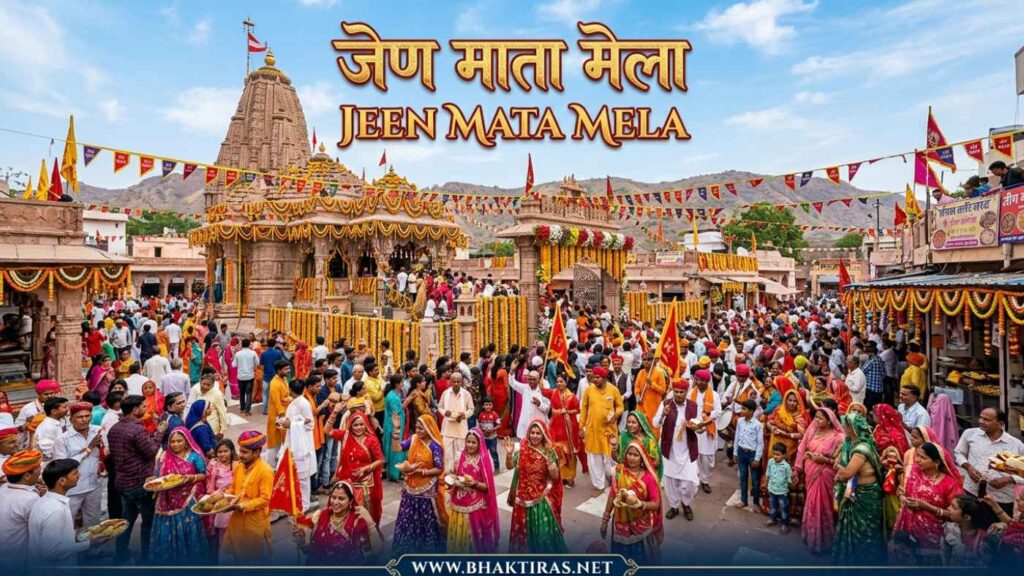
Jeen Mata Mela is the great pilgrim fair held at the ancient Jeen Mata temple in Harsh village, about 29 km south of Sikar in Rajasthan. The goddess Jeen Mata, also called Jayanti Mata, is worshipped here as a form of Shakti and is the kuldevi of many Agarwal and local families. The fair is held twice a year, over the nine nights of Chaitra Navratri in spring and Ashwin Navratri in autumn, when lakhs of devotees arrive with jyot, jaggery and coconuts to seek her blessing.
Jeen Mata Mela 2026-2028: Navratri Dates
The next Jeen Mata Mela falls on Ashwin Navratri, from 11 to 19 October 2026. Because the fairs follow the lunar Navratri calendar, both the spring (Chaitra) and autumn (Ashwin) fairs shift by a few days each year.
| Year | Fair | Nine nights | Notes |
|---|---|---|---|
| 2026 | Chaitra Navratri | 19-26 March | Spring fair (already passed) |
| 2026 | Ashwin Navratri | 11-19 October | Next occurrence; Vijayadashami 20 Oct |
| 2027 | Chaitra Navratri | 7-15 April | Spring fair |
| 2027 | Ashwin Navratri | 30 Sep – 8 October | Autumn fair |
| 2028 | Chaitra Navratri | 27 March – 4 April | Spring fair |
| 2028 | Ashwin Navratri | 19-26 September | Autumn fair |
The autumn (Ashwin) fair draws the larger crowds and coincides with the wider Sharad Navratri and Durga Puja season. Devotees often plan darshan for a specific night rather than the full nine, and Ashtami and Navami are the busiest days.
Why the Jeen Mata Mela Is Held
The Jeen Mata Mela honours the goddess Jeen Mata as a living form of Shakti, and marks the two Navratri seasons at one of Rajasthan’s oldest and most-visited Devi shrines.
A Shakti shrine of old faith
The temple at Harsh is believed to be well over a thousand years old, built in stone on the lower slopes of the Aravallis. For centuries devotees have kept an akhand jyoti, an unbroken flame, burning before the goddess. Navratri, the nine nights sacred to the Devi across India, is when this shrine draws its greatest crowds.
The legend of Jeen and Harsh
Local tradition tells of a devout girl, Jeen, and her brother Harsh, a Chauhan Rajput family of these hills. When a family quarrel parted them, Jeen turned to deep tapasya and was worshipped as the goddess Jeen Mata, while Harsh gave himself to the worship of Shiva as Bhairav on the neighbouring hill. Sister and brother are honoured on facing peaks, and pilgrims often visit both.
Harshnath, the brother's hill
A short distance away rises Harshnath (Harsha) hill, with an old Harsh Bhairav temple linked in legend to Jeen’s brother. The pairing of the Devi shrine below and the Bhairav-Shiva shrine above gives the site a Shakti-and-Bhairav character common to Rajasthan’s older centres of worship.
A kuldevi for many families
Jeen Mata is the kuldevi, the family goddess, of many Agarwal and Bania households as well as local Rajput and other communities. Families return generation after generation to offer the first jyot after a wedding or a birth, which keeps the fair as much a family reunion as a pilgrimage.
The Goddess Worshipped
The fair centres on Jeen Mata, also known as Jayanti Mata, revered as a form of the great Shakti or Durga.
Jeen Mata (Jayanti Mata)
Jeen Mata is worshipped as a form of Shakti, the divine feminine power, and is often identified with Durga. Her image sits in the sanctum where the eternal flame burns, and it is to her that jyot, coconut and jaggery are offered through the nine nights.
Harsh Bhairav (Shiva)
On the adjacent Harshnath hill stands the shrine of Harsh Bhairav, a fierce form linked to Shiva and, in the local legend, to Jeen’s brother Harsh. Many pilgrims pay respects here too, honouring the sister-and-brother bond at the heart of the story.
What Happens at the Fair, Step by Step
The mela follows the rhythm of Navratri, night by night, with the eternal flame at its centre.
- Lighting the jyot. Devotees offer a jyot, an oil or ghee lamp, before the goddess. Families with a special vow bring an akhand jyoti to burn through all nine nights.
- Ghatasthapana and the first darshan. The fair opens on Pratipada, the first night of Navratri, when the ritual pot is installed and the season of worship begins.
- Darshan across nine nights. Pilgrims queue for a glimpse of Jeen Mata, many walking the last stretch on foot. Crowds swell towards Ashtami and Navami, the eighth and ninth nights.
- Offerings of coconut and jaggery. Coconuts, jaggery, batasha and cloth for the goddess are handed over at the shrine, with prasad shared back among the family.
- Bhajan and jagran. Through the nights, groups sing bhajans and hold jagran, staying awake in devotion, so the temple lanes stay lit and full until dawn.
- Climbing to Harsh Bhairav. Many families climb or drive to the nearby Harshnath shrine to complete the visit, honouring both the sister and the brother of the legend.
- Kuldevi rites. Families for whom Jeen Mata is the kuldevi perform first-lamp rites for new marriages and newborns, a duty that brings each generation back to the fair.
Prasad and Fair Foods
Offerings and prasad at Jeen Mata lean towards the sweet and the simple, in keeping with a Shakti shrine.
Churma
Coarsely crushed wheat rotis or baatis mixed with ghee and jaggery or sugar, churma is a favourite offering and prasad across Rajasthan and is shared widely during the fair.
Coconut and jaggery
Whole coconuts and lumps of gur (jaggery) are the classic offerings carried to the goddess, later broken and shared as prasad among family and fellow pilgrims.
Batasha and patasha
Light sugar drops, batasha and patasha, are offered by the handful and given out at the shrine, a small sweet blessing to carry home.
Fair-ground food
The mela grounds fill with stalls selling kachori, pakora, jalebi and tea, feeding the lakhs who arrive over the nine days and turning the pilgrimage into a shared feast.
The Setting: Sikar and the Harsh Hills
The fair is rooted in Rajasthan’s Shekhawati region, at the meeting of shrine, hill and family tradition.
Harsh village, Sikar district
The temple sits in Harsh (Jeenmata) village, about 29 km south of Sikar town and roughly 108 km north-west of Jaipur, well connected by road for the pilgrim rush.
The Harshnath hill
Rising close by, Harshnath (Harsha) hill carries the old Harsh Bhairav temple. The pairing of the goddess below and Bhairav above shapes the whole pilgrimage.
An Agarwal kuldevi tradition
For many Agarwal and Bania families spread across Rajasthan, Delhi and beyond, Jeen Mata is the kuldevi, and the two Navratri fairs are the natural time to return and offer the family jyot.
Jeen Mata Mela Do's and Don'ts
A few simple courtesies help at a shrine this crowded during Navratri.
Do
- Carry your jyot, coconut and jaggery from home or buy them from the temple stalls
- Plan darshan for early morning or late night to avoid the heaviest Ashtami-Navami rush
- Keep children close and note meeting points in the packed temple lanes
- Dress modestly and remove footwear before entering the sanctum
- Visit the nearby Harsh Bhairav shrine to honour the full legend
Avoid
- Do not carry leather items or alcohol into the temple precinct
- Do not push in the queue; volunteers and staff manage the crowd flow
- Do not litter the fair grounds or the hill paths
- Do not offer non-vegetarian food at this Shakti shrine
- Do not attempt the Harshnath climb late at night without proper light and company
Frequently Asked Questions
When is the Jeen Mata Mela in 2026?
The next Jeen Mata Mela is held during Ashwin (Sharad) Navratri from 11 to 19 October 2026, with Vijayadashami on 20 October. This is the autumn fair; the spring (Chaitra) fair of 2026 was held from 19 to 26 March and has already passed.
When is the Jeen Mata Mela in 2027 and 2028?
In 2027 the fairs fall on Chaitra Navratri from 7 to 15 April and on Ashwin Navratri from 30 September to 8 October. In 2028 they fall on Chaitra Navratri from 27 March to 4 April and on Ashwin Navratri from 19 to 26 September. Both fairs run for about nine nights each.
Why is the Jeen Mata Mela celebrated?
The Jeen Mata Mela is celebrated to honour the goddess Jeen Mata, a form of Shakti, on the nine nights of Navratri. It is held twice a year, in spring and autumn, and draws lakhs of devotees, many of whom worship Jeen Mata as their kuldevi or family goddess.
Which goddess is worshipped at Jeen Mata?
Jeen Mata, also called Jayanti Mata, is the goddess of the shrine and is worshipped as a form of the great Shakti or Durga. Her sanctum keeps an akhand jyoti, an unbroken flame, said to have burned for centuries.
Who is Harsh, and what is the Jeen-Harsh legend?
In local legend Jeen and Harsh were a devoted sister and brother of a Chauhan family in these hills. When they were parted, Jeen turned to deep penance and was worshipped as the goddess Jeen Mata, while Harsh became a Bhairav-Shiva devotee on the neighbouring Harshnath hill, so the two are honoured on facing peaks.
Where is the Jeen Mata temple located?
The Jeen Mata temple stands in Harsh village in Sikar district, Rajasthan, about 29 km south of Sikar town and roughly 108 km north-west of Jaipur. It is reached by road and is one of Rajasthan’s most visited Shakti shrines during Navratri.
What offerings are made at the Jeen Mata Mela?
Devotees offer jyot (oil or ghee lamps), coconuts, jaggery, batasha and cloth to the goddess, and share churma and other sweets as prasad. Families with a vow bring an akhand jyoti to burn through all nine nights of Navratri.
Why is Jeen Mata a kuldevi for many families?
Jeen Mata is the kuldevi, or family goddess, of many Agarwal and Bania households as well as several local communities. These families return to the fair generation after generation to offer the first jyot after weddings and births, which is why the mela is as much a family gathering as a pilgrimage.
May Jeen Mata’s eternal flame light your path this Navratri. Jai Jeen Mata.