
Independence Day 2026 – India's 80th Year of Freedom
स्वतंत्रता दिवस
When is Independence Day in India in 2026?
Independence Day in India falls on Saturday, 15 August 2026. It marks the day in 1947 when India became free from British colonial rule. The date is fixed and never changes – 15 August every year.
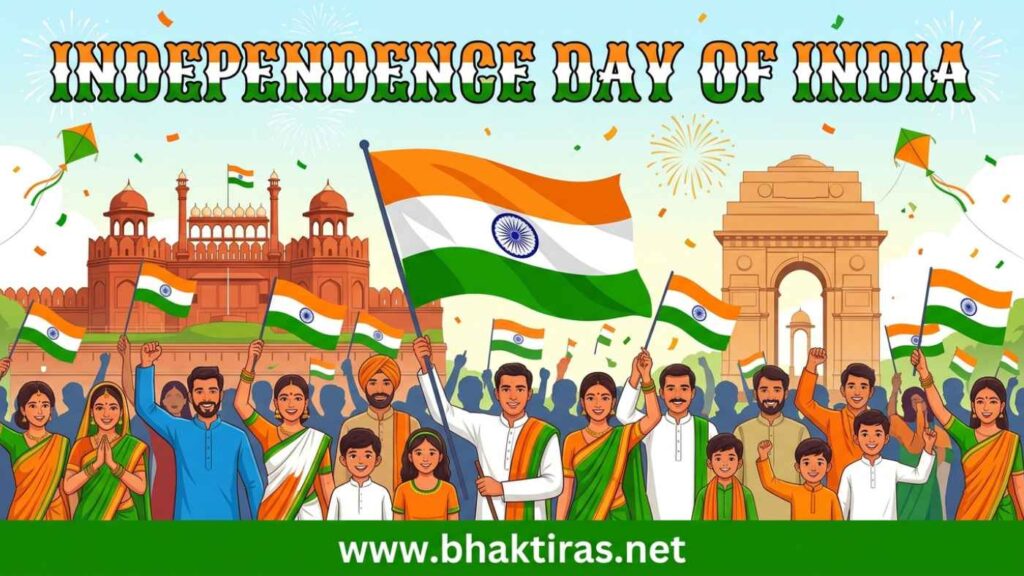
Independence Day is India’s national day, observed on 15 August every year. It marks the moment in 1947 when nearly two centuries of British rule ended and India became a free, self-governing nation. The day belongs to no single religion or region – it is a shared civic occasion, honouring the freedom fighters who gave their lives for that freedom. The Prime Minister raises the national flag at the Red Fort in Delhi, and schools, offices and homes across the country do the same, singing the national anthem together.
Independence Day 2026-2028: Date & Day
Independence Day is fixed on 15 August every year and does not move. In 2026 it falls on a Saturday.
| Year | Date | Day | Notes |
|---|---|---|---|
| 2026 | 15 August | Saturday | India’s 80th Independence Day |
| 2027 | 15 August | Sunday | 81st Independence Day |
| 2028 | 15 August | Tuesday | 82nd Independence Day |
The main national ceremony takes place in the morning at the Red Fort in New Delhi, where the Prime Minister hoists the flag and addresses the nation. State capitals hold parallel flag-hoisting events led by their governors and chief ministers.
Why Independence Day Is Observed
Independence Day is observed to mark India’s freedom from British colonial rule on 15 August 1947 and to honour those who fought for it.
The freedom did not arrive suddenly. It followed decades of struggle – from the first organised movements of the late 1800s, through the mass campaigns led by figures such as Mahatma Gandhi, Jawaharlal Nehru, Sardar Patel, Subhas Chandra Bose, Bhagat Singh and countless lesser-known names, to the final transfer of power at midnight on 14-15 August 1947. Jawaharlal Nehru’s “Tryst with Destiny” speech that night gave the moment its lasting words.
The end of colonial rule
British authority over India, exercised in various forms since the 1700s and directly under the Crown from 1858, ended on 15 August 1947. India became a sovereign nation able to govern itself and write its own future.
The freedom struggle
Independence came at a heavy human cost. Ordinary people, activists and soldiers endured prison, exile and death across many decades. The day is above all a remembrance of that sacrifice, which is why it is marked with solemnity as well as celebration.
The tricolour
The national flag – saffron, white and green with the navy-blue Ashoka Chakra at its centre – is the emblem of the day. Saffron stands for courage and sacrifice, white for peace and truth, green for growth and faith, and the 24-spoke wheel for righteous progress.
How Independence Day Is Observed
The day centres on flag-hoisting, the national anthem and public ceremonies held from early morning across the country.
- Red Fort ceremony. The Prime Minister hoists the national flag at the Red Fort in Delhi, followed by a 21-gun salute and a speech to the nation carried live on television and radio.
- Flag-hoisting everywhere. Schools, colleges, government offices, housing societies and shops raise the tricolour in their own grounds, usually between 7 and 9 in the morning.
- The national anthem. Everyone present stands to attention as Jana Gana Mana is sung together after the flag is raised.
- Distribution of sweets. Sweets are handed round after the ceremony, a simple gesture of shared joy.
- Cultural programmes. Schools stage patriotic songs, dances, poems and short plays on the freedom struggle; children often dress as national leaders.
- Speeches and remembrance. Teachers, officials and elders speak about the freedom fighters and the meaning of the day, and a moment is taken to honour those who died for the country.
- Kite-flying. In north India, especially Delhi, Gujarat and Rajasthan, families take to rooftops to fly kites through the day – a long-standing way of marking the sky as free.
Tricolour Foods on Independence Day
There are no fixed religious dishes, but many families and caterers prepare food in the flag’s three colours as a light, festive touch.
Tricolour sweets & barfi
Three-layered barfi and other saffron-white-green sweets are popular in shops and homes on the day. Saffron kesar, plain khoya and pistachio or mint layers give the three bands.
Tiranga rice & pulao
A tricolour pulao uses saffron-tinted rice, plain white rice and coriander or spinach-green rice arranged in bands – a common item at community lunches.
Fruit and salad in three colours
Simple tricolour platters of oranges or carrots, coconut or paneer, and green fruit or cucumber appear at school events and family gatherings as a healthy nod to the flag.
Across the Country
The core observance is the same everywhere, but the setting and small customs vary from place to place.
Delhi
The Red Fort is the heart of the national ceremony. The Prime Minister’s address from its ramparts sets the tone for the day, and the surrounding areas fill with visitors, security and, later, kites in the sky.
State capitals
Each state holds its own official flag-hoisting, usually led by the governor or chief minister, along with parades by police and school contingents and awards for public service.
Schools and colleges
For most children this is the most vivid part of the day – the morning assembly, the flag going up, sweets, songs and skits about the freedom struggle before a half-day holiday.
The diaspora
Indian communities abroad mark the day at embassies, high commissions and cultural associations with flag-hoisting, music and food, keeping the occasion alive far from home.
Independence Day Flag Etiquette
The tricolour is governed by the Flag Code of India – handling it with respect matters as much as the celebration itself.
Do
- Hoist the flag briskly and lower it slowly and with respect.
- Ensure the saffron band is always at the top when the flag is displayed.
- Stand to attention for the national anthem when the flag is raised.
- Use a clean, undamaged flag made to the correct proportions.
- Fold and store the flag properly, or dispose of a worn one with dignity.
Avoid
- Do not let the flag touch the ground, water or the floor.
- Do not display a torn, faded or soiled flag.
- Do not use the flag as clothing, tablecloth, wrapping or decoration for goods.
- Do not draw on, deface or write on the national flag.
- Do not leave paper flags littered on the ground after the celebrations – collect and dispose of them respectfully.
Frequently Asked Questions
When is Independence Day in India in 2026?
Independence Day in India is on Saturday, 15 August 2026. The date is fixed and falls on 15 August every year, marking India’s freedom from British rule in 1947.
When is Independence Day in 2027 and 2028?
Independence Day falls on 15 August every year – Sunday, 15 August 2027 and Tuesday, 15 August 2028. Unlike lunar festivals, the date never changes because it marks a fixed historical event.
Why is Independence Day celebrated in India?
Independence Day is celebrated because India became free from British colonial rule on 15 August 1947 after a long freedom struggle. It honours the sacrifices of the freedom fighters and marks the birth of India as a sovereign nation.
What happens at the Red Fort on Independence Day?
On Independence Day, the Prime Minister hoists the national flag at the Red Fort in Delhi, a 21-gun salute is fired, and the Prime Minister addresses the nation. The event is broadcast live and is the main national ceremony of the day.
What do the colours of the Indian flag mean?
The Indian tricolour has saffron for courage and sacrifice, white for peace and truth, and green for growth and faith. At its centre is the navy-blue Ashoka Chakra, a 24-spoke wheel representing righteous and continuous progress.
How is Independence Day celebrated in schools?
Schools celebrate Independence Day with a morning flag-hoisting, the national anthem, and cultural programmes of patriotic songs, dances and plays about the freedom struggle. Sweets are distributed and children often dress as national leaders before a half-day holiday.
Is Independence Day a public holiday in India?
Yes, Independence Day on 15 August is a national public holiday across all of India. Government offices, schools, banks and most businesses remain closed for the day.
What is the difference between Independence Day and Republic Day?
Independence Day on 15 August marks India’s freedom from British rule in 1947, while Republic Day on 26 January marks the day India’s Constitution came into force in 1950. On Independence Day the Prime Minister hoists the flag at the Red Fort; on Republic Day the President unfurls it at the Kartavya Path parade.
As the tricolour rises this 15 August, it is a day to remember those who won that freedom and to carry it forward with care. जय हिन्द।