
Gandhi Jayanti 2026 – Honouring the Father of the Nation
गांधी जयंती
When is Gandhi Jayanti in 2026?
Gandhi Jayanti falls on Friday, 2 October 2026. It marks the birth anniversary of Mohandas Karamchand Gandhi, born on 2 October 1869, and is one of India’s three national holidays. The same day is observed worldwide by the United Nations as the International Day of Non-Violence.
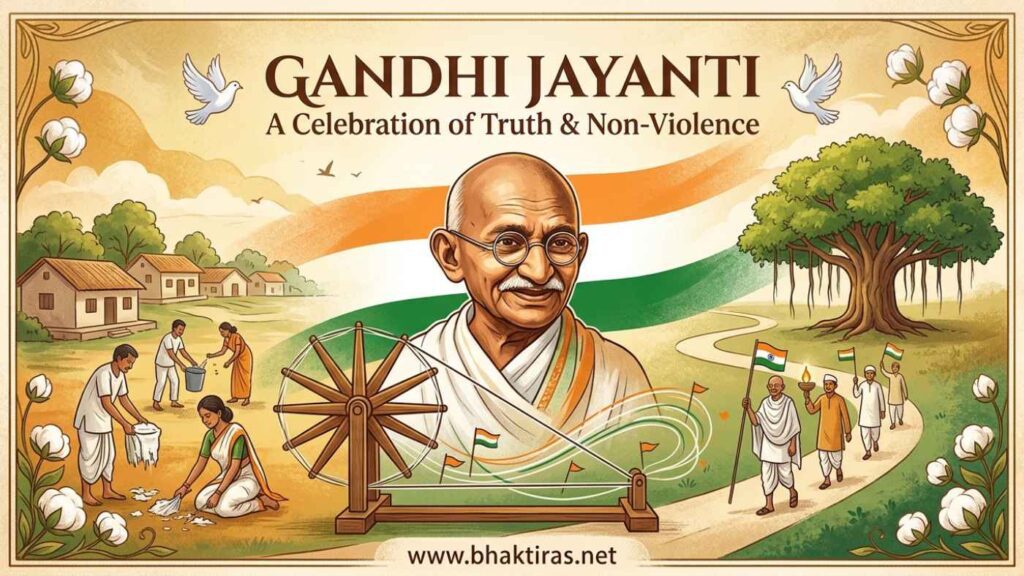
Gandhi Jayanti is the birth anniversary of Mohandas Karamchand Gandhi, better known as Mahatma Gandhi, born on 2 October 1869 in Porbandar, Gujarat. Falling on 2 October every year, it is one of only three national holidays that the whole of India keeps, alongside Independence Day and Republic Day. Government offices, schools and most businesses close, and the day is given over to remembering the man who led the freedom struggle without lifting a weapon – through truth, self-discipline and non-violence. In 2007 the United Nations added its own layer of meaning by declaring 2 October the International Day of Non-Violence.
Gandhi Jayanti 2026-2028: Dates & Calendar
The next Gandhi Jayanti is on Friday, 2 October 2026. The date never shifts because it follows the fixed Gregorian solar calendar, not a lunar tithi – it is always 2 October, the day Gandhi was born in 1869.
| Year | Date | Day | Notes |
|---|---|---|---|
| 2026 | 2 October | Friday | Next occurrence |
| 2027 | 2 October | Saturday | National holiday |
| 2028 | 2 October | Monday | National holiday |
The 2026 observance also marks the 157th birth anniversary of Mahatma Gandhi, counting from his birth in 1869.
Why Gandhi Jayanti Is Observed
Gandhi Jayanti is observed to honour Mahatma Gandhi and to keep alive the principles he lived by – truth (satya) and non-violence (ahimsa). It is a day of reflection on his role in winning India’s freedom and on how his ideas still shape public life.
A remarkable life
Born in Porbandar in 1869, Gandhi trained as a barrister in London and first tested his methods of civil resistance in South Africa. Returning to India in 1915, he turned the freedom movement into a mass campaign that ordinary villagers could join. His simple dress, vegetarian diet and life of voluntary poverty made him instantly recognisable and gave weight to everything he asked of others.
Ahimsa and satyagraha
Gandhi’s central gift to the world was a practical method of non-violent resistance he called satyagraha, or holding firmly to truth. Rather than answering force with force, he taught that patient, disciplined refusal to cooperate with injustice could wear down even an empire. That idea later inspired leaders such as Martin Luther King Jr and Nelson Mandela, which is why the day carries global meaning.
Leading the freedom struggle
From the Champaran and Kheda campaigns to the Non-Cooperation and Quit India movements, Gandhi shaped nearly three decades of India’s fight for independence. The 1930 Salt March, when he walked 240 miles to the sea to make salt in defiance of British law, became the defining image of peaceful protest. India won its freedom in 1947, and his birthday is now the nation’s way of thanking the man it calls the Father of the Nation.
The Day of Non-Violence
In June 2007 the United Nations General Assembly voted to mark 2 October as the International Day of Non-Violence, choosing Gandhi’s birthday deliberately. On this day his message is remembered not only in India but in schools, universities and peace groups around the world, giving Gandhi Jayanti a reach far beyond a national holiday.
How Gandhi Jayanti Is Observed
Gandhi Jayanti is a quiet, dignified day rather than a noisy festival. Observances centre on prayer, service and remembering his ideals, in these familiar ways.
- Tributes at Raj Ghat. The President, Prime Minister and other leaders gather at Raj Ghat in Delhi, Gandhi’s cremation memorial, to lay flowers and observe silence at the black marble platform inscribed with his last words.
- Prayer meetings and bhajans. Gatherings across the country sing his two favourite devotional songs, Raghupati Raghava Raja Ram and Vaishnav Jan To, echoing the interfaith prayer meetings he himself held every evening.
- Cleanliness drives. Under the Swachh Bharat mission, people take part in shramdaan – voluntary clean-up work in streets, schools and public places – reflecting Gandhi’s belief that cleanliness and self-reliance go together.
- Spinning the charkha. Many events feature the spinning wheel, the symbol Gandhi made central to self-reliance and khadi cloth, with demonstrations of hand-spinning cotton.
- School and college programmes. Students hold speeches, essay competitions, debates and skits on non-violence, truth and simple living, and often recite passages from Gandhi’s own writings.
- Community service and simple living. Blood donation camps, tree planting and charity drives are common, and many people mark the day by keeping it alcohol-free, in line with India’s dry-day tradition on 2 October.
How Gandhi Jayanti Is Marked Across India and Abroad
As a national holiday, Gandhi Jayanti is kept everywhere in India in broadly the same spirit, with a few places holding special significance.
New Delhi
The main national ceremony takes place at Raj Ghat on the banks of the Yamuna, where leaders and citizens pay floral tributes and sing his favourite bhajans in a multi-faith prayer service.
Gujarat
Gandhi’s home state holds special programmes at Porbandar, his birthplace, and at Sabarmati Ashram in Ahmedabad, from where he launched the Salt March. Both draw visitors and schoolchildren on the day.
Maharashtra
Sevagram Ashram near Wardha, where Gandhi lived in his later years, becomes a focus for prayer meetings, spinning demonstrations and talks on his constructive programme.
Around the world
Marking the International Day of Non-Violence, Indian missions, universities and peace organisations across the globe hold seminars, film screenings and floral tributes at Gandhi statues and memorials.
Gandhi Jayanti Do's and Don'ts
A short guide to observing the day in a way that honours its spirit.
Do
- Take part in a cleanliness drive or shramdaan in your neighbourhood.
- Read or share Gandhi’s own words on truth and non-violence.
- Join a prayer meeting or listen to Vaishnav Jan To and Raghupati Raghava Raja Ram.
- Support khadi and handmade goods, in the spirit of self-reliance.
- Use the day to teach children about ahimsa, honesty and simple living.
Avoid
- Do not treat it as just another day off – it is a day of remembrance.
- Avoid alcohol; 2 October is observed as a dry day across India.
- Do not litter or leave public spaces dirty on a day about cleanliness.
- Avoid reducing Gandhi to a single quote; his ideas repay real reading.
- Do not turn commemorations into loud, disruptive events – keep the tone dignified.
Frequently Asked Questions
When is Gandhi Jayanti in 2026?
Gandhi Jayanti in 2026 falls on Friday, 2 October. The date is fixed on 2 October every year, as it marks the birthday of Mahatma Gandhi, born on that date in 1869.
When is Gandhi Jayanti in 2027 and 2028?
Gandhi Jayanti is on Saturday, 2 October 2027 and on Monday, 2 October 2028. Because it follows the fixed Gregorian solar calendar rather than a lunar tithi, it always falls on 2 October and only the weekday changes each year.
Why is Gandhi Jayanti celebrated?
Gandhi Jayanti is celebrated to honour Mahatma Gandhi, who led India’s freedom struggle through non-violence and truth. It is one of India’s three national holidays and a day to reflect on his ideals of ahimsa, self-reliance and simple living.
Is Gandhi Jayanti a national holiday?
Yes, Gandhi Jayanti is one of India’s three national holidays, alongside Independence Day (15 August) and Republic Day (26 January). Government offices, banks, schools and most businesses remain closed on 2 October, which is also observed as a dry day.
What is the International Day of Non-Violence?
The International Day of Non-Violence is a United Nations observance held on 2 October, Gandhi’s birthday. The UN General Assembly established it in 2007 to promote non-violence through education and public awareness, drawing on Gandhi’s philosophy of satyagraha.
How is Gandhi Jayanti observed?
Gandhi Jayanti is observed with prayer meetings, floral tributes at Raj Ghat in Delhi, and the singing of his favourite bhajans. People also take part in cleanliness drives, spin the charkha and hold school programmes on non-violence, truth and simple living.
Which songs are sung on Gandhi Jayanti?
The two bhajans most associated with Gandhi Jayanti are Raghupati Raghava Raja Ram and Vaishnav Jan To. Both were favourites of Mahatma Gandhi and are sung at prayer meetings and memorial gatherings on 2 October.
Where was Mahatma Gandhi born?
Mahatma Gandhi was born on 2 October 1869 in Porbandar, a coastal town in present-day Gujarat. His full name was Mohandas Karamchand Gandhi, and he is widely honoured in India as the Father of the Nation.
On this day India pauses to remember a man who proved that gentleness can be a form of strength. गांधी जयंती की शुभकामनाएं।