
Gogamedi Mela 2026 – Rajasthan's Fair for the Snake-God Gogaji
गोगामेड़ी मेला
When is Gogamedi Mela in 2026?
Gogamedi Mela runs for three days from Goga Navami, which falls on Saturday, 5 September 2026. The fair is held at Gogamedi in Rajasthan’s Hanumangarh district to honour Gogaji (Jaharveer Goga), the folk warrior-saint worshipped as a protector against snakebite. It opens on Bhadrapada Krishna Navami and continues to the eleventh day of the same dark fortnight.
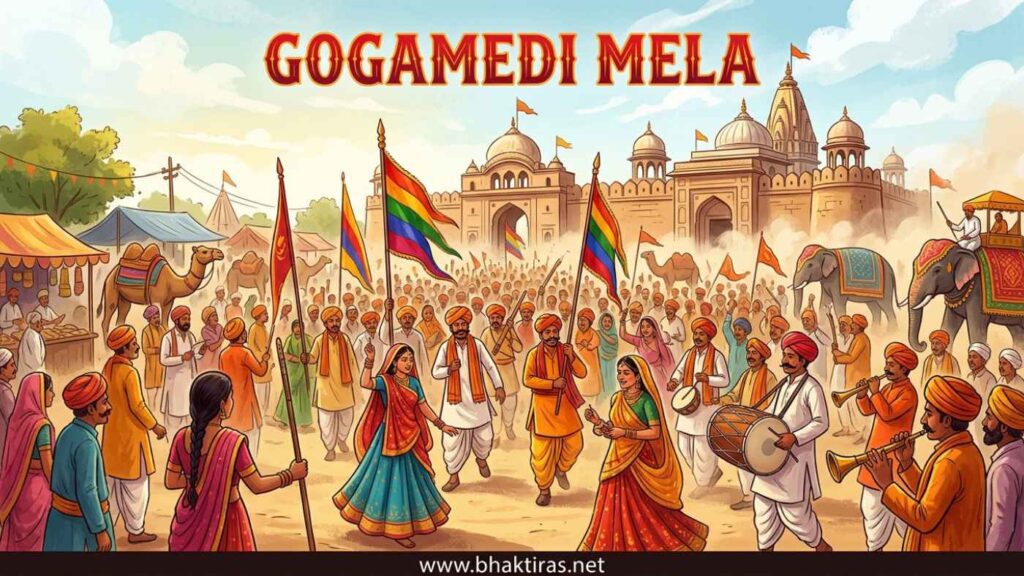
Gogamedi Mela is the great annual fair held at Gogamedi in Rajasthan’s Hanumangarh district, honouring Gogaji, also called Jaharveer Goga or Goga Chauhan. A warrior-saint of around the 11th century, Gogaji is worshipped across northern India as a snake deity and a guardian against snakebite. For three days from Goga Navami in the dark fortnight of Bhadrapada, thousands of villagers walk to his medi carrying blue nishan flags, singing his ballads and seeking protection for their families and cattle. Both Hindus and Muslims revere him, which makes the fair a living emblem of shared devotion.
Gogamedi Mela 2026-2028: Dates & Calendar
The fair opens on Goga Navami and runs about three days. The date shifts each year because it follows the Hindu lunar calendar, landing on the ninth day of the dark fortnight of Bhadrapada.
| Year | Goga Navami (opening) | Day | Notes |
|---|---|---|---|
| 2026 | 5 September | Saturday | Next occurrence; fair runs to about 7 September |
| 2027 | 26 August | Thursday | Bhadrapada Krishna Navami |
| 2028 | 14 August | Monday | Bhadrapada Krishna Navami |
The main crowds gather on Goga Navami itself, when the shrine’s blue flag is honoured and processions of nishan flags converge on Gogamedi from surrounding villages.
Why Gogamedi Mela Is Celebrated
Gogamedi Mela is celebrated to honour Gogaji, the folk deity believed to shield people from snakebite and to guard cattle. The fair marks the place where, by tradition, Gogaji entered the earth on horseback.
The snake-god who guards against venom
Gogaji is the best-known serpent deity of the northern plains. Farmers and herders, whose lives are lived close to the ground and its snakes, pray to him for safety. Sacred ash from his shrine, called bhabhut, is applied to a snakebite as a customary first act of faith before other help is sought.
A warrior-saint of the Chauhan line
By popular account Gogaji was a Chauhan Rajput hero born at Dadrewa in the Churu region around the early 11th century. His courage in battle earned him the title Jaharveer, and after death he was remembered as a lok devta, a deity of the common people rather than of the great temples.
A shrine of Hindu and Muslim devotion
Gogaji is worshipped by both communities and is also known as Gugga Pir or Jahar Pir. His story weaves together the blessing of Guru Gorakhnath and a Sufi-tinged tradition of him riding into the earth. The fair therefore draws Hindus and Muslims alike, and many treat it as a symbol of communal harmony.
Protection for cattle and household
Beyond snakes, Gogaji is called on to keep livestock healthy and homes free of misfortune. In pastoral Rajasthan and Haryana this is no small matter, and families who have made a vow return year after year to fulfil it at the medi.
Deities & Figures Worshipped
The fair centres on Gogaji, worshipped as both a warrior-hero and a serpent deity. His guru Gorakhnath is honoured alongside him.
Gogaji (Jaharveer Goga)
The presiding figure of the fair, shown as a rider on a blue horse, often with a snake at hand or coiled about him. Devotees invoke him against snakebite and for the wellbeing of cattle and family. His shrine at Gogamedi carries a distinctive blue flag.
Guru Gorakhnath
The Nath yogi whose blessing, in the folk story, brought about Gogaji’s birth. His presence links the cult of Gogaji to the wider Nath tradition, and his name is often taken at the shrine.
The serpent (Nag)
Snakes are woven through Gogaji’s imagery and worship. Some accounts identify him with the serpent itself, and the fear and respect owed to snakes lie at the heart of why villagers seek his protection.
Key Rituals, Step by Step
Most observance follows a simple, heartfelt pattern built around the nishan flag and the walk to the medi.
- Preparing the nishan. Families ready a nishan, a tall bamboo pole dressed with peacock feathers, a coconut, coloured threads and a blue cloth. The nishan stands in for Gogaji’s banner and leads the way to his shrine.
- The nishan yatra. Groups set out from their villages, carrying the nishan and singing to the beat of the dholak and the whine of the been. Many walk long distances on foot as an act of vow and thanks.
- Arrival at the medi. At Gogamedi the processions converge on the domed shrine, or medi, where Gogaji is said to have entered the earth. The blue flag above it is saluted as the pilgrims file in.
- Worship and offerings. Devotees offer coconut, sweets, cloth and coins, light lamps and bow at the samadhi. Those who came to fulfil a vow do so here, and new prayers for protection are made.
- Receiving bhabhut. Sacred ash and blessed water are taken from the shrine. The bhabhut is treasured for its believed power against snakebite and illness.
- Singing the ballad of Goga. Bards and villagers recite the long sung story of Gogaji’s life, his valour and his passing, keeping the oral tradition alive through the night.
- Sharing the prasad. Cooked offerings such as churma and communal deg are distributed, and pilgrims eat together before beginning the journey home.
Special Foods of Gogamedi Mela
Fair food is plain and generous, meant to be shared among pilgrims and offered first to Gogaji.
Churma
Coarsely crushed wheat rotis mixed with ghee and jaggery or sugar, churma is a staple offering at Rajasthani shrines. It is presented to Gogaji and then shared as prasad.
Deg
A large cauldron of cooked rice or sweet rice prepared for the crowds, deg is ladled out to all who come. Cooking and giving it away is itself treated as an act of devotion.
Coconut and batasha
Whole coconuts and batasha, light sugar drops, are among the most common things carried to the medi and laid before the flag. They return to families as blessed prasad.
Fair sweets and snacks
Rows of stalls sell jalebi, pakora, gud-laddu and other simple sweets and fried snacks that families eat while moving through the crowd and the market.
Regional Names & Variations
Gogaji is honoured well beyond Gogamedi, under several names and at countless village shrines called Goga than.
Rajasthan
The heartland of the cult, where Gogamedi in Hanumangarh is the chief shrine and Dadrewa in Churu is revered as his birthplace. Village Goga than dot the countryside and hold their own smaller fairs.
Haryana and Punjab
Here the deity is often called Gugga or Gugga Pir, and the observance around Goga Navami is known as Gugga Naumi. Bhagats carry the nishan from house to house singing his praises.
Uttar Pradesh and beyond
In western Uttar Pradesh, Himachal Pradesh, Jammu and parts of Gujarat, Gogaji is worshipped as a snake-god and folk protector, with local shrines marking his memory.
As Jahar Pir
Among Muslim devotees Gogaji is venerated as Jahar Pir or Gugga Pir, and the shared observance at his shrines is often held up as an example of Hindu-Muslim harmony.
Gogamedi Mela Do's and Don'ts
A few simple customs help you take part respectfully.
Do
- Carry a nishan or a modest offering of coconut and cloth if you are visiting the medi.
- Join the processions and folk singing in a spirit of devotion.
- Take bhabhut and blessed water home if offered, and keep them respectfully.
- Share and accept prasad graciously, since giving food is part of the fair.
- Respect the crowds and the pace of the pilgrimage, especially the many who walk on foot.
Avoid
- Do not rely on bhabhut alone for a snakebite; seek proper medical treatment at once.
- Do not treat the shrine or the blue flag casually or climb where it is not permitted.
- Do not push ahead of elderly pilgrims and vow-keepers in the queues.
- Do not litter the fairground or waste the deg and prasad handed out.
- Do not turn the visit into mere sightseeing; approach it as a place of living faith.
Frequently Asked Questions
When is Gogamedi Mela in 2026?
Gogamedi Mela 2026 begins on Goga Navami, Saturday, 5 September 2026, and runs for about three days. It is held at Gogamedi in Hanumangarh district, Rajasthan, to honour the folk deity Gogaji.
When is Goga Navami in 2027 and 2028?
Goga Navami, which opens the fair, falls on Thursday, 26 August 2027 and on Monday, 14 August 2028. The date moves each year because it follows the Hindu lunar month of Bhadrapada, on the ninth day of the dark fortnight.
Who is Gogaji and why is he worshipped?
Gogaji, also called Jaharveer Goga or Goga Chauhan, is a folk deity of northern India revered as a warrior-saint and a snake-god. He is worshipped chiefly as a protector against snakebite and as a guardian of cattle and family, and his devotees include both Hindus and Muslims.
Where is Gogamedi and how is it connected to Gogaji?
Gogamedi is a town in Rajasthan’s Hanumangarh district and the site of Gogaji’s chief shrine, the medi. Tradition holds that Gogaji entered the earth here on horseback, and the three-day fair each Bhadrapada marks this spot.
Why is Gogamedi Mela seen as a symbol of communal harmony?
Gogamedi Mela is seen as a symbol of Hindu-Muslim harmony because Gogaji is honoured by both communities. Hindus revere him as a warrior-saint and snake-god, while Muslims venerate him as Jahar Pir or Gugga Pir, and devotees of both faiths gather at his shrine together.
What is the nishan carried at the fair?
The nishan is Gogaji’s banner, a tall bamboo pole dressed with peacock feathers, a coconut, coloured threads and a blue cloth. Villagers carry it in procession, the nishan yatra, from their homes to the medi as an act of devotion.
What foods are offered and shared at Gogamedi Mela?
Churma, sweet rice cooked as deg, coconut and batasha are the main offerings and are shared as prasad. Fair stalls also sell jalebi, pakora and other simple sweets and snacks for the pilgrims.
What does the blue flag and horse represent?
The blue flag marks Gogaji’s shrine and is his emblem, while the horse recalls his image as a rider and the legend of him entering the earth on horseback. Both are central to how he is pictured and worshipped.
May Gogaji watch over your home, your fields and your family. Jai Gogaji.